Imakatsu Gill Soft 130: the soft bluegill that walks under the surface
This lure shines under specific conditions. CarnaFish tells you in 10 seconds if today is one of them.
On a lake where bass are eating bluegill, most swimbaits are beside the point. They offer the outline of a long, slim fish to fish that are hunting a tall, wide disc slipping between the branches. The Gill Soft 130 starts from that observation and takes it a long way: a soft body, bluegill depth, and a weighting system that lets you choose your layer of water instead of putting up with it.
Why soft material changes everything at this size
Imakatsu's main argument is not the realism of the paint, careful as it is. It is the material. When a fish engulfs a rigid 13 cm swimbait, that bait stays a block: the jaws close on a hard shell, the trebles work from the outside, and a share of the bites end in a dropped fish. A soft body collapses under jaw pressure and lets the fish inhale the bait far deeper. Imakatsu explicitly claims that better conversion rate, and it is the strongest point on the spec sheet.
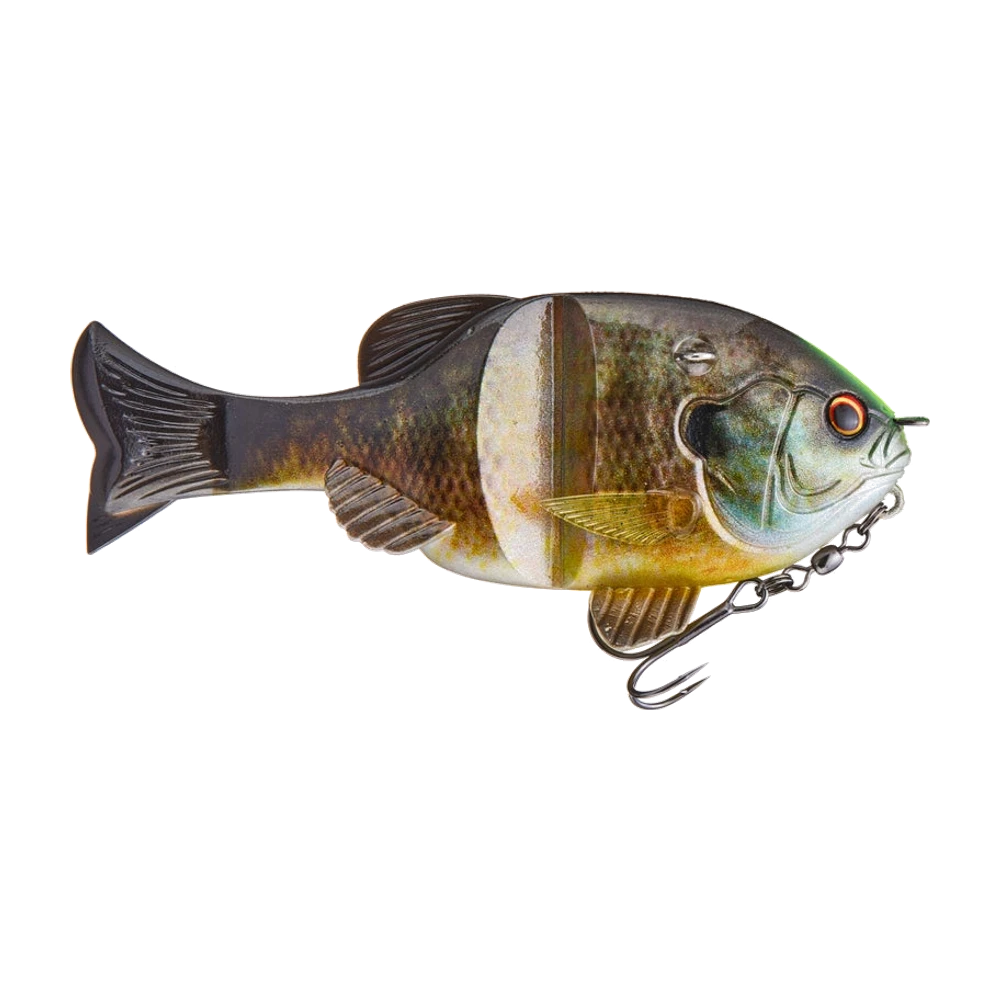
The imitation itself is thorough: a tall, compressed shape, moulded pectoral, dorsal and anal fins, a blue-green gill cover and a red eye on the photographed example. That level of detail only makes sense in a specific context — clear water, fish with time to look, heavily fished water. That is also the stated target: pressured fisheries where the fish feed on bluegill, bream and other sunfish.
The numbers, and what they force on you
Imakatsu's table is minimal: 5.1 in and 1.8 oz, that is 13 cm for about 51 g. Note that it carries no buoyancy column — it is the maker's text, not the table, that describes a slow-floating build. The distinction matters, because you will not be able to confirm the exact behaviour from a label.
The 51 g, on the other hand, are not negotiable, and they set your tackle. This is swimbait territory: a powerful casting rod with an action that can cope with launching a soft block, a sturdy reel, heavy braid and a thick fluorocarbon leader. A standard cranking rod will fold on the cast without ever really propelling the lure, and that is the best way to break a rod on a badly timed wrist snap.
The nail that decides your depth
This is the real idea behind the model. The body has an abdominal section designed to take a nail weight that you insert yourself. With no nail, the lure stays in the slow-floating logic Imakatsu describes and swims just under the surface. With a light nail, you bring it back towards suspending and can work a mid-column layer. With a heavier nail, it sinks, and you effectively choose your rate of fall.
In practice, carry two or three nails of different weights and change them to suit the spot. On a two-metre weed flat, no nail. On a five-metre break, a nail that takes the lure down in twenty seconds lets you count before retrieving. It is a setting, not an accessory.
Always insert the nail straight and well centred, and check it after a few fish. A nail that has shifted to one side makes the body roll onto its flank at the first acceleration — and because the material is soft, you cannot see it from the outside. Two seconds of feeling along the body is enough to avoid it.
Two ways to work it
The straight retrieve under the surface
A slow, steady retrieve with the lure twenty or thirty centimetres under the film. The soft body undulates on its own, the tail kicks widely, and the tall outline throws a bluegill shadow that reads very clearly from below. This is the default presentation and the one that covers the most fish.
The subsurface walk
This is the most interesting feature. Worked with short rod twitches, the Gill Soft 130 darts side to side, a movement close to that of a glide bait but below the surface. Few soft baits this size can do it. Its use is very specific: you bring it out when a fish is following without committing. Two twitches that shift the lure one way then the other, and the follower goes from watching to deciding. Keep it for those moments, not as a continuous retrieve.
The side hangers, and what they allow
The body carries two side hook hangers, designed for size 3 or 4 trebles — those are hook sizes, not weights. Mounting the trebles on the sides improves hook-ups on a sideways strike, which is the most common kind on a tall lure.
Those same hangers allow two more things. First, you can remove the belly treble — the one the photo shows hanging under the belly on a short chain — to fish the bottom snag-free, keeping only the side trebles. Second, and this is rarer, a side hanger can be used as a line tie. The lure then swims crooked, on its flank, exactly like a dying fish. That is a last-resort presentation for locked-up fish, worth trying once everything else has failed.
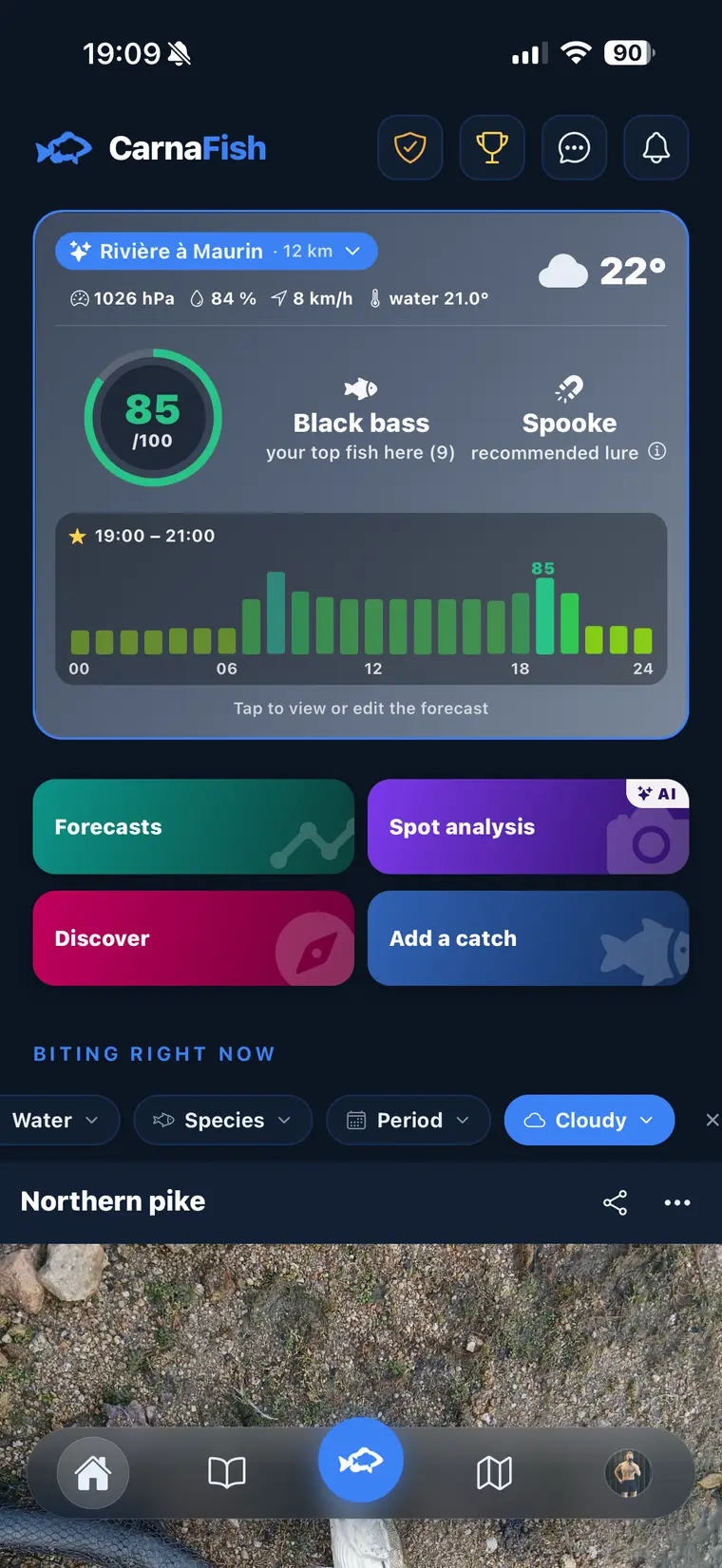
Not sure what to tie on?
Photograph your spot: CarnaFish reads the scene, cross-checks the conditions and gives you the zone, the lure and the retrieve. Free on iOS and Android.
Where and when to use it
Shallow to medium zones holding bluegill: edges of flooded timber, around docks, sparse weed, rock piles. The lure comes into its own from late spring to autumn, when sunfish are visible and bass are actively working them.
Imakatsu aims it at bass, and that is the only fish it names. In Europe a 13 cm, 51 g lure with a tall profile obviously interests pike, but that is not a claimed use: if you fish water holding pike, add a suitable leader before the first cast, because 51 g of cleanly bitten-off Japanese swimbait is expensive.
Colours by water
- Clear water: the bluegill finish of the photo, scaled olive-brown back, golden flanks, orange belly and blue-green gill cover. That is the logical colour when the fish has time to look.
- Low light: a solid dark back. Seen from below, the outline counts more than the detail, and a tall body already cuts a very clear shape.
- Stained water: a strong orange or chartreuse belly, still identifiable at low visibility where the scale pattern disappears within a few tens of centimetres.
Against the other bluegill imitations
The niche is busier than it looks. A Bucca Baby Bull Gill plays the small hard-bait card, a Geecrack Bellows Gill Swimmer the lighter and handier soft option, a Clutch Wake Gill the pure surface angle. The Gill Soft 130 stands apart through the combination of a soft body, adjustable weighting and a lateral walk — and through its weight, which restricts it to a dedicated outfit. For a comparable glide in a jointed hard body, the Gan Craft Jointed Claw remains the benchmark of the genre.
The right lure never replaces reading the spot, and that is exactly what CarnaFish makes easier: a photo of the spot, and the AI suggests the zone, the depth and the type of presentation that fit the day's conditions. For the basics on tackle and bass water, our guide to getting started in bass fishing remains a good way in.
What to remember
- 13 cm for 51 g: a genuine swimbait that calls for a dedicated casting outfit, not an all-round rod.
- The soft body collapses on the bite and clearly improves the conversion rate compared with a hard body.
- The nail weight set in the abdomen tunes depth and rate of fall: it is a setting, not an option.
- The side hangers take size 3 or 4 trebles, let you remove the belly treble for bottom work, and can serve as a line tie for a crooked swimming action.
FAQ
What are the dimensions of the Gill Soft 130?
Imakatsu's table lists 5.1 in and 1.8 oz, that is 13 cm for about 51 g. That table carries no buoyancy column: it is the maker's text that describes a slow-floating build.
Does the Gill Soft 130 float or sink?
With no added weight, Imakatsu describes a slow-floating build that swims just under the surface. The final behaviour depends on the nail you insert in the abdomen: you can bring it back to suspending or make it sink at the rate you choose.
What treble size should you fit?
Size 3 or 4 trebles on the two side hangers, as the maker specifies. Those are hook sizes, not weights, and it is worth sticking to them: an oversized treble changes the balance of a soft body.
How do you get the side-to-side dart?
With short, crisp rod twitches, not with retrieve speed. The lure then darts one way then the other, in a movement close to a glide bait but entirely below the surface. Save this action for fish that follow without striking.
Can you fish it near the bottom without snagging?
Yes, by removing the belly treble and keeping only the trebles on the side hangers. You lose a little hook-up rate and gain the ability to work cluttered bottoms.
What tackle does it take to cast 51 g?
A swimbait-class casting outfit: a powerful rod, a sturdy reel, strong braid and a thick fluorocarbon leader. An all-round cranking rod will not propel this lure properly and may not survive the cast.
The full bass lure guideSeason-by-season strategy: which family of lure, when, and why.Go from theory to fish
CarnaFish reads your spot from a photo and gives you the game plan: zone, lure, retrieve. Free on iOS and Android.