Savage Gear Structure Gill: the bluegill swimbait built for the bottom
One lure, endless conditions. CarnaFish reads your spot from a photo so you are not just guessing.
Some spots simply refuse an ordinary swimbait: a pile of sunken branches, a thin edge of lily pads, a rock pile where an exposed hook finds trouble on the second cast. You throw a jig at those, because a jig gets through. The Savage Gear Structure Gill starts from that problem and offers something in between — a compact swimbait with a bluegill profile, protected enough to travel through that mess, and weighted so it stands back up on the bottom instead of flopping over on its side.
A bluegill shape with a jig's manners
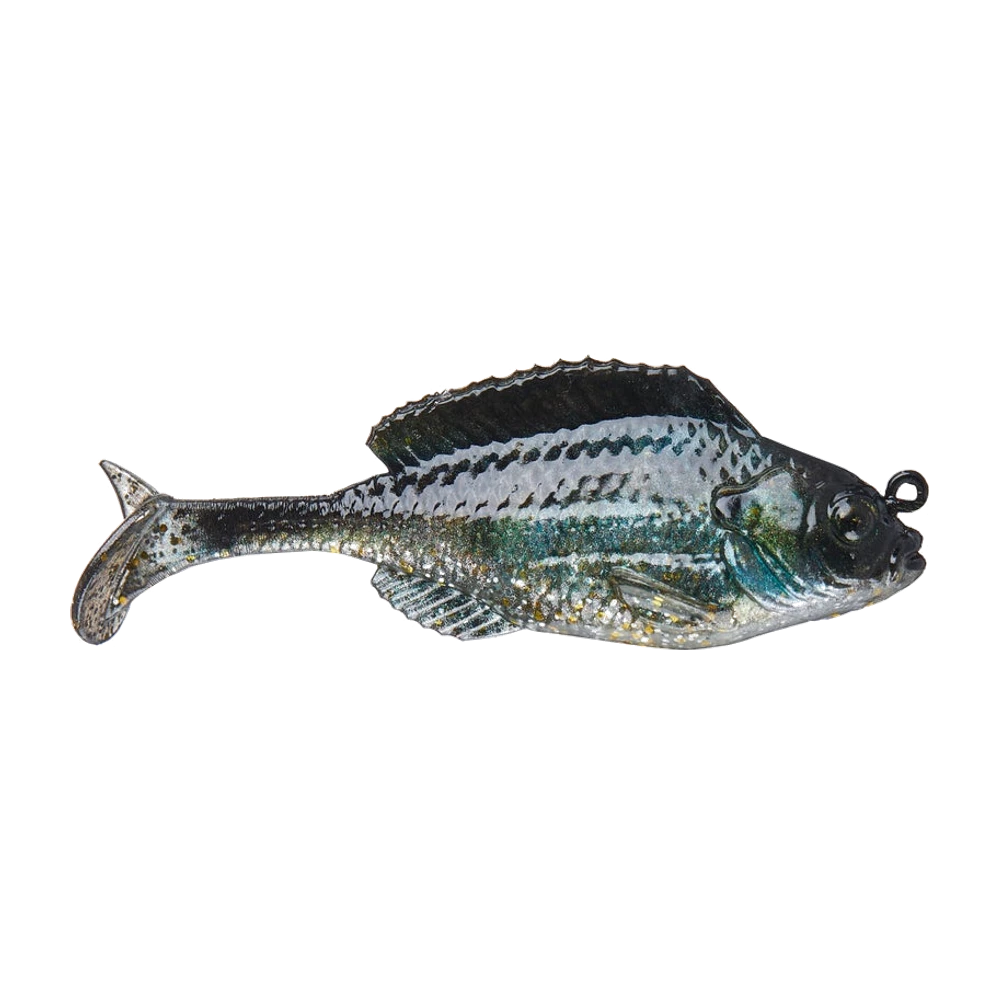
Savage Gear frames this lure as a collision between a snack-sized swimbait and a structure jig. The body is a tall, flat panfish, not a slim shiner. The maker claims a heavily detailed mould — scale pattern, gill rakers, mouth, fins and eyes in relief — finished with a photo print. On the Ghost Gill sample in the photo you can indeed make out a dorsal fin moulded along the whole back, a raised pectoral and a three-dimensional eye; a wire loop comes out of the top of the snout, though that is an observation from a product photo, not a published specification.
The bluegill is the forage this lure copies, and it is one of the most eaten prey items for bass in North America. In Europe the pumpkinseed sunfish fills exactly the same niche: same round, tall silhouette, same shoreline cover, same habit of getting ambushed. A lure drawn to imitate one works perfectly well for the other, which is not true of every American import.
The triangular lead, and what it actually changes
This is the technical point worth stopping on. The description specifies a floating plastisol construction with a triangular lead embedded in the head. The two facts belong together: the plastic on its own would rise, so it is the lead that takes the lure down. The centre of gravity ends up very low and very far forward, and the stated result is a lure that sits upright on the bottom at rest.
In practice, on the pause, the head stays pinned to the substrate while the body and tail try to lift. The lure stands rather than collapses, exactly like a small fish rooting through the bottom nose down — an image bass know by heart. An ordinary swimbait lying on the bottom says nothing; this one keeps saying something even when it is still. It is the same mechanism that makes a Megabass Sleeper Gill interesting, built as it is around a credible resting posture.
Working a lure designed to touch bottom
Bottom bouncing
This is the use the maker puts forward, and the one that gets the most out of the lead. Cast, let it drop on a controlled line, then work it back with short rod pulls while keeping contact. Between pulls, always allow two or three seconds of complete stillness: that pause is when the lure stands back up, and that is very often when the line goes. Chain the pulls without ever stopping and you have paid for a weighted lure that fishes like any other.
Swimming it over cover
As soon as the lure moves, the T-tail starts kicking — the maker describes an action that begins the instant the lure goes into motion, which is exactly how a narrow caudal section behind a wide paddle behaves. A slow, steady retrieve just above the tops of a grass bed or a brush pile gives a clean swim with nothing to do. That is the search mode, the one that finds the fish before you come back and work the bottom properly.
On visible fish
The description also mentions targeting bedded bass, a common practice in North America. In Europe, the spawning period falls inside the closed season or inside tightly framed windows: check local regulations before considering that kind of presentation. The technical interest holds outside the spawn, on any sighted fish you want to annoy with a lure that holds its position.
The habit that changes everything here: count the pause out loud. One, two, three. Three seconds feels endless with a rod in your hand, and it is exactly how long the body needs to finish standing up. The bite usually comes on "two".
The classic mistake
Trying to use it as a fast search bait. The Structure Gill is a spot lure, not a mileage lure: you pull it out once you have identified a precise piece of structure and want to comb it without hanging up. If you need to cover open water quickly, a paddle tail on a plain jig head such as a Keitech Swing Impact Fat 3.8 does that job faster and cheaper.
What the description does not say
Worth being blunt about, because it matters when you buy. The maker description carries no size table at all: no length row, no weight row, no buoyancy class. The version name calls out four inches, roughly ten centimetres, and a 3/4 that in all likelihood reads as three quarters of an ounce, around twenty-one grams — but that is an order-of-magnitude reading, not a figure published by Savage Gear.
Nor is there any word on whether the hook is included. The sample in the photo is bare. The description only states that the soft plastic dorsal fin deflects vegetation and protects the hook from snags, which places the rigging: point exiting through the back, sheltered under the dorsal, Texas style.
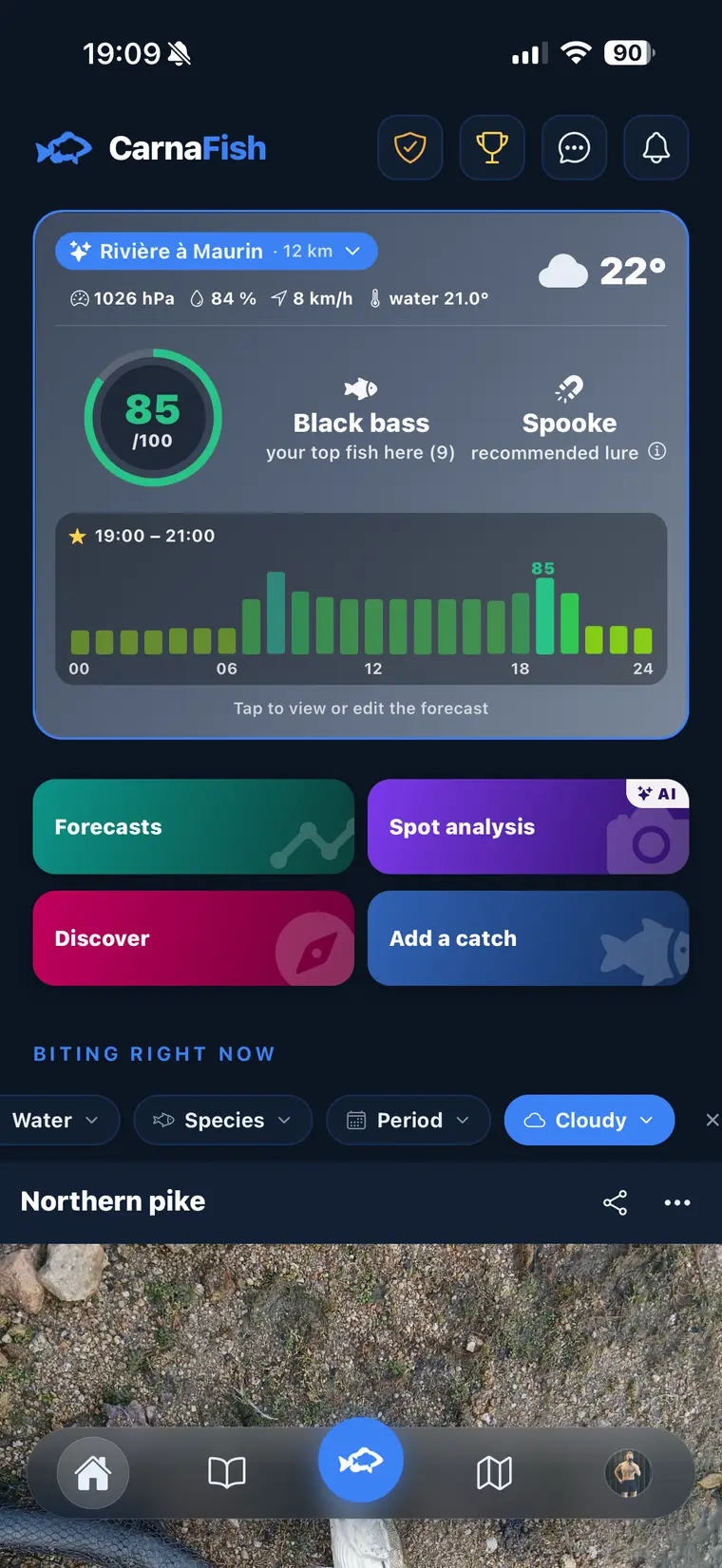
Not sure what to tie on?
Photograph your spot: CarnaFish reads the scene, cross-checks the conditions and gives you the zone, the lure and the retrieve. Free on iOS and Android.
Colours by water clarity
- Clear water: Ghost Gill, the one in the photo, translucent with gold and silver flake over a dark green back. It passes light and gives a ghostly outline rather than a solid block.
- Lightly stained water: a natural green bluegill, denser, which keeps the flank pattern without relying on transparency.
- Dirty water or dark vegetation: a frankly dark tone that cuts a shape against the light from above. On a lure this tall, the profile works as hard as the colour.
A situation lure, not a do-everything lure
The Structure Gill only earns its keep if you know where you are sending it. That is exactly what CarnaFish makes easier: one photo of the spot, and the AI suggests the zone, the depth and the lure family that suit the conditions of the day — enough to tell whether the spot deserves a protected bottom lure or a plain search swimbait. To build the reading-the-water basics, our guide to getting started on bass is the right place to begin. And if you want another bluegill-profile swimbait to compare, the Bucca Brand Baby Bull Gill 3.75 plays in the same register with a different approach.
Key takeaways
- The plastisol floats; it is the triangular lead in the head that sinks the lure and stands it back up on the bottom at rest.
- The T-tail starts kicking the moment the lure moves: no need to speed up to switch it on.
- The soft dorsal fin deflects vegetation and shelters the point, which opens up cover where a bare hook would hang.
- No size table in the description: length and weight are read off the version name, not off published data.
FAQ
Does the Structure Gill sink or float?
The lure as a whole sinks. The description states a floating plastisol, but also a triangular lead embedded in the head: that lead is what takes it down. The combination of the two is precisely what lets it stand up instead of falling over on its side.
What does this version weigh exactly?
The maker publishes no size table. The name mentions a 3/4 that most likely reads as three quarters of an ounce, roughly twenty-one grams, but that is a deduction of order of magnitude. Have the retailer confirm it if the weight matters to your rigging.
Does it come with a hook?
The description does not say, and the lure in the photo is bare. It does state that the soft dorsal fin protects the hook point, which implies rigging with the point out through the back, sheltered under the dorsal.
Does it work on anything other than bass?
The lure is drawn for bass and imitates a bluegill. Its tall, flat shape and slow swim can interest a big perch or a shoreline pike, but that is not the intended use and the standard rigging is not built for pike teeth.
Does it need a particular rod?
A medium-heavy to heavy casting rod, crisp enough to drive a shielded single hook through soft plastic, and braid to pull a fish out of cover. On a rod that is too soft, the hookset gets absorbed by the body of the lure.
How is it different from a straight structure jig?
A jig offers a crawfish silhouette and skirt volume; the Structure Gill offers a tall fish silhouette and a tail that kicks. On a spot where bass are eating bluegill rather than crawfish, that difference in profile is sometimes enough to draw a bite where the jig gets ignored.
The full bass lure guideSeason-by-season strategy: which family of lure, when, and why.Go from theory to fish
CarnaFish reads your spot from a photo and gives you the game plan: zone, lure, retrieve. Free on iOS and Android.