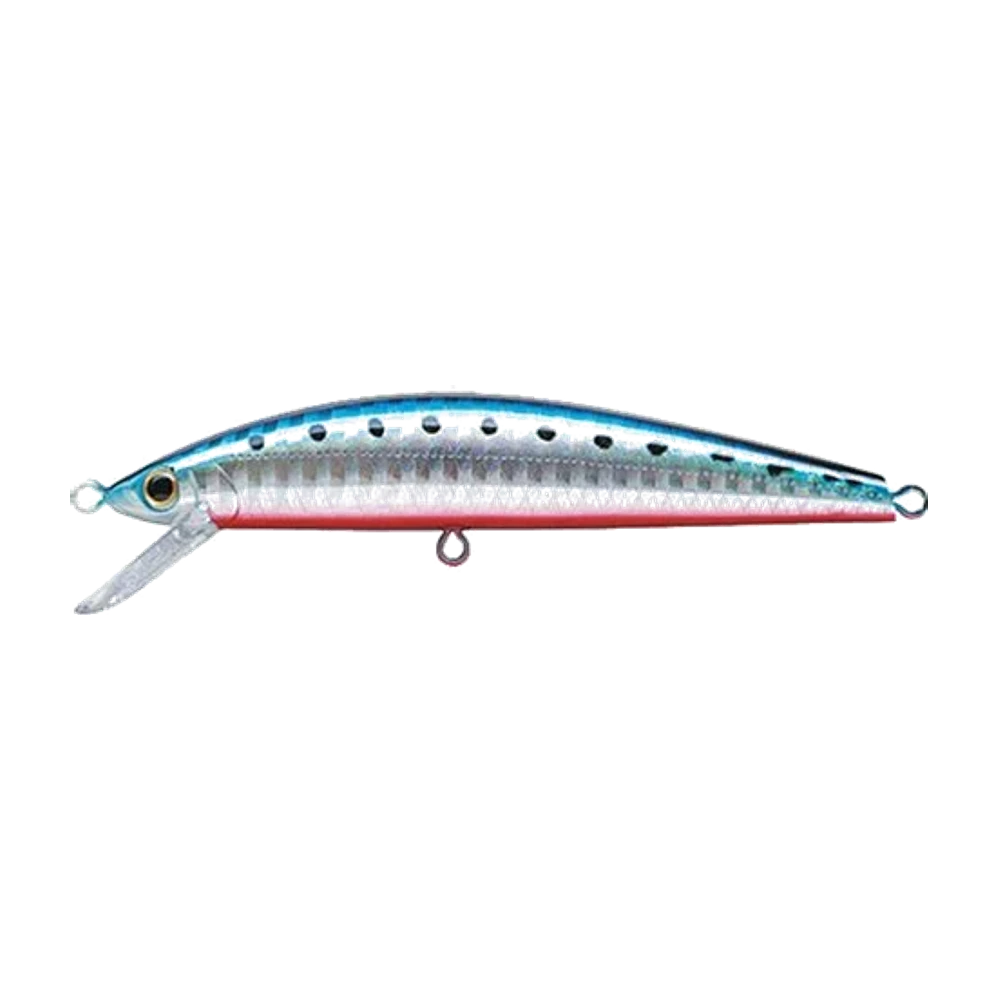
Jackson Pin Tail Tune: the sinking pencil that fishes in the wind
Before tying this one on, it helps to know if the spot actually calls for it. CarnaFish reads the scene from a photo.
There is one situation every shore bass angler knows: the fish are there, you can hear them smashing bait further out, and the wind throws your lure back at your feet. Floating stickbaits, so deadly on a glassy sea, turn into kites the moment it blows in your face. You lose twenty metres of range exactly when you needed ten more.
The Pin Tail Tune answers that problem with mass. It is a sinking pencil, dense, with no air chamber, that cuts through the air instead of catching it. The trade-off is that it does not forgive an automatic retrieve: a lure that sinks is fished by managing depth, not by winding the handle.
A dense body, not a surface stickbait
The difference from a classic stickbait is not cosmetic. A floating pencil relies on surface tension to work; it breaks out of the water, slides flat, leaves a trail. The Pin Tail Tune goes through that layer and hunts for the fish that have not yet decided to come up.
Three concrete consequences:
- The casting trajectory is flat. The tapered profile and the mass concentrated towards the tail limit wind resistance. That is what gives you back the metres you lose when it blows.
- It fishes a band of water, not a line. Depending on the sink time you allow before starting, you work at 20 cm, at 80 cm or at 1.5 m with the same lure.
- It does not rise on its own. On the stop, it drops back down rocking on its flank. That is a fishing phase in its own right, not dead time.
Three retrieves to know, in this order
The same lure covers three very different situations depending on what you do with it. Always start with the simplest.
- The counted straight retrieve. Cast, let it sink on a count (three seconds, then five, then eight across successive passes), then wind steadily with the rod low. You are looking for the depth the fish respond to, not yet trying to work the lure.
- The punctuated straight retrieve. Same thing, but every five or six turns of the handle you slip in two short wrist twitches. The lure breaks off to one side then picks its swim back up. It is the most versatile retrieve on holding bass.
- The controlled drop. At the end of the retrieve, over a drop-off or a hole along the edge, stop everything and let it fall on a semi-tight line. It sinks rocking from side to side. Bites almost always come in this phase, and show up as nothing more than the line stopping.
- The bottom lift. In deeper water or in current, let it touch down, then work it up with two turns at a time followed by a pause. You are recreating a wounded fish trying to get going and falling back.
On the water: when you fish a sinking lure in a cross-current, do not count seconds — count metres of drift. The same five-second count puts you 1 m down in calm water and 30 cm down in a tidal run, because the pull on the line stops it sinking. If you stop touching bottom in the same places as on the previous tide, it is the current that changed, not the fish.
Choosing the size for the conditions
The logic is not "bigger means further", it is "what depth do I want to hold without struggling".
| Conditions | Size / mass to favour | What you are after |
|---|---|---|
| Flat sea, no wind, bass feeding | The smallest, around 14 g | A discreet sub-surface swim |
| Crosswind, short chop | Mid-range, around 20 g | Range without losing subtlety |
| Headwind, built sea | The heaviest, 28-30 g | Getting under the stirred layer |
| Sustained tidal current | The heaviest | Holding depth despite the drift |
| Shallow estuary, under 1 m | The smallest | Avoiding constant snags |
The rig stays simple: a 0.30 to 0.40 mm fluorocarbon leader depending on how rough the ground is, and a welded stainless snap for quick changes. Keep an eye on the stock trebles after every saltwater session — the wire marks quickly against rock.
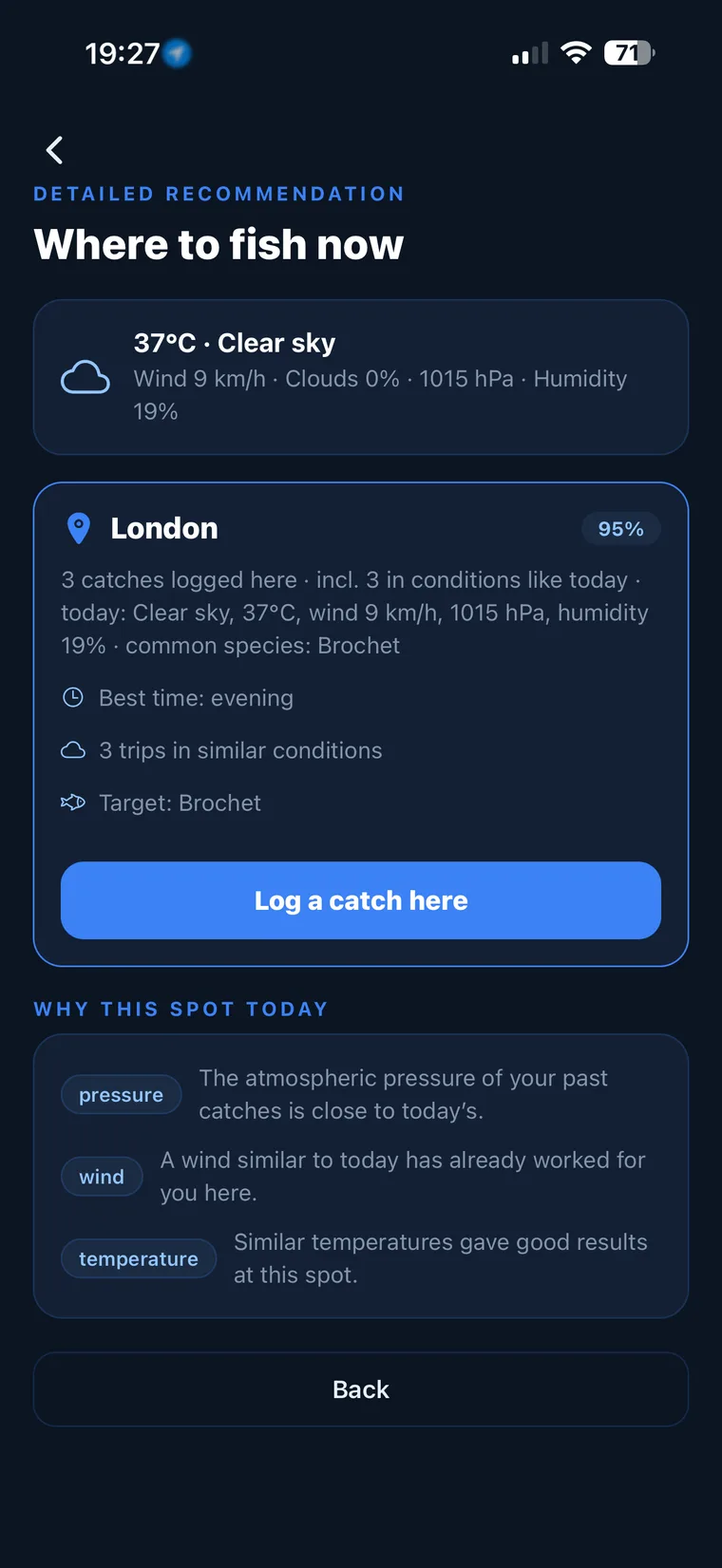
Not sure what to tie on?
Photograph your spot: CarnaFish reads the scene, cross-checks the conditions and gives you the zone, the lure and the retrieve. Free on iOS and Android.
Where it takes the lead, and where it is pointless
Its window is clear-cut:
- Exposed coastline: rocky points, jetties, sandbar beaches, anything that forces you to cast far and often into the wind.
- Fish present but not on top, typically at the start or end of a tide push, when the surface activity is over but the bass are still hanging under the stirred layer.
- Late night and dawn, when you are fishing blind across a 50 m band and the density lets you cover ground fast.
It is unsuited to two specific cases, though. Over very flat sand in less than 80 cm, you spend your time picking it off the bottom or snagging: a floating lure makes more sense. And on bass actively feeding on fry at the surface, a small floating stickbait worked slowly almost always wins — the Pin Tail Tune runs too deep and too fast for that particular scenario.
Pin Tail Tune or floating stickbait
Against a Xorus Patchinko 140, the split is simple: the Patchinko is built to walk across the surface and create a visual call on a readable sea, the Pin Tail Tune to go and find fish when that surface layer is no longer worth fishing. One calls, the other digs.
The more useful comparison is with another sinking lure, the DUO Realis Pencil 130SW: similar profile and similar logic, but the Pin Tail Tune is happy to be fished slower and deeper, where the Pencil SW is at its best on fast glides just under the surface. If you want to cover the same water with a swimming action rather than a roll, the Jackson Athlete SW from the same brand fills that role.
Our guide to lure fishing for sea bass explains how to read a tide push before choosing your density. And if you are unsure what depth to attack when you reach the point, CarnaFish analyses a photo of the spot and answers.
Key takeaways
- A dense, tapered lure: it casts far into a headwind, where a floater becomes unfishable.
- The count before you start reeling is the real adjustment: it sets the band of water you fish.
- The fall on the stop is a fishing phase; the bite reads as nothing more than the line stopping.
- Tidal current cuts the sink rate hard: recount every time it changes.
- Unsuited to very flat beaches and to surface feeding on fry.
FAQ
Does the Pin Tail Tune float or sink?
It sinks. It is a dense pencil with no air chamber, designed to cast far and fish under the surface. On the stop it drops back down rocking on its flank instead of rising, which makes it a water-column lure rather than a topwater.
What size should I start with from the shore?
A mid-range model, around 20 g. It casts far enough in a crosswind while staying discreet enough for a lightly stirred sea. You then add the heaviest for headwinds and the smallest for shallow estuaries.
How long should I let it sink?
Start at three seconds, then extend in steps until you find the layer where you get bites. In current the same count leaves you much higher than in calm water: recalibrate by first finding bottom contact.
Can I use it with a snap?
Yes, a small welded stainless snap works well and makes changes quick. Avoid oversized snaps, which weigh down the nose and flatten the lure's characteristic roll.
Does it work in freshwater for pike?
It will catch fish, but that is not its ground: the density and the anticorrosion finish are built for saltwater and long casting. In freshwater, a jerkbait or a swimbait gives you better depth control at low speed.
What colour at night?
A dark silhouette, black or deep blue back. At night a bass sees a shape cut out against the sky and picks up vibration above all: contrast matters far more than the exact shade or any reflective finish.
The full sea bass lure guideSeason-by-season strategy: which family of lure, when, and why.Go from theory to fish
CarnaFish reads your spot from a photo and gives you the game plan: zone, lure, retrieve. Free on iOS and Android.