Johnson Beetle Spin: the little grub spinner that outlived 50 years
The right lure in the wrong spot still catches nothing. CarnaFish spots the zone that works, from a single photo.
Some lures get a condescending glance on the shelf: two bent steel wires, a stamped blade, a soft plastic grub, and a price you could pay in loose change. The Beetle Spin belongs to that category, and that is a misjudgement. This lure is a direct descendant of the Beetle Spin created by Virgil Ward more than fifty years ago, and it has outlived entire generations of better-marketed novelties. Something that survives fifty years without changing shape usually has a good reason to.
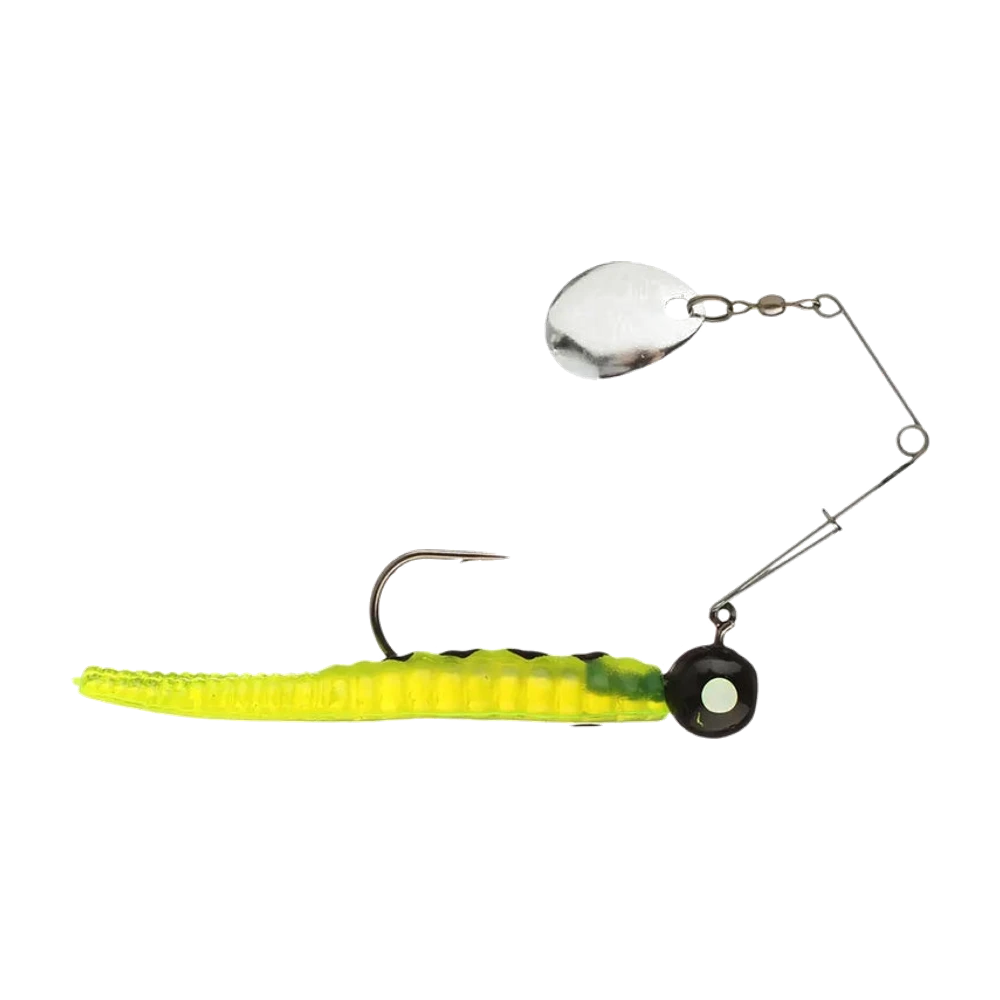
A nickel Colorado blade on a safety-pin arm
The build is the classic spinnerbait, in miniature: a steel wire bent into a safety pin, the line tie at the bend, the blade up top on a swivel, the jighead and grub below. Nothing original in the principle — what counts is the choice of blade.
Johnson fits a nickel-plated Colorado. The Colorado is the widest and roundest blade shape: it turns at a very open angle to the shaft, offers plenty of resistance and generates far more vibration than flash compared with a willow leaf. Two direct consequences for you.
First, it starts turning at very low speed. You can crawl the lure back and the blade keeps spinning, which is exactly what you want on an inactive perch or in cold water. Second, it throws out a strong pressure signal, detectable by the lateral line long before the fish sees anything. In stained or loaded water, it is the blade that does the work, not the color of the grub.
The nickel plating adds a hard flash, whiter and sharper than gold or copper. That is an advantage under overcast skies and in slightly murky water, and a drawback in very clear water under full sun, where it can get too aggressive.
The split-tail grub, and what it brings
At the back sits a soft grub with a tail split into two strands. The difference with a single tail is not cosmetic: the two strands work independently of each other and cross over, producing a disorderly flutter instead of a regular beat. To a fish inspecting the lure from close range, that disorder reads as more credible than an over-tidy wobble.
Being soft and threaded on a simple jighead, the body wears and tears. That is not a flaw but a fact of the lure: carry spare bodies, or recycle any small shop-bought grub onto the original arm. It is actually one of the model's strengths — the arm and blade last a very long time, only the soft part is consumed.
When a grub's tail is half torn off, do not bin it straight away: trim it cleanly at the tear and carry on. A shorter grub is a smaller silhouette, and on an educated perch at the end of the day that is often exactly what was needed.
The float rig almost nobody tries
This is the most interesting line in Johnson's description, and it slips past unnoticed: the Beetle Spin can also be fished suspended under a float, to target fish holding at mid-depth. In Europe, running a spinner under a bobber is an almost unknown approach, even though it solves a real problem.
The problem is that a bladed lure sinks the moment you stop reeling. There is no way to hold it at a given depth without moving forward. With a float set to the right depth, that constraint disappears: you can let the lure hang in place, make it shiver with small pulls, let it drift downwind along a bank. The blade turns at the slightest movement and the grub ripples even at rest, nudged by the chop.
It is deadly on perch sitting above cluttered bottom, where a free-swinging lure would end up snagged, and on suspended fish you mark on the sounder but cannot reach on a straight retrieve. Set the float about thirty centimetres above the fish's level: they need to be looking up.
What the manufacturer does not publish
It needs saying plainly: Johnson publishes no length, no weight, no blade size and no hook size for this lure. There is therefore no way to state a weight or a size here that would rest on anything. That has a practical consequence when you buy: check the size and count on the packaging, and do not trust a figure read off a page — ours included. On a lure sold in several sizes with no spec table, the packaging is the only reliable source.
The classic mistake
Reeling too fast. The reflex with a bladed lure is to crank hard enough to feel the blade thump in the rod. With a Colorado, that feeling arrives well before the optimal speed: you already feel it turning while the lure is still crawling. Slow down to the point where the vibration becomes irregular, then go back up one notch. That is the speed at which the lure fishes, not three notches above.
Not sure what to tie on?
Photograph your spot: CarnaFish reads the scene, cross-checks the conditions and gives you the zone, the lure and the retrieve. Free on iOS and Android.
Where and when to use it
The Beetle Spin is an upper-layer, bank-edge lure: canals, backwaters, gravel pit banks, reed lines, riprap, bridge pilings. Its small size makes it a perch lure first, and one of the best starting points for anyone new to lure fishing — it fishes almost by itself, with no particular action to master.
It also draws bass on shallow spots, especially when the fish refuse bigger baits, and trout in lakes or big rivers, where a small bladed lure on a soft body remains a safe bet. The manufacturer only states that it works on a wide variety of species without naming them: these applications are the ones its size and speed make coherent in Europe.
Its useful season is broad, from spring to autumn, peaking when the water is cool and vibration matters more than speed. And since it ranks among the cheapest lures on the market, it is also the one you send without hesitation into the cluttered spots you avoid with a twenty-euro bait.
Colors by water
- Stained or loaded water: the chartreuse with a green back from the photo. Paired with the nickel blade's flash, that is the most visible combination once visibility drops below a metre.
- Clear water: a pearl white, imitating a fry without overloading on color and leaving the blade to do the attracting.
- Educated fish or bright light: a black or brown body. The contrast of a dark silhouette sometimes triggers where every bright color has failed.
A simple lure does not spare you from knowing where to cast it: that is exactly what CarnaFish offers, with one photo of the spot and an AI that suggests the zone, the depth and the lure type matching the day's conditions. To go further on the species that suits it best, our guide to lure fishing for perch covers the spots and retrieves worth knowing.
Key takeaways
- Nickel Colorado blade: lots of vibration, turning from very low speed, ideal in stained water and on inactive fish.
- The split-tail grub produces a disorderly flutter as the two strands cross, more credible than a regular beat.
- The float rig Johnson mentions lets you hold a fixed depth without moving forward: a rare approach in Europe and a very effective one on suspended fish.
- No specs published by the maker: trust the packaging for size and count, not a figure copied from a page.
FAQ
How big is the Johnson Beetle Spin?
Johnson publishes neither length nor weight for this model, and inventing a figure would be dishonest. The lure comes in several sizes: check the marking on the packaging before you buy, it is the only reliable source.
Why a Colorado blade rather than a willow leaf?
Because the Colorado turns at a very open angle and produces far more vibration than flash. It starts at very low speed, which lets you fish at a crawl for inactive fish, and its pressure signal carries a long way in murky water.
How do you fish the Beetle Spin under a float?
Set the float about thirty centimetres above the depth where you marked the fish, then work it with small pulls or let it drift downwind. The lure stays exactly in the target layer, which a straight retrieve cannot achieve.
Is it a good lure to start with?
Yes, one of the best. It fishes on a plain retrieve with no action to master, it costs very little, and it lets you attack cluttered spots without the fear of losing an expensive bait.
What do you do when the grub is torn?
Either replace it with a spare body or recycle any small shop-bought grub onto the original arm. The arm and blade last a very long time: only the soft part is consumed, just as on a Big Bite Double Tail Grub.
How does it differ from a full spinnerbait or an inline spinner?
A full spinnerbait like the Booyah Covert is far bulkier and targets predators of another size. An inline spinner like the Blue Fox Vibrax vibrates just as hard but offers no soft body behind the blade. The Beetle Spin sits between the two: the vibration of a spinner, the ripple of a soft bait, in a reduced format.
The full perch lure guideSeason-by-season strategy: which family of lure, when, and why.Go from theory to fish
CarnaFish reads your spot from a photo and gives you the game plan: zone, lure, retrieve. Free on iOS and Android.