Keitech Flex Chunk: the legged trailer built to replace pork
This lure shines under specific conditions. CarnaFish tells you in 10 seconds if today is one of them.
The old hands knew it: the best jig trailer was a strip of pork rind. It undulated at the slightest movement, never stiffened in cold water, and had a texture fish were happy to hold on to. It also had three deal-breaking faults — it dried out the moment you forgot to close the jar, it came in about three colours, and it smelled of vinegar all the way home in the car. The Flex Chunk is Keitech's attempt at keeping the first list without the second.
Leaf legs, not whip legs
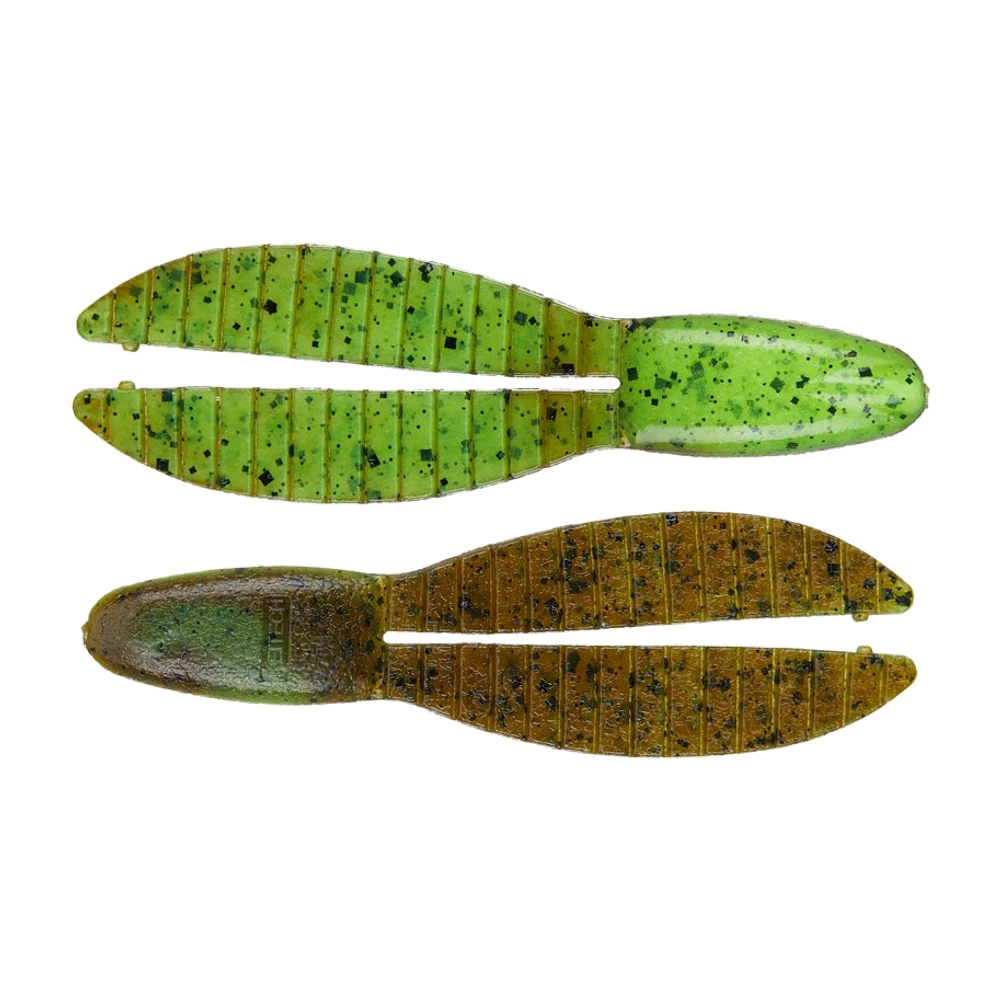
The difference is obvious in the photo: the two appendages are not thin strips but wide flat leaf-shaped legs, scored with transverse segments across their whole surface. That geometry is not decorative. A wide leg presents a lot of surface to the flow and therefore starts flapping on a minimal displacement of water, where a thin strip needs speed before it moves at all. The segmentation creates successive flex zones: the leg does not bend as one piece but undulates, which produces exactly the slow fluttering you are after in cold water.
Keitech also claims a high salt content in the blend. Two practical consequences: the lure is heavier than it looks for its bulk, so the jig's fall stays positive despite all that leg surface, and a fish that has it in its mouth tends to hold on a second longer — which, on a jig rig where the hookset needs a long sweep, genuinely changes how many fish end up hooked.
The dense body section, and why it matters
The front part of the Flex Chunk is a smooth, thick block, noticeably denser than the legs, stamped with the brand's embossed logo. That is where you thread the trailer onto the jig hook. Keitech deliberately over-densified that zone for a simple reason: on a conventional chunk, the hook's entry point is always what goes first, after two or three hard pitching casts. A dense body holds the trailer in place without glue and without the point tearing it on every hookset.
The maker specifies that this body is designed to thread snugly onto a football jig, a casting jig or a pitching jig. That is the classic trio of trailer jigs, and it is exactly what you expect from this family.
Thread the chunk until the front block butts up against the jig skirt with no play at all. Leave a millimetre of gap between skirt and trailer and the whole thing starts spiralling on the drop instead of falling straight. On a winter presentation where everything happens on the fall, that mistake costs you the day.
A cold-water lure, but not only
The maker positions the Flex Chunk clearly as a trailer for the period when temperatures drop, and that is consistent with its mechanics. When the water falls below about twelve or thirteen degrees, bass stop chasing: they will only take prey that passes within immediate reach and does not flee too fast. A trailer that flaps on the spot through a slow fall ticks exactly that box, where a paddle tail or a ribbon needs travel to exist at all.
That is precisely what separates it from a Keitech Flapper Grub: the grub needs to spin, the chunk works standing still. In the same family, a Keitech Crazy Flapper plays a neighbouring register with bulkier claws and a more pronounced crayfish profile; the Flex Chunk stays lower and quieter on the bottom.
That said, the maker itself extends use beyond winter, and rightly so: on a jig crawled slowly over hard bottom in midsummer, a legged chunk remains an excellent choice when fish are holding deep and will not come up. Behind a Keitech Crankin' Football Jig, for instance, it slows the fall and adds bulk without upsetting the head's posture.
The classic mistake
Rigging a 4.3 in Flex Chunk behind a small 7 g jig on the theory that more bulk means more bites. The leg surface brakes the descent, and a light jig carrying a big trailer takes forever to reach bottom — with a fall that drifts off at an angle and a complete loss of contact. Match the trailer size to the jig, not to your urge to bulk up the silhouette.
Two lengths, two pack counts
The chart the maker publishes is short, and needs reading correctly: the second column is a piece count, not a weight.
- 3.2 in, 8.1 cm: pack of 6. The all-round size, to go behind a medium jig, and the default choice when the water is clear or the fish pressured.
- 4.3 in, 10.9 cm: pack of 5. The large format, for heavy jigs, stained water and spots where you are hunting an above-average fish.
No per-piece weight is published. That is not trivial on a trailer, whose weight adds to the head's and changes the fall rate — but between a salt-loaded chunk and a standard one, the difference is felt in the rod more than it is read off a label. Judge by the descent rate you observe on your first few casts.
Not sure what to tie on?
Photograph your spot: CarnaFish reads the scene, cross-checks the conditions and gives you the zone, the lure and the retrieve. Free on iOS and Android.
The squid scent
Keitech adds a squid scent to its blend across the whole range. On a fast-moving lure, scent does very little: the fish has no time to register it. On a jig trailer fished very slowly, sitting on the bottom for several seconds between pulls, the argument becomes more defensible. It is not what triggers the bite, but it can influence how long a fish keeps the lure in its mouth — and that fraction of a second is exactly what is missing when you keep missing winter bites.
Colours for the bottom
The maker stresses the breadth of the colour range, wider in its view than pork trailers ever allowed, but publishes no list. Three lines of reasoning cover a jig trailer:
- Light rocky bottom, clear water: the brown green pumpkin flake in the photo, which copies a crayfish and disappears into the scenery.
- Stained water or murky bottom: the chartreuse green flake, the other version photographed, which keeps a readable contrast as light drops.
- Night fishing or very dark water: a solid dark tone, which gives the fish nothing but a clean silhouette seen from below.
The key is that the trailer stays coherent with the jig skirt. A chartreuse chunk behind a black-and-blue skirt creates a visual break that imitates nothing in nature.
Not an accessory
People talk about the trailer as a detail, when it actually sets the fall rate, the bulk and a good part of the jig's action. Picking the right one means knowing what state the fish are in and what depth they are holding at, which is not the easiest of questions. That is exactly where CarnaFish helps: one photo of the spot, and the AI suggests the zone, the depth and the kind of presentation that fit current conditions. To go into winter with the right register, our guide to predator fishing season by season sets out the markers.
Key takeaways
- The wide segmented leaf legs start flapping on a minimal displacement of water, which is what makes this a cold-water trailer.
- The dense front body section lets you thread the trailer snug without glue and without it tearing on the hookset.
- Two lengths, 8.1 and 10.9 cm / 3.2 and 4.3 in, in packs of 6 and 5; no per-piece weight is published.
- Match trailer size to jig weight, or the fall slows too much and drifts off at an angle.
FAQ
Which Flex Chunk size should I pick?
The 3.2 in / 8.1 cm behind a medium jig: it is the most versatile format and the right call in clear water. Keep the 4.3 in / 10.9 cm for heavy jigs, stained water and spots where you are after a big fish.
Does the Flex Chunk really replace a pork trailer?
That is the stated intent, and on movement it holds up: the segmented legs flutter slowly the way rind does. The real gains are elsewhere — no drying out, no smell, and a colour selection beyond anything pork allowed.
Do I need to glue the trailer to the hook?
No. The front body section is deliberately denser than the rest precisely so it holds without glue. Thread it until it meets the skirt with no play, and check that it sits dead straight.
How much does a Flex Chunk weigh?
The maker publishes no per-piece weight, only the two lengths and the pack counts. On a trailer, the simplest approach is to watch the jig's fall rate on your first casts and adjust the head accordingly.
Is it only a winter lure?
No, but that is its best window. The maker positions it for falling temperatures, when fish stop chasing. In summer it stays relevant behind a jig crawled slowly on deep hard bottom, where a paddle tail adds nothing.
What is the squid scent for?
Keitech builds it into the whole range. On something as slow as a cold-water jig, it may influence how long a fish holds the lure after taking it. Do not count on it to trigger a strike: the leg movement does that job.
The full bass lure guideSeason-by-season strategy: which family of lure, when, and why.Go from theory to fish
CarnaFish reads your spot from a photo and gives you the game plan: zone, lure, retrieve. Free on iOS and Android.