NetBait BaitFuel Paca Chunk: the chunk that slows a jig's fall
The right lure in the wrong spot still catches nothing. CarnaFish spots the zone that works, from a single photo.
On a jig, the bite almost never comes while you are pulling. It comes on the drop, in the two or three seconds when the bait falls and you can do nothing about it. So the whole job of a trailer comes down to one question: how long it makes that drop last. The NetBait Paca Chunk is built around that idea, and it does it with two flat claws that brake the bait like a parachute.
Two claws that work by drag
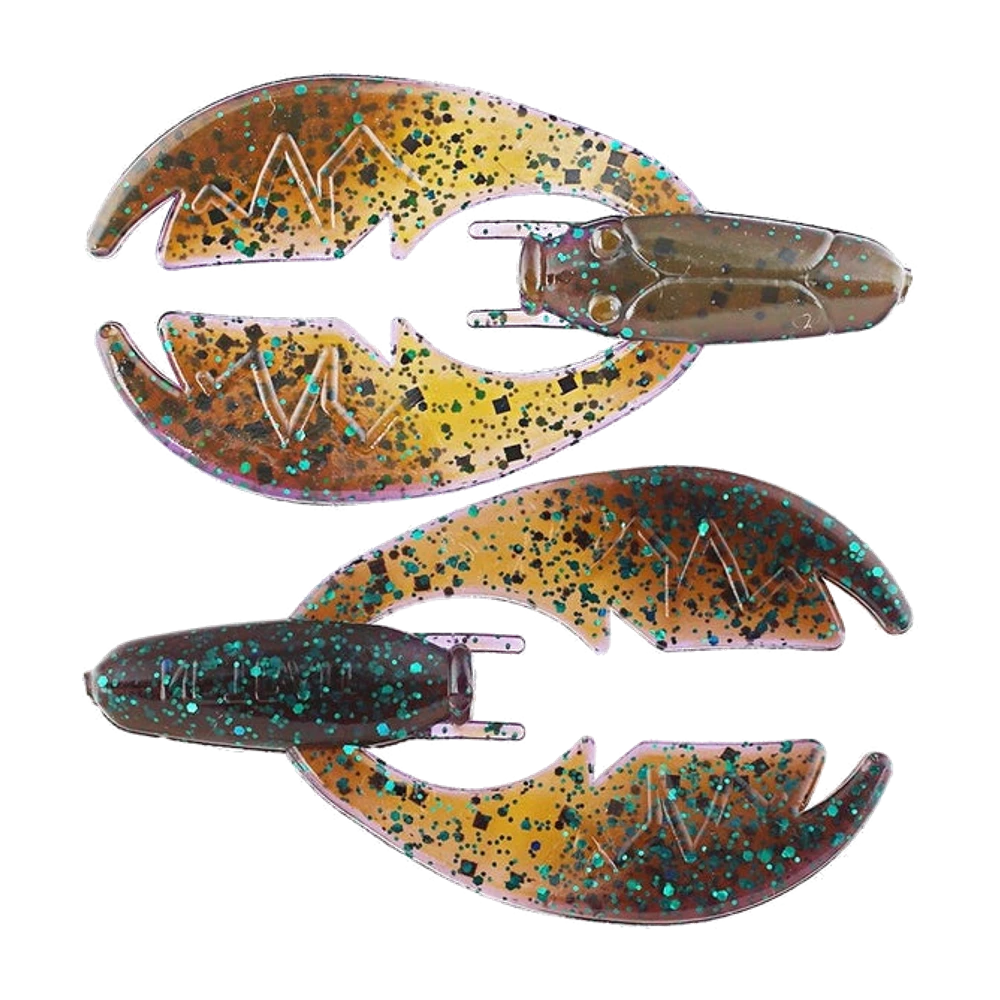
Look at the photo: the claws make up almost the entire surface of the bait. They are wide, flat, sickle-shaped, with a notched inner edge, and the body itself stays short. That ratio is deliberate. NetBait describes a parachuting effect: the claw area slows the descent and keeps them fluttering even at very low speed, where a trailer with slim appendages only comes alive past a certain amount of movement.
The difference is measurable. With a 10 g jig and a flat-clawed chunk you easily gain one to two seconds of fall over three metres of water. On an inactive fish, that is exactly the window that turns a follow into a bite. The reverse is also true: if you want to get down fast on a deep spot, this trailer works against you, and a slimmer body like the NetBait BaitFuel Paca Slim Craw suits better.
The 45 degree posture, the detail that sells it
NetBait claims something else, less spectacular but more interesting: at rest the bait settles at 45 degrees, claws raised, to copy the defensive posture of a cornered crawfish. That is exactly what a crawfish does when a fish pins it against a rock — it does not flee, it rears up and opens its claws.
The practical value is real. When you leave your jig sitting on the bottom for five or ten seconds, the trailer does not slump: it stays upright and visible, and the slightest line vibration makes it quiver. That is what lets you fish a rock or a stump by leaving the bait motionless for a long time, a technique that catches fish a continuous retrieve will never touch.
After every contact with cover, stop everything for five full seconds. That is a long time on the water, far longer than it feels. Count them for real: it is during those five seconds that the chunk rights itself, and it is often at the end of them that a fish which was only watching makes up its mind.
What the BaitFuel scent changes, and what it does not
NetBait builds in its house scent, BaitFuel, with one technical detail worth noting: it is a water-based formula that disperses in water, not in air. That sounds trivial, but it is the difference between a scent that creates a halo around the bait and one that evaporates in your box without ever working where it should.
The claimed benefit is not pulling a fish in from twenty metres — no scent does that. It is holding time: a fish that has taken the bait keeps it a fraction of a second longer before spitting. On a slow presentation where the hookset fires off a vague sensation, that fraction of a second is exactly what is missing.
The rigs
Behind a football jig
This is the headline use. The football jig is made to roll over hard, rocky bottom, and the chunk adds the bulk and the crawfish silhouette. On a Strike King Tungsten Football Jig or any equivalent, thread the body up to the head and leave the claws free to work.
On a ball head
NetBait also mentions rigging it on the back of a ball head, which gives a more compact and discreet package than a skirted jig. That is the finesse version of the same principle: less bulk, the same braked fall, useful when fish refuse a wide silhouette.
The solid body, a genuine argument
The maker insists on a solid body, with no cavity. The point is not cosmetic: a solid body locks onto the jig's bait keeper and does not slide back cast after cast. If you have ever spent a day pushing a trailer forward every three casts, you know what that saves.
The mistake that cancels the parachute
Pairing this chunk with too heavy a jig. An 18 or 21 g jig crosses the water column so fast that claw drag no longer counts, and you pay for the bulk without getting the benefit. Stay on 7 to 14 g as long as depth and wind allow. The second common mistake: trimming the claws to cut bulk. You are removing exactly the surface that creates the braking.
Not sure what to tie on?
Photograph your spot: CarnaFish reads the scene, cross-checks the conditions and gives you the zone, the lure and the retrieve. Free on iOS and Android.
What the maker leaves out
It should be said plainly: NetBait publishes no dimensions for this bait. No length, no weight, no pack count in the technical description. On a trailer the missing weight is secondary, since the jig supplies the load, but the missing length makes it harder to match the chunk precisely to your skirt. Measure your first one and write it down, it is the only reliable reference.
Colours by water
- Lightly stained water: the colour in the photo, olive-green body and amber claws with green flake, which echoes a real crawfish over gravel.
- Dirty water: a plain dark tone, because up close a fish reads a mass before it reads a detail.
- Spring, moulting season: a red or orange dominant, copying a freshly moulted crawfish and triggering decisive reactions on shallow flats.
A slow-fishing trailer, not a search bait
The Paca Chunk is not made to cover water. It is a spot bait, paired with slow fishing over identified hard bottom, and it requires you to accept leaving the lure still. Against a more compact chunk like the Keitech Flex Chunk, it leans on claw surface rather than on a slim profile.
That leaves the most important question: where to put the jig. That is exactly what CarnaFish makes easier — one photo of the spot, and the AI suggests the zone, the depth and the type of presentation that fit the day, including when the right answer is to slow down. For tackle basics and reading water, our guide to getting started on bass fishing is still the best entry point.
Key takeaways
- Two wide flat claws brake the drop like a parachute and flutter even at very low speed.
- At rest the bait settles at 45 degrees, claws raised, copying the defensive posture of a crawfish.
- The BaitFuel scent is water-based and disperses in water: its job is to make fish hold on longer, not to draw them from a distance.
- No dimensions published by the maker, and too heavy a jig cancels the parachute effect: stay between 7 and 14 g where you can.
FAQ
What jig weight should I pair with the Paca Chunk?
Between 7 and 14 g for as long as depth and wind allow. Beyond that the jig falls so fast that claw drag no longer counts and you lose the whole point of this trailer.
How long is the Paca Chunk?
NetBait publishes no dimensions for this bait: no length, no weight. Measure your first one and note it down, it is the only reliable reference for matching chunk size to skirt size afterwards.
Does BaitFuel actually do anything?
Its job is not to pull a fish in from a distance, no scent does that. The maker highlights that it disperses in water rather than in air, which creates a halo around the bait and makes fish hold their mouth shut longer.
Can it be rigged other than behind a jig?
Yes, the maker presents it as riggable several ways, including on the back of a ball head. That version gives a more compact and discreet package with the same braked fall.
Should I trim the claws if the bait looks too big?
Definitely not. The claws are precisely the surface that creates the braking on the drop and the flutter at low speed. If the bulk is a problem, change bait rather than mutilate this one.
How long should I leave the bait still?
Five seconds after every contact with cover, actually counted. That is the time the chunk needs to right itself to 45 degrees, and the bite often comes right at the end of that pause.
The full bass lure guideSeason-by-season strategy: which family of lure, when, and why.Go from theory to fish
CarnaFish reads your spot from a photo and gives you the game plan: zone, lure, retrieve. Free on iOS and Android.