Raid Japan Egu Chunk: the big-clawed trailer that brakes the fall
One lure, endless conditions. CarnaFish reads your spot from a photo so you are not just guessing.
A jig without a trailer is a lead head wearing a wig. The trailer is not decoration: it decides the rate of fall, the width of the silhouette and what happens during the three seconds the lure spends dropping. Raid Japan's Egu Chunk takes that role so seriously that it has built its whole case on it — deliberately oversized claws.
Two sizes, and a table to read correctly
The maker's table gives two columns: Size and Quantity. It reads 3 in for 7 pieces and 4 in for 5 pieces. In other words: 7.6 cm sold in packs of 7, and 10.2 cm sold in packs of 5. The second number is a pack count, not a weight — the classic confusion when the table arrives flattened, with no formatting. Raid Japan publishes no weight at all, which makes sense: on a trailer, volume matters more than mass.
The 3 in is the everyday format, the one that rigs behind a 7 to 14 g jig without unbalancing the whole thing. The 4 in aims at a distinctly bigger silhouette, best kept for stained water, big fish, or Texas rigs where the bait fishes on its own.
Claws that work from the moment the bait lands
Raid Japan describes claw arms of unusual thickness, built to produce an aggressive kicking action at the precise moment the bait hits the water. That is the point to grasp: the action does not depend on a retrieve. It exists from impact, through the fall, which is exactly the window in which a bass decides to eat a jig.
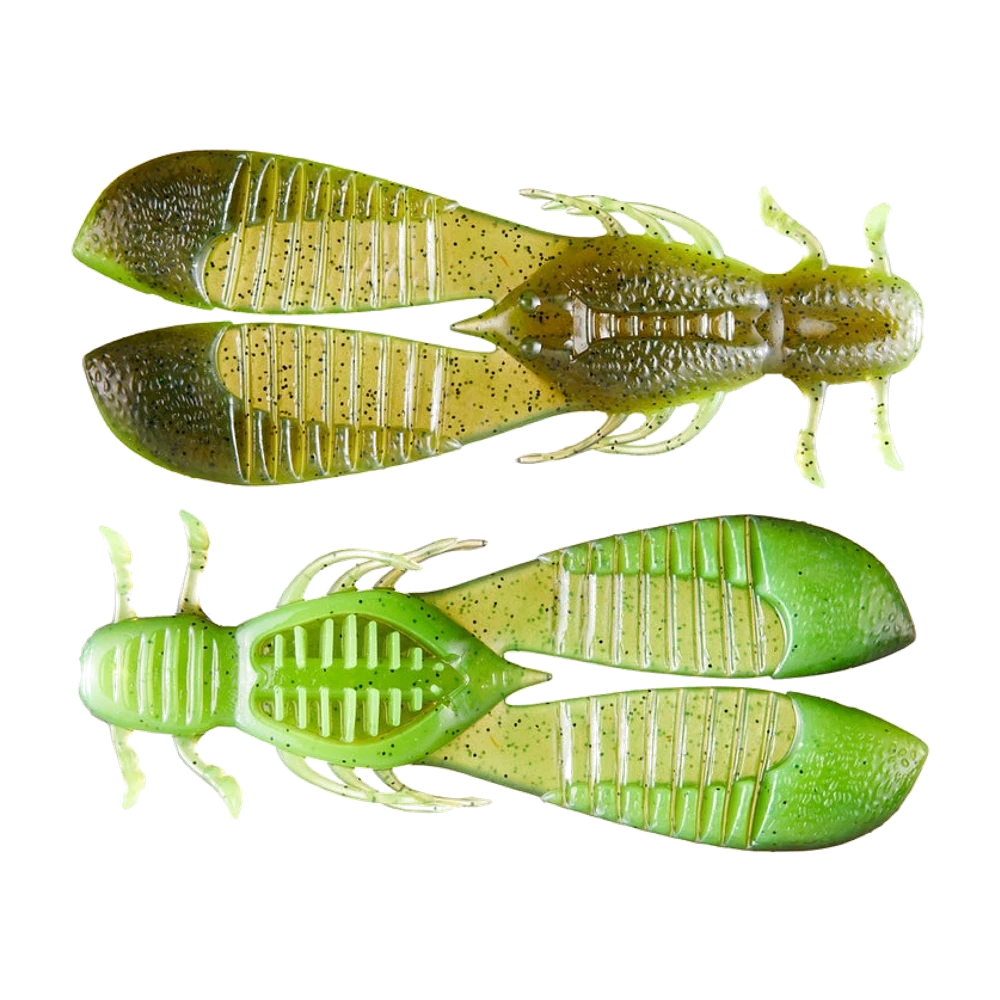
In the photo those claws look wide, flat and ribbed on the inner face. A flat claw grabs a lot of water: it kicks with amplitude, but it also brakes the descent. The maker speaks of exceptional buoyancy coming from those claws — a marketing phrase to be taken for what it is, though the braking effect itself follows directly from the visible geometry.
The body carries in addition a series of small soft appendages and fine abdominal ribs, which Raid Japan presents as producing crustacean-like micro-waves. In practice those appendages keep moving while the bait sits on the bottom and you do nothing at all. That is the moment most trailers go dead.
On the other hand, the source consulted publishes neither the material, nor the salt content, nor the density of the plastic. Those are the three figures that decide how a soft bait stands up to teeth, and how many fish one piece absorbs before it falls apart. On a jig trailer, whose body is pierced by the shank every time you re-rig it, that silence has a practical cost: there is no way to know in advance whether you will go through one per session or one per day. Buy generously the first time.
The test that beats any sales pitch: drop the rigged jig into thirty centimetres of clear water by the bank and watch it for ten seconds without touching the rod. If the appendages are still moving, the trailer is working. With the Egu Chunk the residual movement is visible — that is what you are buying.
The rigs the brand claims
Raid Japan leads with the jig trailer role, then Texas, free rig and Carolina. The four are not equally interesting with this bait.
As a jig trailer
Its main job. Threaded on a jig shank, the chunk widens the silhouette and clearly slows the fall. Behind a compact jig like the Queen Tackle Tungsten Flipping Jig, whose tungsten head is deliberately small, the added volume rebalances the pair: you get a readable drop back without giving up penetration into cover.
On a Texas rig
Rigged on its own with a wide-gap hook and a tungsten bullet, it becomes a lure in its own right. This is where the 4 in makes sense: big silhouette, a fall braked by the claws, and a noisy entry that pulls attention along a grass edge.
On free rig and Carolina
Both rigs leave the bait free behind a weight that reaches bottom first. The chunk then sinks more slowly than the weight and hovers in the strike zone — behaviour that only exists if the claws genuinely brake, which they do here.
The mistake that ruins it
Rigging a 4 in behind too light a jig. The trailer takes over, the pair drops at an angle, and you lose the verticality that makes a jig worth fishing. Simple rule: if your jig is not falling straight, the trailer is too big or the jig too light — never the other way round.
Not sure what to tie on?
Photograph your spot: CarnaFish reads the scene, cross-checks the conditions and gives you the zone, the lure and the retrieve. Free on iOS and Android.
Colour by water
Raid Japan advertises a colour range without the source consulted listing it. What the photo shows already gives two useful registers.
- Clear water over hard bottom: the olive green with black flake visible on the back, the crawfish tone that works anywhere.
- Stained water or low light: the chartreuse visible on the belly side, which adds a contrast point without distorting the silhouette.
- Rocky bottom, crawfish dominant: a deep brown, paired with a jig in the same tone to stay coherent.
Where it sits among other chunks
The trailer market is saturated, and the Egu Chunk is not after versatility. Against a Keitech Flex Chunk, softer and more discreet, it offers the opposite: amplitude and volume. Against a Reaction Innovations Sweet Beaver, the benchmark for compact Texas rigs, it brakes far harder. Raid Japan presents it as the culmination of chunk-type plastics in Japan — that is a brand claim, not a measurement; what can be verified is the thickness of the claws in the photo and the behaviour it implies.
The right trailer does not rescue a bad spot, and that is exactly what CarnaFish makes easier: a photo of the spot, and the app suggests the zone, the depth and the presentation suited to current conditions. To learn how to read the banks and breaks where this kind of rig earns its keep, our guide to reading a fishing spot lays out the method.
Key takeaways
- Two sizes, 3 in (7.6 cm) and 4 in (10.2 cm); the figures 7 and 5 in the table are pack counts, not weights.
- The thick claws kick from the moment the bait lands and brake the fall: this trailer acts on the drop, not on the retrieve.
- The fine appendages keep vibrating while the bait rests, where most chunks go inert.
- A 4 in behind a light jig kills the verticality: match trailer size to head weight.
FAQ
Which Egu Chunk size should I pick?
The 3 in (7.6 cm) for everyday use behind a 7 to 14 g jig, the 4 in (10.2 cm) for a big silhouette in stained water or rigged Texas on its own. When in doubt, start with the 3 in: it unbalances the pair far less.
How many baits per pack?
Seven in 3 in and five in 4 in, according to the maker's table. Be careful not to read those figures as weights: the column is headed Quantity.
Does this trailer float?
Raid Japan attributes exceptional buoyancy to its claws but publishes no density figure, and the table has no buoyancy column. What can be stated is that wide flat claws brake the fall; calling the bait buoyant in the strict sense would go beyond what is documented.
Can it be fished alone, without a jig?
Yes, Texas rigged with a tungsten bullet or on a free rig. The 4 in suits that use particularly well, with a pronounced entry and a braked fall that gives the fish time to react.
How does it differ from a standard craw?
A craw imitates a crawfish with thin pincers and a discreet action. A chunk like this one bets on volume and amplitude: the claws are wide, flat and thick, so the signal is stronger and the fall considerably slower.
Does it need a particular hook?
For a Texas rig, a wide-gap straight-eye hook matched to the thickness of the body, not a fine wire: the body is dense and an undersized hook will not come through on the hookset. As a jig trailer, the jig's own hook does the work and no other is needed.
The full bass lure guideSeason-by-season strategy: which family of lure, when, and why.Go from theory to fish
CarnaFish reads your spot from a photo and gives you the game plan: zone, lure, retrieve. Free on iOS and Android.