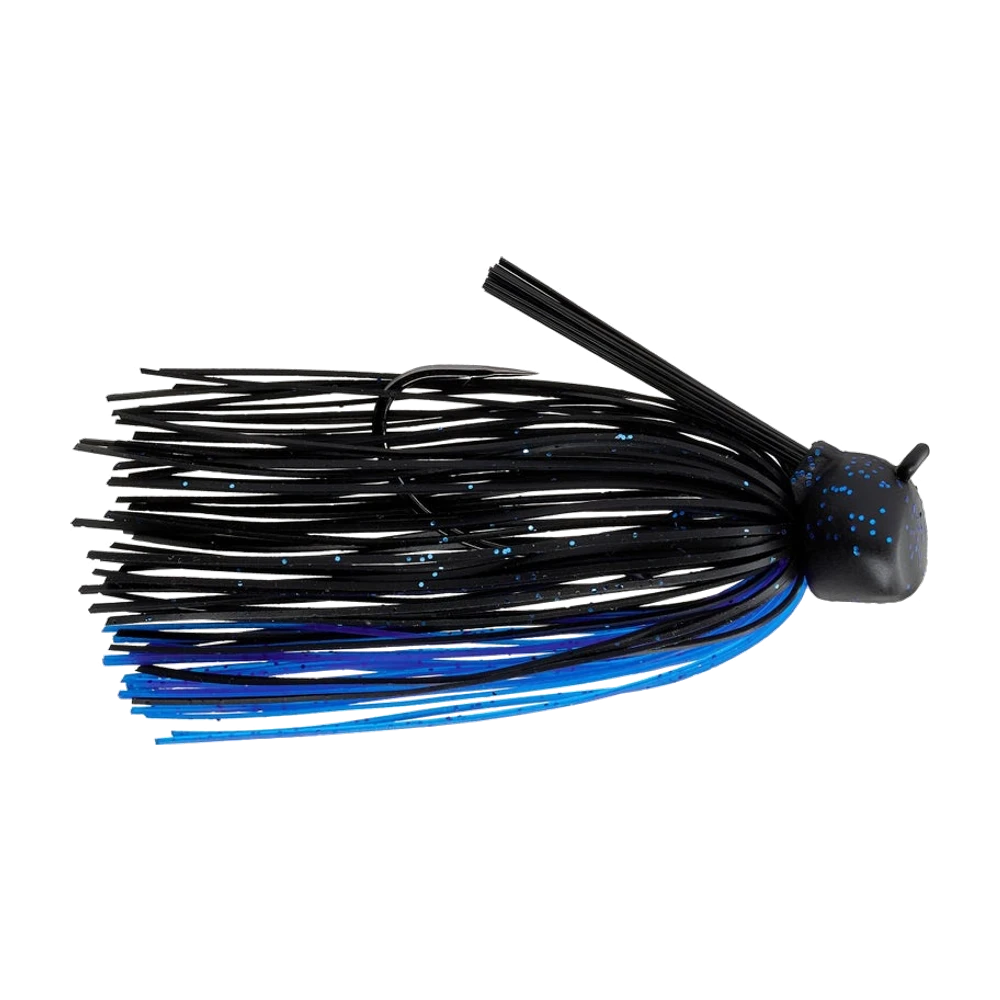
Keitech Crankin' Football Jig: the football jig you fish on the reel
This lure shines under specific conditions. CarnaFish tells you in 10 seconds if today is one of them.
There are two ways to fish a jig. The first, the one everybody learns, is to let it down and work it with the rod in short pulls. The second is to barely touch the rod at all and do everything on the reel, dragging the jig so slowly that it stays glued to the bottom across the whole retrieve. Keitech's Crankin' Football Jig is drawn for the second — it is literally what the name says — and that changes how you rig it and how you fish it.
The Reverse Delta head, and what it fixes
The trouble with a standard football jig is that it tips over. Crawled slowly across uneven bottom it lies down on its side, the skirt loses its volume, the hook ends up pointing anywhere and the first bite turns into a missed one. Keitech's answer is a head it calls Reverse Delta: the front face is flat and faces forward, so as the jig moves it pushes water instead of cutting through it. That frontal resistance drives the nose down and holds the jig upright, hook up, for the whole retrieve.
The side effect is as useful as the main one: the flat face throws a small amount of turbulence behind it, a quiet eddy that works the skirt without you doing anything at all. On an extremely slow retrieve, that micro-movement is often the only thing separating a jig that fishes from a jig that is merely being dragged.
The football shape itself does its usual job: wide and low, it rolls over rock instead of wedging between pieces, and it transmits a remarkably clean bottom signal. You know at all times, without looking, whether you are on gravel, on hard rock or on soft silt. Keitech explicitly claims reduced snagging from that geometry.
Drop the jig and count the seconds of descent once, on a bare cast. That number becomes your depth gauge for the rest of the session: as soon as it changes by two seconds you have just crossed a break, and that is where you slow down further.
What the maker does not publish
Worth stating straight away, because it is the information you miss when ordering online: the product copy gives neither a length nor a list of weights. All it says is that each head is stamped with its weight so you can find the right one at a glance when you need to re-tie. That is sound design — nobody enjoys hunting for a size in a jig box mid-drift — but it does not replace a published chart. Check the weight on the packaging before you buy, and do not rely on equivalences from another football jig.
The depth range, on the other hand, is stated: the maker gives sizes covering habitats from five to fifty feet, roughly 1.5 to 15 m. That is a wide band, and it confirms that weight selection is the real variable with this lure. Shallower than ten or twelve feet, a jig that is too heavy hits bottom before the skirt has opened; past thirty feet, one that is too light stops telling you anything and you are fishing blind.
The trailer is half the lure
Keitech states the intended pairing plainly: a Fat Swing Impact in 4.3 or 4.8 in behind the head. That is not a sales line, it is consistent with the whole logic of the lure. A paddle-tail shad on a slowly dragged jig means a tail kicking continuously while the head crawls — exactly the complement an ultra-slow retrieve needs. If that is the behaviour you want, the Keitech Fat Swing Impact 4.8 is the default choice, with the Keitech Swing Impact 4 as a slimmer option for wary fish.
The rig is secured by a double barb driven into the body of the trailer, which stops it sliding back cast after cast. That detail matters a lot on a slow presentation: a trailer that has crept back five millimetres masks the hook point and costs you fish without you ever working out why.
When to change trailer family
The paddle is not compulsory. In cold water, when fish stop chasing anything, a legged trailer that undulates on the spot usually beats a kicking tail. A Keitech Flex Chunk or a Keitech Crazy Flapper turns the jig into a crayfish in a defensive posture, with less bulk and a much slower fall. Rule of thumb: paddle above about fifteen degrees when fish are chasing, legs below that.
Working it: drag, do not hop
The retrieve is done on the reel, at the slowest speed you can actually hold, rod at ten or eleven o'clock. The aim is simple: never lift the jig off the bottom. When you feel the head bump a rock, do not rip it free — lean gently, let the flat face work its way around the obstacle, then carry on. It is the exact opposite of the reflex you build with a flipping jig.
The hook fitted as standard is a Decoy with a sproat bend, chosen for rapid penetration under load. That matches the hookset this technique calls for: you do not snap the rod upward, you accelerate the retrieve while dropping the rod until you feel the weight, then lock up. With a sproat bend, the point goes in during that loading phase, often before you have finished the motion.
The classic mistake
Putting this jig on a stiff rod and fishing it like a flipping jig, in vertical pulls. The Reverse Delta head is pointless in that register: it needs forward travel for the flat face to do anything. Hopped along, the Crankin' Football Jig loses its posture, stops pushing water and goes back to being an ordinary football jig. If your day is a vertical one, pick a different model.
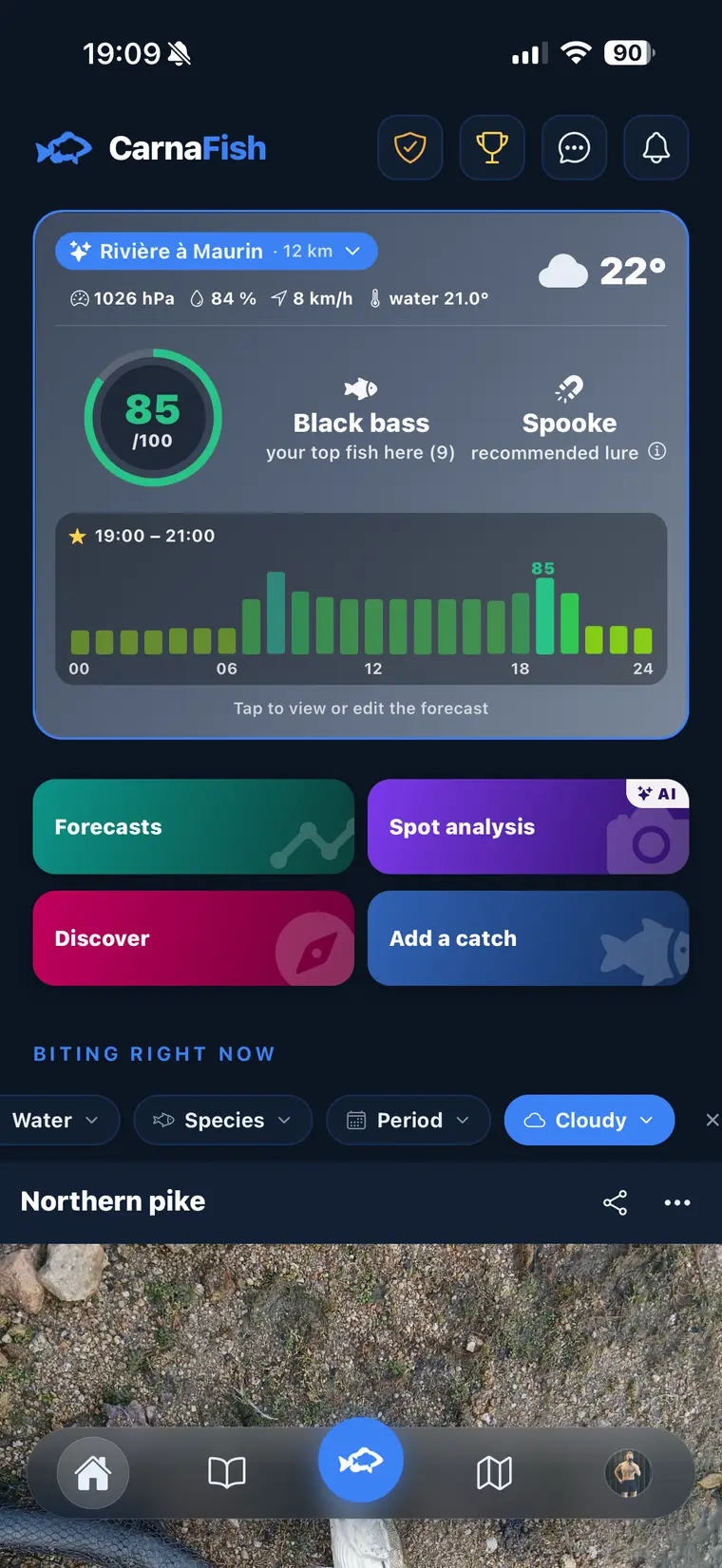
Not sure what to tie on?
Photograph your spot: CarnaFish reads the scene, cross-checks the conditions and gives you the zone, the lure and the retrieve. Free on iOS and Android.
Colours for bottom and water
The product copy publishes no colour chart, but jig logic is stable across brands and fits in three lines:
- Low light, stained water, soft bottom: black and blue, the version photographed here. It is the combination that keeps a readable silhouette when there is not much left to see.
- Clear water over weed or timber: green pumpkin, a tone that disappears into the scenery and lets the movement do the work.
- Rocky bottom with crayfish present: a brown with an orange cast, copying the colour of a crayfish around a moult.
A jig for one specific job
The Crankin' Football Jig is not a do-everything jig: it is a slow search tool for hard bottom, halfway between a classic jig and a deep crankbait. It asks you to accept fishing slowly, for a long time, over zones you chose before casting. That is exactly where CarnaFish helps: one photo of the spot, and the AI suggests the zone, the depth and the kind of presentation that fit the day's conditions, before you have tied anything on. For the groundwork on bass tackle and bass structure, our guide to getting started on bass fishing sets the scene.
Key takeaways
- The flat forward face keeps the jig upright on the retrieve and creates turbulence that works the skirt by itself.
- The maker publishes neither a length nor a weight chart: the weight is stamped on the head, so check it before buying.
- Stated range of roughly 1.5 to 15 m / 5 to 50 ft, with weight selection as the lure's main variable.
- It is fished on the reel in permanent bottom contact; hopped vertically, it loses the whole point.
FAQ
Why is it called a Crankin' jig?
Because it is fished on the reel, like a crankbait, rather than pulled with the rod. That is the design premise of the Reverse Delta head, whose flat forward face only does something while the jig is moving forward continuously.
What weight should I pick?
The copy gives no weight list, and each head carries its weight stamped on it. Think in terms of depth: the lightest head that still keeps you in touch with the bottom without ripping. Under four metres stay light, past ten metres go up decisively.
Which trailer goes behind it?
Keitech states the pairing with a Fat Swing Impact in 4.3 or 4.8 in. In cold water a legged trailer like a Flex Chunk slows the fall and works on the spot, which suits a fish that has stopped chasing.
Does this jig snag much?
The maker claims reduced snagging from the head geometry, and a football head does roll over rock rather than wedging in it. In dense timber a conical flipping head is still cleaner.
Is it good for anything other than bass?
It is a jig designed for bass, and the product copy mentions no other species. On deep hard bottom a slowly dragged football jig can interest zander, but that is an angler's extrapolation, not a manufacturer's claim.
Does it need a particular rod?
A medium-power rod with a moderate action suits it better than a very stiff blank. The hookset is a progressive load, not a snap — which is what the Decoy sproat-bend hook fitted as standard is built for.
The full bass lure guideSeason-by-season strategy: which family of lure, when, and why.Go from theory to fish
CarnaFish reads your spot from a photo and gives you the game plan: zone, lure, retrieve. Free on iOS and Android.