Zoom Z-Craw: the creature bait that glides instead of kicking
The right lure in the wrong spot still catches nothing. CarnaFish spots the zone that works, from a single photo.
After three hours of pressure on a pond, there comes a point where anything that moves spooks fish. Craws with kicking pincers, shads that vibrate, even a worm worked a little too sharply: the bass sees it coming and slides away. What you have left is a bait that falls. Not a bait that swims slowly — a bait that sinks without making a sound and without going straight down.
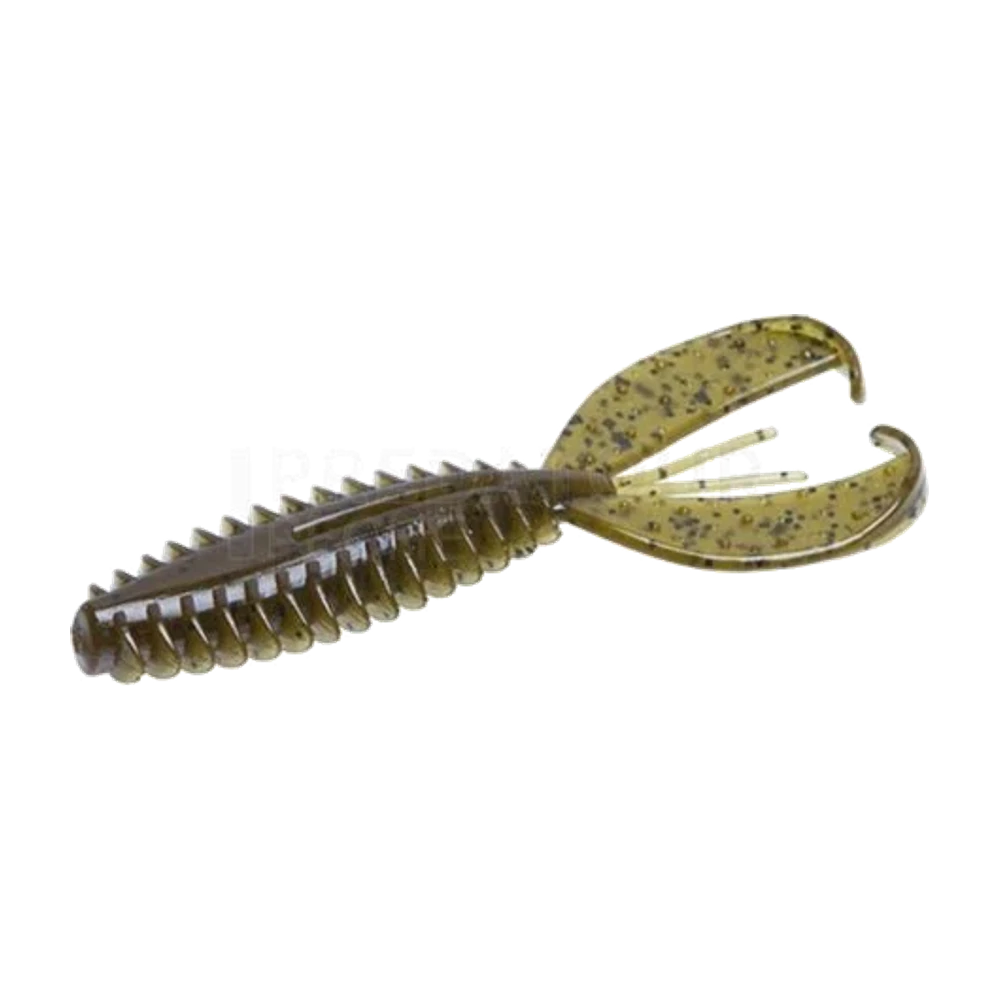
The Z-Craw is built for that. A flattened body, two flat oar-shaped arms, a small flat tail: none of these parts is made to kick. They are made to lean on the water and drift the bait sideways as it sinks.
A profile designed to brake, not to vibrate
Take a classic craw: the pincers are ribbed, curled, drawn to catch the flow and snap. They create a vibration signature readable from a distance. The Z-Craw does the opposite, and that is a choice, not a weakness.
- The arms are flat and smooth. They increase the lifting surface without generating turbulence. As a result, the fall slows right down, and the bait planes.
- The body is flattened on the flanks. It behaves like a wing: instead of dropping vertically under the hook, it slides off at an angle, one way and sometimes the other.
- The flat tail stabilises. It stops the bait spinning as it drifts, which keeps the presentation clean and avoids twisting the line.
What it loses in signal range, it gains in presentation time. Over two metres of water, a standard weighted craw hits bottom in a second; an unweighted Z-Craw takes four to five seconds and also covers a metre or two sideways. You multiply by five the time spent in the fish's field of view.
The retrieve: the descent is the retrieve
- Rig it Texas style, 3/0 or 4/0 EWG hook, point just under the skin. Weightless to start with.
- Cast past the target spot, never on top of it. The drift needs room to bring the bait back into the hot zone.
- Semi-tight line, touch nothing. Watch the line. The bait planes. Most bites happen here, and they read as a sideways shift of the line, not as a knock.
- When it reaches the bottom, wait two seconds. Then a single short lift of the rod tip, twenty centimetres, and let it drop back.
- Three or four cycles maximum per cast, then cast somewhere else. This bait is fished with precise, repeated casts, not long retrieves.
On the water: over two metres of water, an unweighted Z-Craw drifts a good metre to a metre and a half sideways as it sinks. Cast right on the edge of the lily pads and it finishes its fall out in open water, off to one side of the fish. Cast one or two metres past the spot and let the drift bring it back. It is counter-intuitive, and it changes your bite rate on tight spots.
Setting the weight without killing the glide
| Situation | Weight | What happens |
|---|---|---|
| Clear margin, under 2 m, wary fish | None | Maximum glide, 4 to 5 s fall |
| Margin of 2 to 3 m, light wind | 3.5 g bullet | Reduced glide but control kept |
| Structure in 3 to 5 m | 5 to 7 g bullet | Almost straight descent, clean bottom contact |
| Vegetation to punch | 10 g bullet, pegged | The glide disappears: a penetration bait |
The logic to remember: every gram added cuts the sideways drift. Beyond 7 g, the Z-Craw loses what makes it interesting and becomes an ordinary Texas-rigged craw. If the spot really demands weight, you might as well pick a bait designed for it. For line, fine braid with a 0.25 to 0.30 mm fluorocarbon leader gives you the sensitivity to read a bite during the fall — on straight mono, you will miss half of them.
Not sure what to tie on?
Photograph your spot: CarnaFish reads the scene, cross-checks the conditions and gives you the zone, the lure and the retrieve. Free on iOS and Android.
Where it excels, where it is beside the point
It wins on pressured fish in clear water, in high summer or after several anglers have been through, and on vertical spots: dock edges, stumps, dam walls, lily pad margins. Anything that offers a depth of water for the glide to use. It is also an excellent post-spawn bait, when bass are present but refuse aggression.
It is unsuited, on the other hand, to covering large areas — you cover very little ground. It is also unsuited to stained or moving water: with no vibration, the fish only detects it if it sees it. And it is pointless over flat, bare bottom in less than a metre, where there is simply not enough depth for the glide to exist.
Z-Craw, Brush Hog or Crazy Flapper
These three creature baits look alike in the box and have almost nothing in common on the water.
The Zoom Brush Hog is the penetration bait: its many appendages grab the water, it is fished weighted, flipping and punching into thick cover. It is the call when you have to get through vegetation and wake up a fish that is hiding.
The Keitech Crazy Flapper is the action bait: its ribbed pincers kick hard the moment it moves, including on the fall. It puts out a signal, it calls fish in, and it works on active fish or in less clear water.
The Z-Craw is the discretion bait. Neither of the other two can do what it does: plane for a long time, in silence. And if you are after a creature to run behind a jig as a trailer, the Keitech Hog Impact is cut out for that role.
The Texas rig remains the basis for all these setups, and our beginner's guide to bass fishing places these approaches within the season. If you are unsure which weight to use for the depth in front of you, CarnaFish analyses a photo of the spot and answers.
Key takeaways
- Flat arms and a flattened body: the bait planes and drifts sideways instead of dropping straight.
- The descent is the retrieve; the bite reads as a shift in the line.
- Cast one or two metres past the spot so the drift brings the bait back to it.
- Every gram added cuts the glide; beyond 7 g, the point of the bait disappears.
- With no vibration: unsuited to stained water, to current and to covering water.
FAQ
How do you rig the Zoom Z-Craw?
Texas style, with a 3/0 or 4/0 EWG hook, the point brought out then tucked back just under the skin of the back. Weightless in most cases, or with a 3.5 to 7 g bullet weight pegged with a stopper when depth or wind demand it.
Why does the Z-Craw drift sideways as it sinks?
Because its flat arms and flattened body behave like lifting surfaces. The water leans on them during the fall and pushes the bait off at an angle. Over two metres of water, it can move a metre to a metre and a half sideways.
Should the Z-Craw be weighted?
As little as possible. Weightless, the fall lasts four to five seconds over two metres and covers a wide drift. Every gram added shortens that time and straightens the path; beyond seven grams, the bait becomes a conventional Texas-rigged craw.
How do you detect a bite during the fall?
By watching the line, not by waiting to feel something. A bite on the drop shows up as an abnormal stop in the line or a sideways shift. Fine braid with a fluorocarbon leader improves that reading markedly.
What is the difference with a craw with kicking pincers?
A craw with kicking pincers produces vibration and calls fish from a distance, which is an asset on active fish or in coloured water. The Z-Craw barely vibrates at all: it plays on slowness and discretion, on fish that are refusing movement in the first place.
Does it work in murky water?
Hardly. With no vibration signal, it is only detected visually, at short range. In stained water, prefer a high-action creature or a strongly vibrating bait that stays detectable by the lateral line even without visibility.
The full bass lure guideSeason-by-season strategy: which family of lure, when, and why.Go from theory to fish
CarnaFish reads your spot from a photo and gives you the game plan: zone, lure, retrieve. Free on iOS and Android.