Keitech Tungsten Football Jig V2: deep-water fishing by feel
Rather not fish it blind? Photograph your spot — CarnaFish cross-checks the conditions and points you the right way.
On a rock break in 7 or 8 m / 23 to 26 ft of water, you can't see a thing and everything happens in your fingers. The jig scrapes, stalls, tips over, moves on — and that string of tiny signals tells you whether you're on gravel, on slick rock or in a lump of dead wood. Keitech's Tungsten Football Jig Version 2 is built for exactly that moment: the brand presents it plainly as a deep-water jig.
Why head hardness matters as much as head weight
The central claim in the description is that the head's tungsten compound is thirty percent harder than lead, and that the extra hardness sharply increases sensitivity. The logic checks out rod in hand: a hard material barely deforms when it hits a rock, so it returns the impact instead of soaking it up. A lead head absorbs part of that impact by denting — which is why an old lead jig ends up covered in little craters.
A second consequence gets mentioned less often: for a given weight, tungsten takes up less volume than lead. The head is therefore more compact for the same mass, which reduces the surface that can wedge between two rocks.
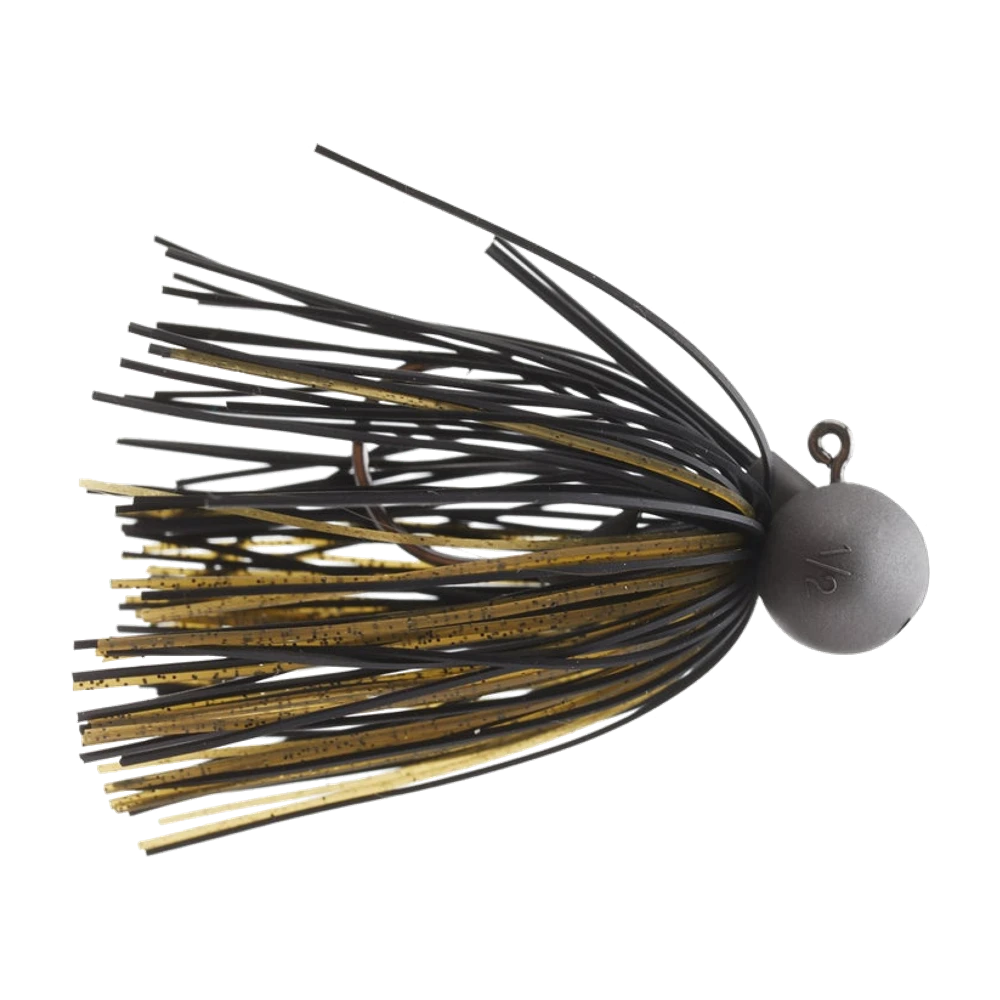
Keitech also chose to leave the head raw and unpainted, presented as a durability gain and a neutral matte finish. That's a genuine engineering call: there is no paint to chip after three sessions over rock. The trade-off is that you lose any play on head colour — here, all the visual work is carried by the skirt.
What Keitech publishes, and what it doesn't
Worth saying straight away, because it's what you miss most when ordering: the description contains no spec table. No length, no list of weights. The only numbers given are build numbers: a hundred-strand skirt hand-tied in SR-40 silicone, a ten-fiber weed guard glued by hand, and a custom Gamakatsu hook in size 2/0. Watch that last point, which reads badly when you skim: 2/0 is a hook size, not a quantity. There is one hook, like on any jig.
The photographed sample does carry a 1/2 stamp on the side of the head, so half an ounce, roughly 14 g / 0.5 oz. But that's a reading off a photo, not published data, and it says nothing about the other weights offered. Check the weight on the retailer's listing. Same caution on length: a skirted jig has no useful length until you've picked a trailer.
The SR-40 skirt, silicone aiming at rubber behaviour
Silicone replaced flat rubber on the vast majority of jigs: rubber ages badly, hardens and cracks. It did have one advantage plenty of anglers still miss, a softness that keeps the skirt breathing at rest with nothing else moving. Keitech claims precisely that its SR-40 silicone is super soft and delivers action comparable to traditional flat rubber skirted jigs. That's the promise worth keeping in mind: a skirt that stays alive during the seconds the lure sits still. A hundred strands is dense, and it takes slightly longer to close back up after a drag — on a wary fish, that delay is exactly what you want.
Count to three after every drag without touching the rod. That's how long the skirt takes to close, and that open-and-close is when a bass makes up its mind. Restarting the retrieve the instant the jig touches down removes the one thing this skirt does better than most.
Working a deep football jig
A football head doesn't roll like a round head: its wide shape makes it tip one way then the other as it clears an obstacle, while standing up on flat bottom. It's built to be dragged, not hopped. Pull with the rod tip, rod low, over 30 to 50 cm / 12 to 20 in, then take up the slack and wait. A football jig worked with big rod sweeps lifts off the bottom and has nothing left to tell you.
Keitech claims deep-water duty, but the depth you actually reach depends on the weight you bought, the current and your line diameter. Thin braid cuts drag and lets you go down with a lighter jig — often the best way to gain sensitivity without adding lead.
The trailer and the double keeper
Keitech fitted this jig with a double barbed keeper system that holds the soft plastic without glue: a trailer that slides back after three casts unbalances the lure and has you reeling in constantly. A soft craw is the most logical pick on a football head, since you drag it on the bottom: a Keitech Crazy Flapper stands its claws up at rest, a Strike King Rage Craw flaps its appendages constantly as soon as it moves. Thread it dead straight on the hook shank: a twisted trailer spins the jig and wrecks your leader within minutes.
The mistake that costs the most bites
Trying to feel the bottom by gripping the rod. The reflex is universal and counterproductive: a clenched hand turns your forearm into a shock absorber. Hold the rod loosely, rest a finger on the blank ahead of the reel seat and let the tungsten work. That path — bottom, head, line, blank, finger — is exactly what Keitech paid for a harder compound. Second common error: setting on the first resistance. At 8 m / 26 ft, a jig wedged between two rocks feels just like a mushy bite. Tighten gently, and only set if the resistance moves.
Not sure what to tie on?
Photograph your spot: CarnaFish reads the scene, cross-checks the conditions and gives you the zone, the lure and the retrieve. Free on iOS and Android.
Colour by bottom type and water clarity
Keitech advertises an assortment of selected colours without listing them, so reason by conditions rather than by trade name.
- Clear water, gravel or rock bottom: green pumpkin or crawfish brown, the tone of the crawfish actually living on that substrate.
- Stained water or low light: black and blue, the deep-jig classic, which gives you not a colour but a clean silhouette seen from below.
- Dark bottom under bright sun: the black and gold of the photographed sample, whose gold strands catch what little light gets down without harsh flash.
A deep football jig is backlit anyway. Silhouette contrast matters more than exact hue.
Against the other football jigs
This Version 2 covers the same ground as a Strike King Tungsten Football Jig, with an argument built on material hardness rather than head shape. Keitech also offers the Keitech Crankin' Football Jig, which uses a flat front face and is retrieved on the reel. The two don't replace each other: one is dragged with the rod tip, the other wound in steadily.
Picking the right jig doesn't help much if the break you're fishing isn't really one. That's exactly what CarnaFish is for: a photo of the spot, and the app suggests a zone, a depth and a lure type matched to the day's conditions. To build the tackle and spot-reading basics for bass, our beginner's guide to bass fishing remains the right way in.
Key takeaways
- The head uses a tungsten compound claimed to be thirty percent harder than lead, and that hardness is what carries the sensitivity argument.
- Keitech publishes neither length nor weight: check the weight on the retailer's listing before ordering.
- Hundred-strand SR-40 silicone skirt tied by hand, ten-fiber weed guard, Gamakatsu hook in size 2/0 — one hook, 2/0 is a size.
- It gets dragged with the rod tip in constant bottom contact; the moment the jig lifts, it stops telling you anything.
FAQ
What weight should I pick for this Keitech football jig?
No way to give you the exact range: the description contains no weight chart. The photographed sample carries a 1/2 stamp, so roughly 14 g / 0.5 oz, but that's one sample. Go by the weight shown on the retailer's listing.
Why is the head left unpainted?
It's a deliberate choice: Keitech leaves the tungsten raw for a neutral matte finish and better durability. With no paint, nothing chips when the head grinds over rock.
What's the difference from a round-head jig?
Shape. A football head is wide and low: it stands up on flat bottom, tips one way then the other over an obstacle, and drags naturally. A round head rolls and suits hopping or a light ned rig better.
What trailer should I run on it?
A soft craw is the most coherent pick, since the lure spends its life on the bottom. The double barbed keeper holds it with no glue: thread it dead straight on the hook shank, as a twisted trailer spins the whole thing.
Does the weed guard get in the way of the hookset?
Ten fibers is a moderate guard, hand-glued so it stays aligned with the point. It protects against a hard snag without blocking the set. If it feels too stiff, fan the fibers out rather than cutting any.
Can this jig be fished anywhere but deep?
Nothing stops you, but Keitech presents it as a jig built for deep water, and the wide head earns its keep mainly on hard bottom. To pick apart shallow margins, a flipping jig or a swim jig will serve you better.
The full bass lure guideSeason-by-season strategy: which family of lure, when, and why.Go from theory to fish
CarnaFish reads your spot from a photo and gives you the game plan: zone, lure, retrieve. Free on iOS and Android.