Abu Garcia Atom: the wide spoon that sinks slowly despite its weight
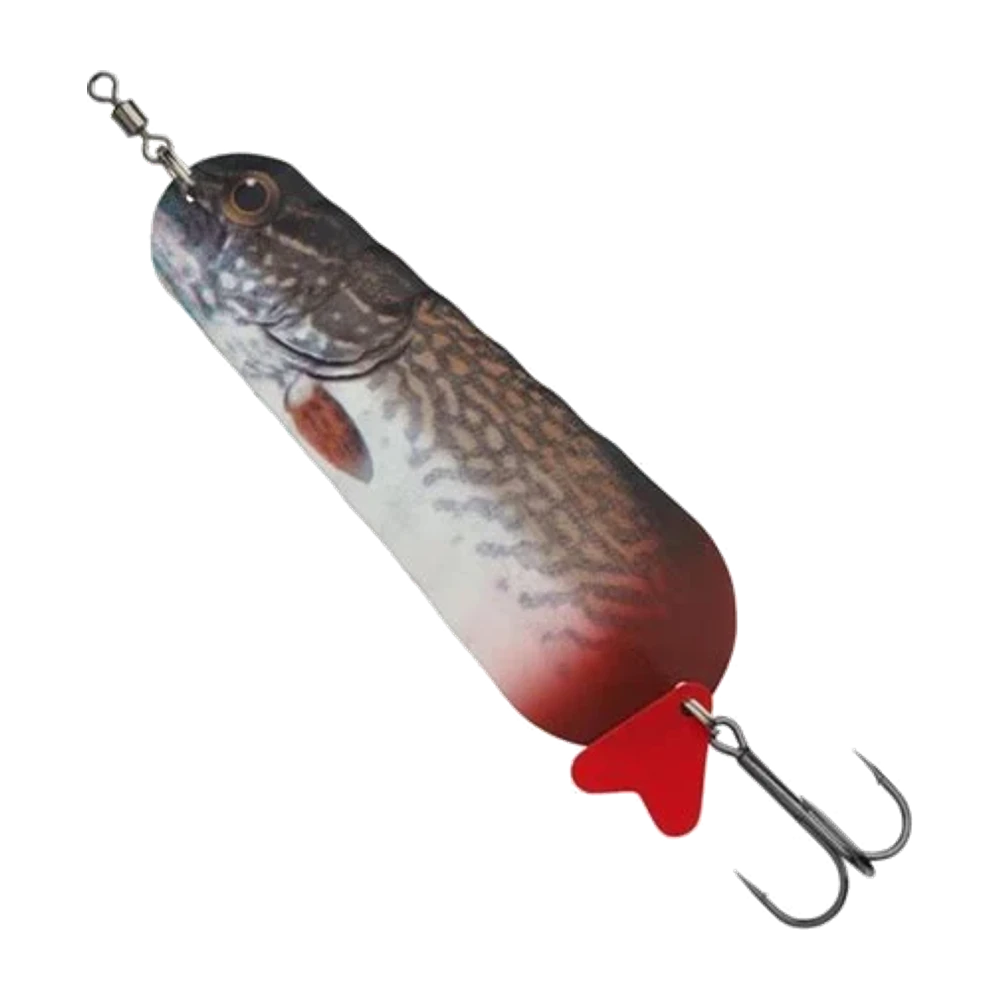
Not sure this lure fits YOUR spot today? CarnaFish tells you in 10 seconds, from a photo.
A gravel-pit lake in October, a stretch of flattened weed over a metre and a half of water, and pike sitting in it. You want a big profile so you only bother the better fish, but everything over 25 g in your box drops like a stone and picks up salad on the second turn of the handle.
The Atom solves that conflict with geometry. It is a wide, domed and relatively flat spoon: it presents a large surface to the water for a moderate thickness of metal. The result is counter-intuitive — a 35 g model sinks about as slowly as a narrow 12 g spoon, while keeping the casting distance and the visual presence of its real weight.
That is what makes it a shallow-water lure when its weight would suggest the opposite.
Surface area, the only explanation for its behaviour
Two spoons of the same weight do not sink at the same speed. What decides it is the ratio between mass and the surface resisting the descent.
The Atom sits firmly on the "lots of surface" side:
- Its fall is slow and flat. The lure does not nose down: it slides sideways while rocking, on a wide trajectory. Over a metre and a half of water you can afford three to four seconds of pause without snagging.
- Its wobble is wide and slow. The broad surface grips the water and tips the lure from one flank to the other with real amplitude, producing a slow, well-separated flash, very different from the fast twinkle of a narrow spoon.
- It tolerates a very slow retrieve. Where a thin spoon stalls and slews sideways below a certain speed, the Atom keeps rocking.
The trade-off is easy to predict: it meets a lot of water resistance. In strong current or on a fast retrieve, it rises and eventually spins on itself.
The retrieve: wind little, let it drop a lot
The typical mistake is to wind it back like a crankbait. This lure is fished in cycles.
- Cast and let the spoon sink on a semi-tight line, counting. Over 1.5 m of weed, stop at three seconds.
- Three or four turns of the handle at a slow, steady speed. You should feel a heavy sway, not a vibration.
- Stop dead, rod at 45 degrees. The lure tips over and glides off on its flank for two to four seconds.
- Re-establish contact with half a turn of the handle before starting the sequence again. That is often where the bite shows up: you feel weight, not a knock.
- Slow down again over the last five metres and make a sideways sweep with the rod before lifting the lure out.
On the water: during the fall, do not watch the rod tip, watch the line where it enters the water. A wide spoon glides more than a metre sideways as it drops, and the take shows up as line moving off to one side or suddenly going slack — well before the tip moves. The day you start setting the hook on that signal rather than on feel, your hook-up rate changes.
Weight, depth and pause
| Weight | Depth | Useful pause |
|---|---|---|
| 20 to 25 g | 1 to 2 m, weed beds and shallows | 2 to 3 s |
| 25 to 35 g | 2 to 3.5 m, margins and drop-offs | 3 to 5 s |
| 35 to 55 g | 3.5 m and more, holes and big lakes | 5 to 8 s |
The lighter weights also work on big lake trout, fished from the bank along deep reservoir margins, with shorter pauses and a slightly firmer retrieve. It is not the main use, but the slow action and the broad flash work well there in spring.
Its waters, its seasons, its limits
It shines in still or slow-moving water: lakes, gravel pits, ponds, backwaters, wide canals. Its best period runs from late summer into early winter, when pike will still take a big profile but have slowed their attack rhythm.
On colour, the wide flank changes things: bare silver throws a slap of light that is very visible in clear water, sometimes too much in full sun. Copper and brass soften that signal and work better on amber late-autumn water, while a green or blue back stays the safe bet on deep, clear lakes.
It is out of place in fast rivers — too much lift, it rises and spins — in dense vertical weed, and in fast searching: its return comes from the number of pauses, not the number of metres covered.
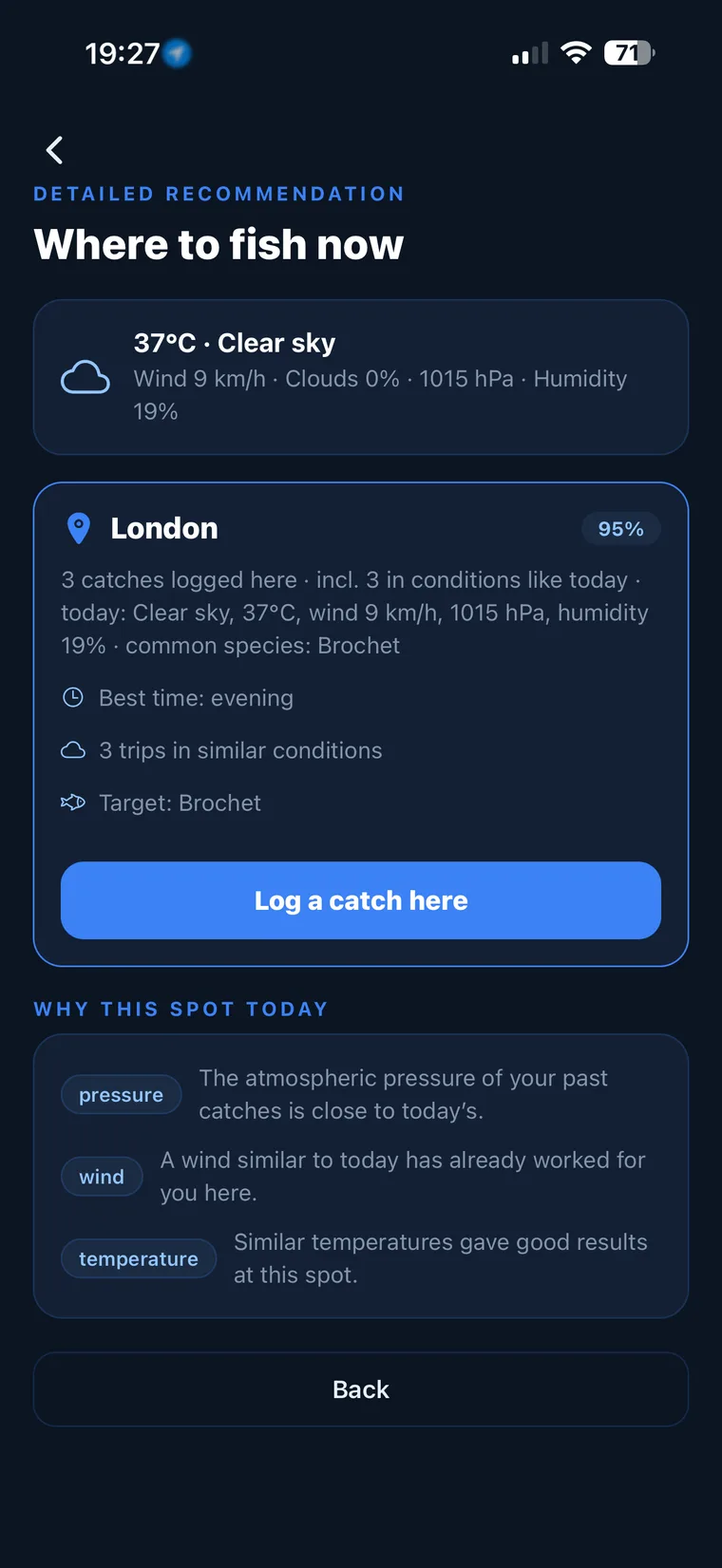
Not sure what to tie on?
Photograph your spot: CarnaFish reads the scene, cross-checks the conditions and gives you the zone, the lure and the retrieve. Free on iOS and Android.
Rigging: two details that cost fish
The stock split ring. On a wide spoon, it works in torsion on every roll. Check it after every fish and replace it at the first sign of opening.
The leader. Wire or titanium, no discussion, for pike: this lure is often taken mid-fall and therefore deep. A 0.60 mm fluorocarbon is not enough when the attack comes from underneath.
Add a rolling swivel sixty centimetres up. A wide spoon does not twist the line on a slow retrieve, but it does as soon as you speed up at the end of the cast to lift it out.
Atom, Toby or Wabler: three Swedish and Canadian geometries
The Abu Garcia Toby is the exact opposite of the Atom within the same brand: narrow, thick, very dense, built to cast far and swim in an S in the current. It is the river and distance lure, not the pause lure.
The Williams Wabler sits between the two with a curved profile and a more rolling action on a steady retrieve.
If you want to cover depth quickly, go to a narrow, thick spoon such as the Luhr-Jensen Krocodile — it does exactly the opposite of the Atom, dropping fast with a tight wobble. Our guide to choosing a pike lure puts these families back in a seasonal context. And if you are unsure how long a pause to hold when you reach the bank, CarnaFish analyses a photo of the spot and answers.
Key takeaways
- Plenty of surface for its weight: a 35 g model sinks as slowly as a thin 12 g one.
- The fall is flat, gliding more than a metre sideways: that is the key phase of the retrieve.
- Three or four turns of the handle, then a two to five second pause depending on depth.
- Watch the line where it enters the water during the fall, not the rod tip.
- Avoid it in strong current and in fast searching.
FAQ
Isn't a 35 g spoon too heavy for two metres of water?
Not in the Atom's case. Its width creates lift that strongly slows the descent: you can allow three seconds of pause over a metre and a half without touching the weed. It is the surface-to-weight ratio that counts, not the weight alone.
How do you work the Abu Garcia Atom?
In cycles: three or four slow turns of the handle, then a dead stop of two to five seconds during which the lure glides as it drops. Re-establishing contact after the pause is when the bite most often shows itself.
Does it catch trout?
Yes, in the 20 to 25 g sizes, on big lake or reservoir trout fished from the bank. Shorten the pauses and retrieve a little faster than for pike, working deep margins in spring.
Do I need a wire leader?
For pike, yes. The take very often comes during the fall, so from underneath and with an open mouth: the lure ends up deep. Heavy fluorocarbon does not protect you in that situation.
Does it work in rivers?
Badly as soon as the current picks up. Its lift makes it rise, then spin on itself. In a river, a narrow, dense spoon like the Toby or the Krocodile is a far better choice.
What is the difference with the Toby from the same brand?
The Toby is narrow, thick and dense: casting distance and an S-shaped action in the current. The Atom is wide and buoyant: slow fall, wide wobble, fishing in pauses over shallow water. They do not cover the same spots.
The full pike lure guideSeason-by-season strategy: which family of lure, when, and why.Go from theory to fish
CarnaFish reads your spot from a photo and gives you the game plan: zone, lure, retrieve. Free on iOS and Android.