LiveTarget Hollow Body Field Mouse: the hollow mouse for matted grass
Before tying this one on, it helps to know if the spot actually calls for it. CarnaFish reads the scene from a photo.
Late August, a backwater choked with lily pads across three quarters of its surface. You have already walked two hollow body frogs over the mat without seeing a thing move, and the fish have watched that profile go by all summer long. A mouse changes the equation for one simple reason: the silhouette is longer, lower, it drags a tail that creases the surface behind it, and it looks nothing like the baits this spot has absorbed since June.
A hollow frog that changed shape
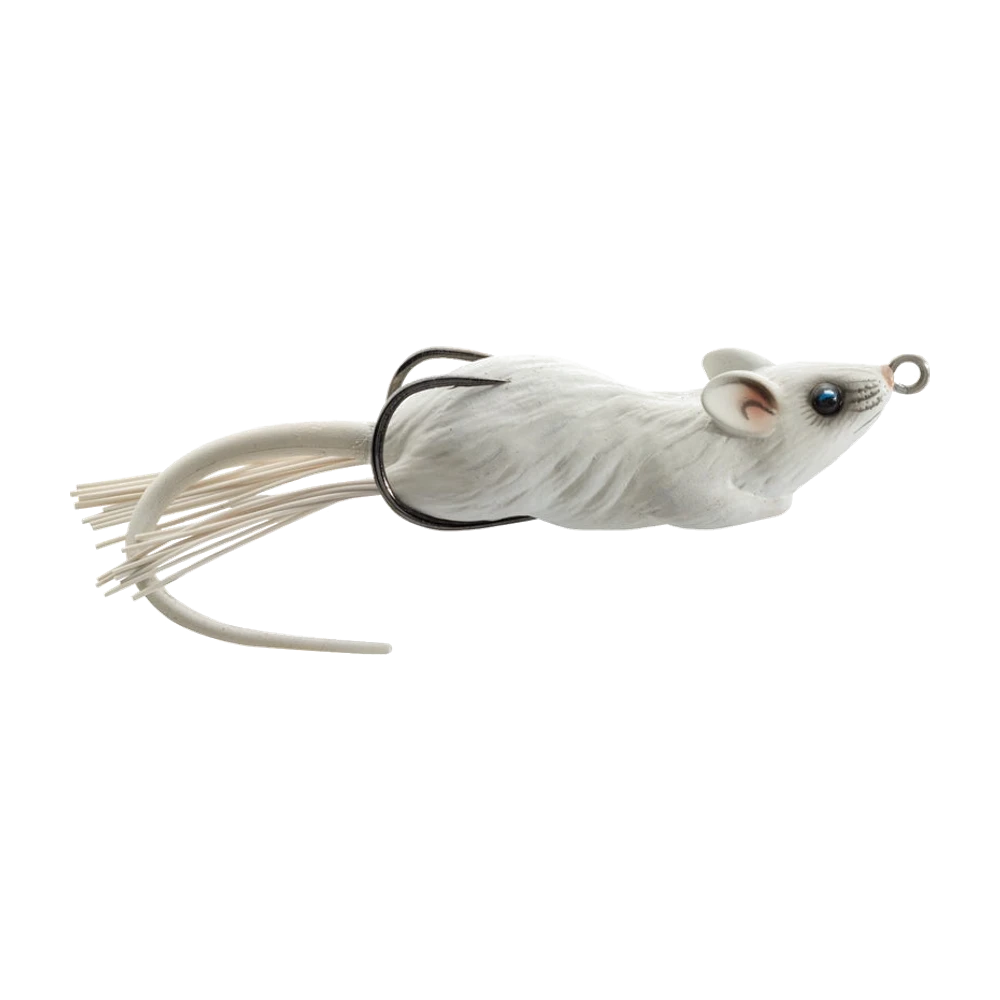
The Hollow Body Field Mouse is built to the same brief as a hollow body frog: a soft plastic shell, thin walls that collapse under the jaws on the hookset, and a double hook lying flat along the back so nothing fouls. LiveTarget, the Koppers range, showed the bait at the 2011 ICAST show and took Best of Show in the soft lure category there. The maker makes no secret of the lineage: it describes the mouse itself as an alternative to the hollow bodied frog.
The biological case is spelled out in the description: field mice are native to most areas of North America, they forage along shorelines and on floating vegetation, which puts them in constant contact with opportunistic bass sitting under the mat. It imitates genuinely available forage rather than a made-up prey item, and the logic carries over to Europe without effort: a vole dropping off an undercut bank is an opportunity neither a bass nor a pike lets go.
On the unit photographed, the white shell carries moulded fur striations, the ears are lined with pink, the eye is a dark bead with a blue highlight and the whiskers are engraved into the snout. A metal ring comes straight out of the nose for the line tie.
Two sizes, two different jobs
The manufacturer's table lists only two references, and it pays to read them properly:
- 60T: 2.25 in, which is 5.7 cm, for 3/8 oz, which is 10.6 g.
- 90T: 3.5 in, which is 8.9 cm, for 1 oz, which is 28.3 g.
The model codes obviously suggest 60 and 90 millimetres. The table says 5.7 and 8.9 cm, and the table is what we go with — it outranks a product code. The gap is three millimetres on the small model, one on the big one, enough to avoid quoting a round number no source backs up.
The weight jump, on the other hand, is huge: close to three times heavier between the two sizes. The 60T is a medium-heavy casting bait for light mats and pad edges; the 90T needs a genuine heavy cover rod and throws into the wind without complaint. In Europe, the 90T is the one that opens the door to weed-bed pike: the maker only talks about bass, but a 28 g weedless topwater interests a pike sitting under a mat as soon as the water warms.
One point of honesty: the description publishes no buoyancy class for this mouse, where the same manufacturer explicitly states Floating for its Hollow Body Frog. So we stick to what is written — a bait designed to be twitched along the tops of pads and grass mats — without claiming a buoyancy the spec sheet does not confirm.
Working it: short twitches, plenty of pauses
A mouse is not fished like a popper. No noise, no spray: you land the bait on the mat and make it crawl. Two or three sharp twitches of the rod tip, a few centimetres each, then a two to four second pause. The body slides, rolls slightly onto its side, and the soft tail draws a thin wake you can pick out at ten metres on flat water.
The real work happens in the holes. Every time the bait reaches the edge of a gap in the vegetation, stop everything: that is the only place a fish can come up without pushing through thirty centimetres of salad, and that is where it commits.
Count the holes before you cast, not during the retrieve. When you already know there are three on the line of travel, you hit all three pauses without thinking about it. When you improvise, you always miss one — the middle one, every time.
The hookset, where most fish are lost
A hollow body does not forgive reflexes. The fish takes the bait in an explosion of water and weed, and everything pushes you to set immediately. That is exactly what you must not do: at that moment the double hook is still lying against the back, the shell has not collapsed, and a sharp set rips the bait out of the mouth without burying a point.
The sequence that works: you see the blow-up, you drop the rod, you count a full beat, you take up contact by reeling, and only once you feel the weight of the fish do you set with a long sideways sweep. The body then collapses under the pressure of the jaws and frees both points.
The tackle around the bait
A heavy casting rod of 2.00 to 2.20 m, fast action but not extra-fast, so you can sweep wide without killing the set. Braid of 40 to 50 lb tied direct: you need to drag the fish out of the mat within a second, and a fluorocarbon leader sinks, pinning the mouse against the vegetation instead of letting it glide over the top. The factory double hook is described as razor sharp by the maker; it still earns a touch of the file after a morning of scraping stems.
One last thing: shell softness is a consumable. After a dozen fish the wall deforms and collapses less well. The manufacturer leans hard on that collapsibility, and it is the first thing you lose.
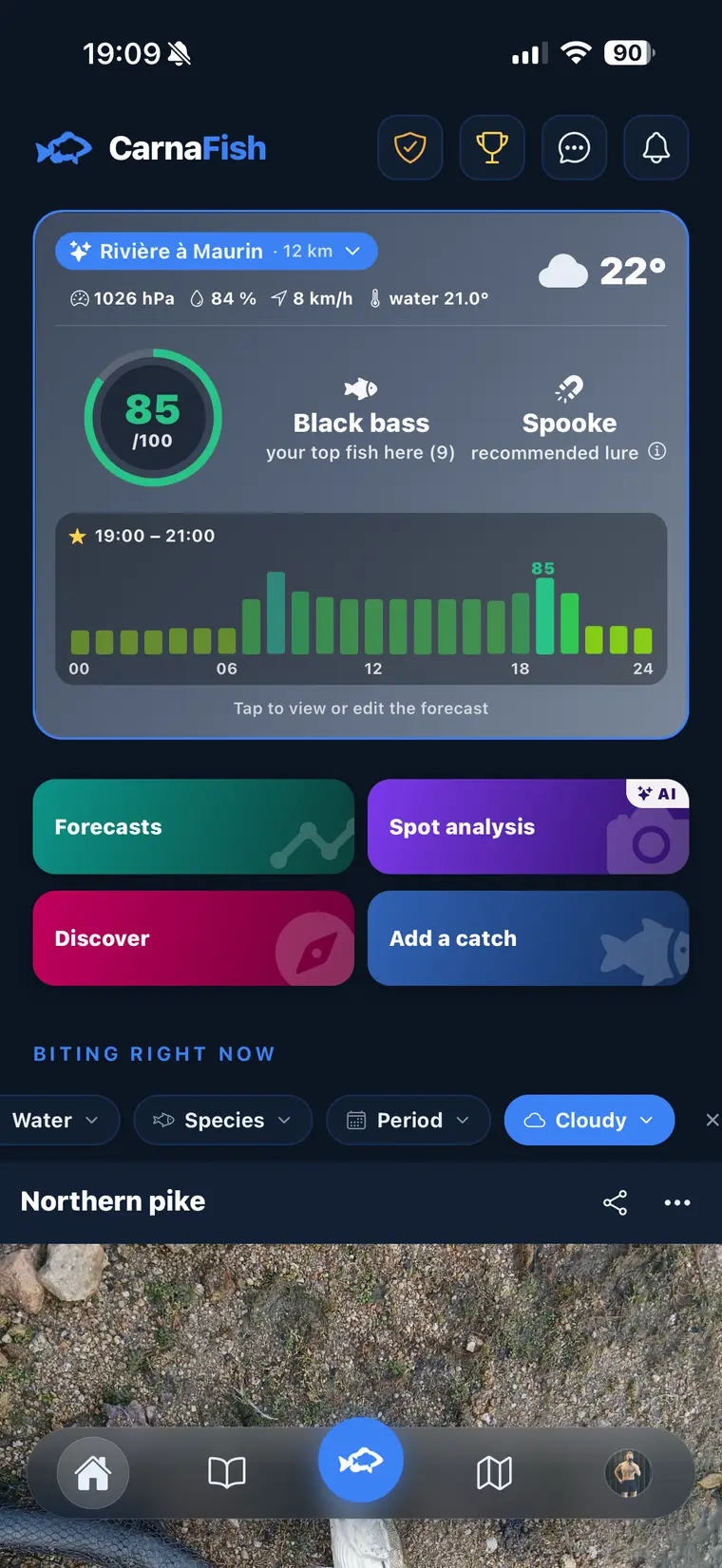
Not sure what to tie on?
Photograph your spot: CarnaFish reads the scene, cross-checks the conditions and gives you the zone, the lure and the retrieve. Free on iOS and Android.
Colour by light
- Overcast, low light: the white of the unit photographed. A pale belly against a grey sky stays readable from underneath, which is exactly the fish's point of view.
- Bright sun, clear water: a natural brown rodent tone that imitates without throwing light back. On clear water where a bass has time to inspect, the moulded realism works for you.
- Stained water, end of day: black. As in all topwater fishing, what counts is the silhouette cut out against the light, not the colour itself.
Alongside the other cover baits
The mouse is no universal replacement. On a mat you need to cross quickly, a Spro Bronzeye Frog stays more compact and easier to walk in place. When you want noise and provocation rather than discretion, a Savage Gear 3D Rad Rat works a different register. The Field Mouse fills a precise niche: a profile the fish have not seen all season, worked slowly, over a mat that has already been fished.
Choosing between a mouse, a frog and a popper depends first on what the spot shows — mat density, holes, water depth underneath. That is what CarnaFish does: a photo of the spot, and the app suggests the zone and the kind of presentation that suits the moment. To lay the groundwork before taking on heavy cover, our beginner's guide to bass fishing covers the tackle and the classic spots.
Key takeaways
- Two sizes only, 5.7 cm for 10.6 g and 8.9 cm for 28.3 g: a near threefold weight gap that calls for two different outfits.
- The maker publishes no buoyancy class; it describes a bait to be twitched along the tops of pads and mats.
- The winning retrieve is short twitches and long pauses, always at the edge of the holes.
- On the take, drop the rod, count a beat and sweep wide — setting into the spray makes you lose fish.
FAQ
Which Field Mouse size should I start with?
The 60T, 5.7 cm for 10.6 g, casts on an all-round baitcasting outfit and covers most pad edges. Keep the 90T, 8.9 cm for 28.3 g, for dense mats and big fish, on a dedicated outfit.
Does the mouse float?
The maker publishes no buoyancy class for this model, unlike its hollow body frog which is listed as floating. What it does state is that the bait is made to be twitched along the tops of pads and grass mats.
Why do I lose half my fish?
Almost always a hookset that comes too early. Until the jaws collapse the shell, the double hook stays lying against the back. Drop the rod, count a beat, take up contact, then set with a long sideways sweep.
Can you fish pike with this mouse?
Yes, especially the 90T. The maker only talks about bass, but a 28 g weedless topwater laid on a weed mat works on pike as soon as the water is warm. A short wire leader then becomes sensible.
Do I need a fluorocarbon leader?
No, braid straight through. Fluorocarbon sinks and pins the mouse against the vegetation when it needs to glide over the top. The one exception is a known pike spot.
Does the Field Mouse replace a hollow body frog?
It complements it. The same maker's Hollow Body Frog is more compact and easier to walk in place; the mouse brings a long profile and a trailing tail that fish see far less often.
The full bass lure guideSeason-by-season strategy: which family of lure, when, and why.Go from theory to fish
CarnaFish reads your spot from a photo and gives you the game plan: zone, lure, retrieve. Free on iOS and Android.