LiveTarget Live Popper Frog: the popping frog with hinged legs
The right lure in the wrong spot still catches nothing. CarnaFish spots the zone that works, from a single photo.
There is a moment in late summer when the grass mats stop being the place to fish. The fish have moved out onto clean banks, in a metre of water, hunting on sight. A weedless hollow frog has no advantage there: its shielded double hook serves no purpose and its silent profile goes unnoticed. What you need is a bait that makes noise and still looks like a frog. That is exactly the slot the Live Popper Frog fills.
Three mechanisms in one bait
The manufacturer's description sets out three distinct things, and it is rare to get that much hard detail on a topwater.
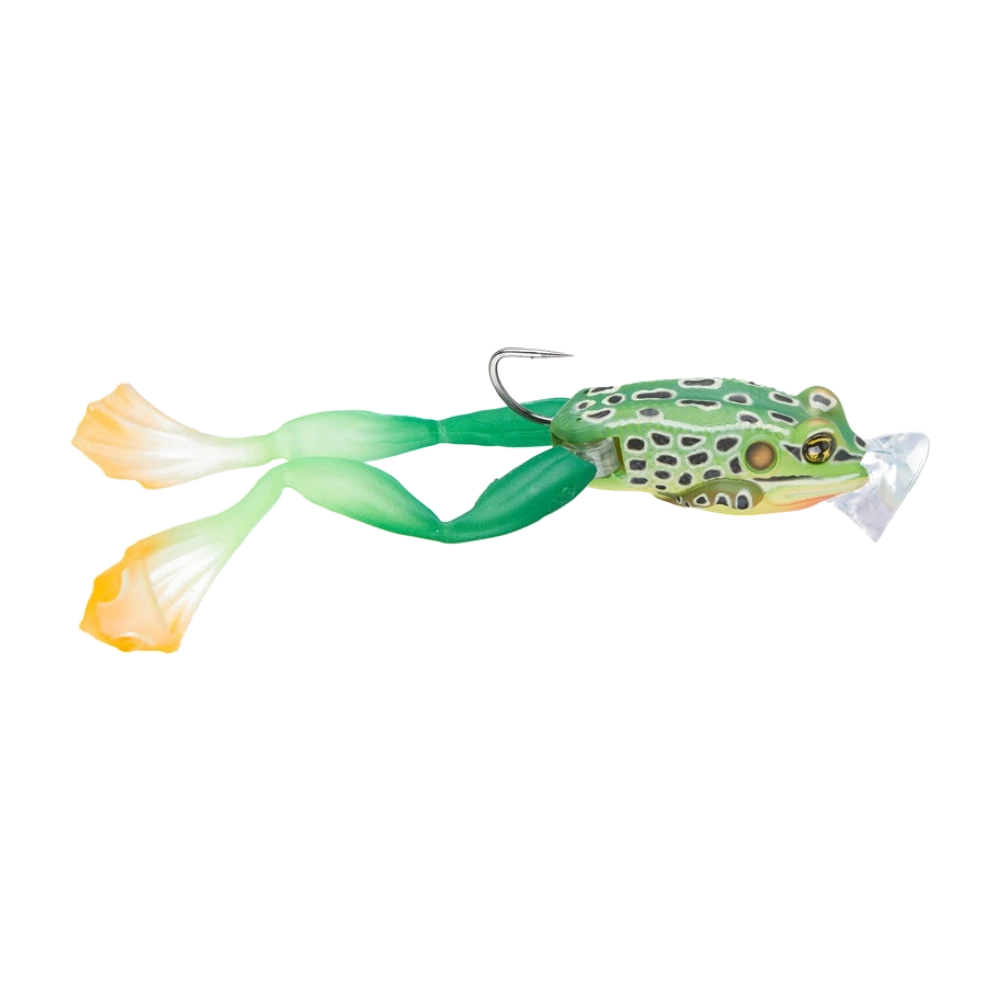
The cupped mouth. A scoop at the front of the body that creates a distinctive bubble pop on every small twitch of the rod tip. On the unit photographed, that mouth is moulded in translucent plastic, clearly visible in front of the green head.
The rattle. The body contains a heavy ball, described as dense, whose job is to call fish in from a distance. On a choppy water or in stained conditions, that signal is often what brings a bass over from the nearby weed long before it ever sees the bait.
The hinged legs. This is the model's defining feature: the rear legs are hinged at the hips and stretch out backwards as you pull the bait, exactly like a frog thrusting forward with a kick. They are TPE, a plastic described as tough enough to withstand numerous fish, and the maker includes two extra legs in every package.
The body is floating ABS, and the table confirms class Floating for both sizes. It is one of the rare baits in this range where buoyancy is established twice over, in the text and in the class column.
The table, and one figure that needs a warning
The full header reads Length Weight Class, in that order:
- Live Popper Frog 50: 2 in, which is 5.1 cm, for 3/4 oz, which is 21.3 g, class Floating.
- Live Popper Frog 60: 2.5 in, which is 6.4 cm, for 1 oz, which is 28.3 g, class Floating.
The codes 50 and 60 most likely refer to 50 and 60 millimetres; the table states 50.8 and 63.5 mm, and the table is what counts.
One point calls for caution. Twenty-one grams for a 5.1 cm floating body is a lot — well above what a hollow body of that length normally weighs. The likeliest explanation is that the Length column measures the body alone, while the legs add a good half of the overall length. But the maker says so nowhere: treat these weights as orders of magnitude, useful for picking a rod, not as figures accurate to the half gram.
Popping it without overdoing it
The commonest mistake with a popper is working it in bursts. With a frog it costs even more: a real frog kicks, stops, drifts, kicks again. A string of tight pops looks like nothing alive.
The rhythm that works: one pop, three to five seconds of complete pause, one pop, pause. During the pause the bait floats sideways, the legs spreading slowly behind it, and that is usually when the water opens up. On a fish that has followed without striking, put two very close pops together then stop dead: that change of rhythm triggers more than persistence does.
Fish it across the wind, never straight into it. The cupped mouth needs a reasonably flat surface to make its bubble; into a head-on chop the pop drowns and you lose exactly what you bought the bait for.
A single hook, and what that changes
Unlike hollow body frogs with their double hooks, this bait is built around a single 2x Mustad Ultra Point O'Shaughnessy hook with TitanX coating, reinforced inside the body. The maker highlights the coating's corrosion resistance, aimed at saltwater use.
For you, the practical consequence is this: the hookset no longer has to be delayed as on a hollow frog. The point is exposed, it bites immediately. In exchange the bait is no longer weedless: keep it for clean banks, thin pads and open water. In a dense mat, go back to a Hollow Body Frog.
Pike, named in black and white
The description explicitly names pike among the surface feeders it targets, which is rare enough to be worth pointing out on a bait of this type. The model 60 and its 28 g cast well and suit a pike over summer weed. Add a short wire leader: with an exposed single hook the fish is often pinned on the edge of the jaw, and the braid then runs right past the teeth.
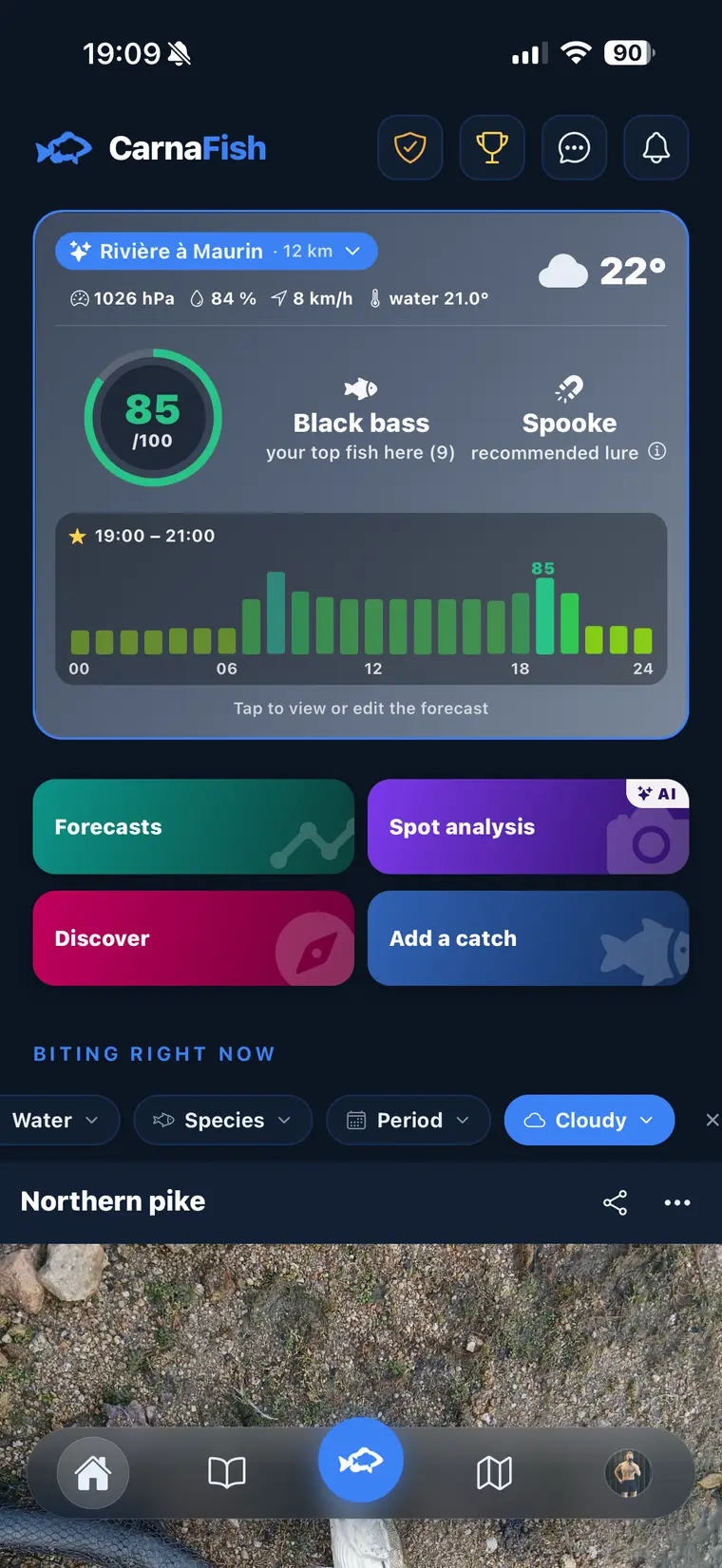
Not sure what to tie on?
Photograph your spot: CarnaFish reads the scene, cross-checks the conditions and gives you the zone, the lure and the retrieve. Free on iOS and Android.
Colour by water
- Clear water, clean bank: the black-spotted green of the unit photographed, a leopard frog livery a fish recognises instantly.
- Dark bottom, wooded bank: an olive brown, more discreet, which works better where the light is filtered by trees.
- Coloured water or very bright day: yellow or white, so the bait stays findable despite glare or turbidity.
What to compare it with
The Live Popper Frog does not play in the same category as a weedless hollow frog. Against a LiveTarget Hollow Body Frog it loses everything in dense cover but gains in sound range and hooking rate. Against a Booyah Poppin' Pad Crasher, which combines a hollow body with a cupped mouth, it leans more on leg realism than on versatility. And if you want a frog you rig yourself for cover, the same maker's ICT Freestyle Frog answers a different need.
Knowing whether fish are still under the mat or already out along the banks is the question that settles the bait choice. CarnaFish answers precisely that from a photo of the spot, suggesting the zone and the presentation of the moment. And if your water mixes bass and pike, our guide to choosing a pike lure usefully rounds out the reasoning.
Key takeaways
- Two sizes, 5.1 and 6.4 cm, both listed as floating, with an ABS body and a dense rattle.
- The published weights, 21.3 and 28.3 g, are high for those lengths: treat them as orders of magnitude.
- Legs hinged at the hips, in TPE, with two spare legs supplied in the package.
- Exposed single hook: an immediate hookset is possible, but the bait is no longer weedless.
FAQ
Does the Live Popper Frog float?
Yes, and it is confirmed twice: the body is described as floating ABS, and the table lists class Floating for both sizes. That is a solid figure, not an inference.
Can it be fished in weed?
Not in a dense mat. Its single hook is exposed and will foul vegetation. Keep it for clean banks, thin pads and open water, and switch to a hollow frog as soon as things close in.
Why do the published weights look high?
Twenty-one grams for 5.1 cm of floating body is a lot. The likeliest explanation is that the published length leaves out the legs, which make up a good share of the bait. The maker does not say so, so treat those weights as orders of magnitude.
Do I need to delay the hookset as on a hollow frog?
No. That is precisely the advantage of the exposed single hook: the point is free and bites as you set. You can react normally, provided you do not strike before the fish has genuinely taken the bait.
Do the legs break?
They are TPE, a material the maker describes as able to withstand numerous fish. Two spare legs come in every package, which suggests breakage does happen in use.
Is it a good pike bait?
The maker explicitly names pike among the predators it targets. The model 60, 6.4 cm and 28.3 g, casts well over summer weed. Plan on a short wire leader, as a single hook often pins on the edge of the jaw.
The full bass lure guideSeason-by-season strategy: which family of lure, when, and why.Go from theory to fish
CarnaFish reads your spot from a photo and gives you the game plan: zone, lure, retrieve. Free on iOS and Android.