LiveTarget ICT Freestyle Frog: the soft frog you rig yourself
One lure, endless conditions. CarnaFish reads your spot from a photo so you are not just guessing.
There are two ways to blow a frog session. The first is turning up with a hollow body frog over thin weed where fish have all the time in the world to inspect it. The second is turning up with a soft frog rigged too heavy on a mat where it digs in instead of gliding. The Freestyle Frog solves the problem in an unusual way: it comes unrigged, and the hook choice is yours.
A bait sold deliberately unrigged
That is the heart of the product, and the manufacturer owns it: the Freestyle Frog arrives without a hook, so anglers can customise the presentation for whatever situation they run into. The description specifies that it is designed for rigging on a traditional single or double frog hook, the two classic set-ups in this family.
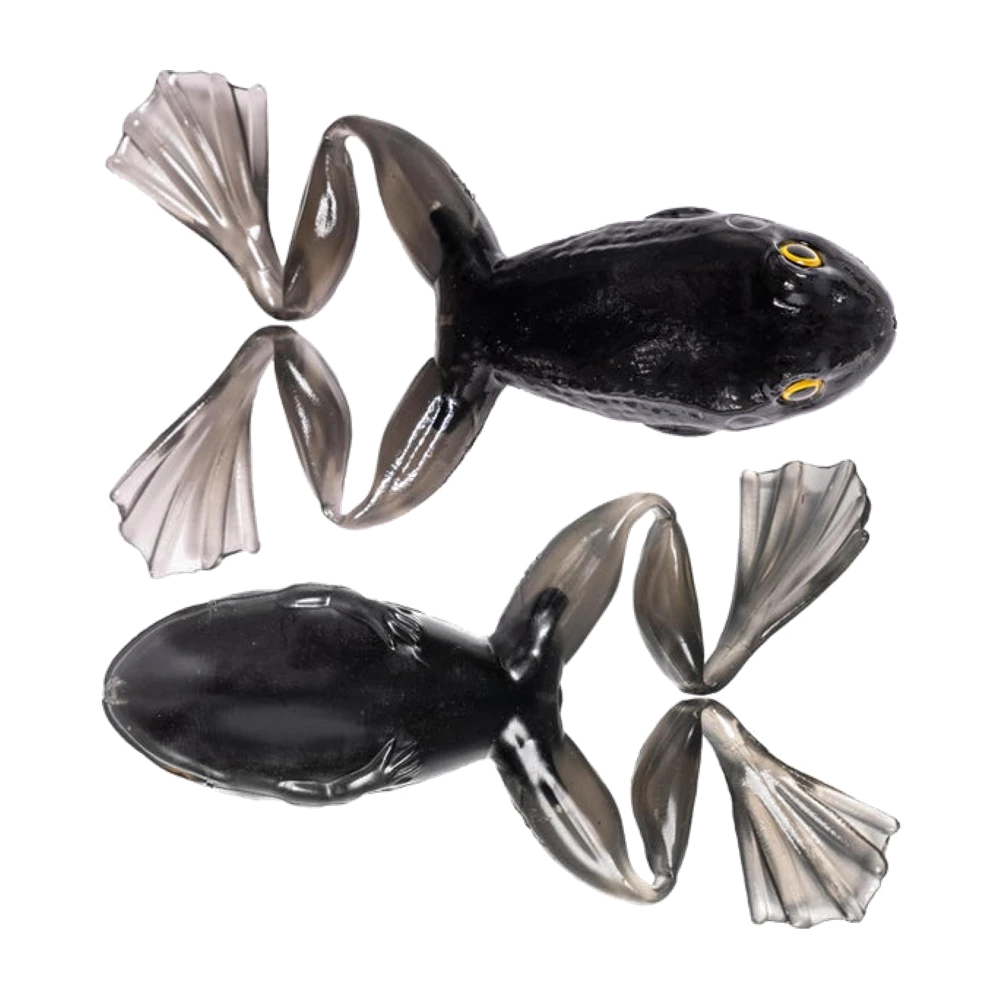
The other technical argument is Injected Core Technology, abbreviated ICT, which gives the model its name. In practice: a multi-injection moulding that layers several colours, with a translucent outer layer that refracts light naturally rather than bouncing it back in one block. The description also stresses realistic eyes, webbed frog feet and detailed texturing. On the units photographed, the black back is glossy and finely warted, the webbed rear feet are translucent smoke grey, and the eye is ringed in yellow around a black pupil.
Two things the maker does not give, and you should know before buying: no weight is published, and no buoyancy class is stated. The real density of your rig will therefore depend entirely on the hook you choose, which is precisely the spirit of the bait.
Three sizes, and one column that must be read properly
The table runs to two columns, headed Length and Quantity:
- 2 in, which is 5.1 cm, sold in packs of 4.
- 2.5 in, which is 6.4 cm, sold in packs of 3.
- 3 in, which is 7.6 cm, sold in packs of 2.
That second figure is a number of pieces per pack, not a hook size nor any sort of weight index. The bigger the frog, the fewer in the bag — logical, and it changes the per-unit price: a 3 in costs twice as much to fish as a 2 in.
The 2 in is a finesse format for a thin-wire 2/0, for days when bass refuse bulk. The 2.5 in is the reference size, the one that works most often on average fish. The 3 in casts better, opens a silhouette visible from a distance and becomes the default as soon as you expect a pike in the weed — the maker only talks about bass, but a 7.6 cm weedless soft frog is a presentation pike take very well in summer.
Two rigs, two kinds of fishing
Single Texas-style hook
A wide-gap screw-lock hook, 3/0 to 5/0 depending on size, nose-entered and brought out through the back with the point tucked into the body. It is the most weedless option and the one that casts best. The frog glides flat over the mat, and once it reaches a hole it sinks slowly with its feet spread, which often triggers more than the glide itself.
Double frog hook
The double, rigged as on a hollow body frog, hooks far better but fouls more. Keep it for moderate weed and edges. Its other advantage is allowing an immediate hookset, whereas the Texas rig calls for letting the fish run a second before sweeping.
Pick the hook first, the colour second. On this bait, switching from a Texas rig to a double changes the number of fish in the net more than any colour change, and yet everybody does it the other way round at the water's edge.
The classic mistake
Rigging too heavy a hook. A 6.4 cm soft frog on a big weighted hook no longer glides over vegetation, it sinks into it, and you spend the session cleaning the bait. Since the maker publishes neither weight nor buoyancy, the balance is yours to set: start with the thinnest unweighted hook your rod power allows, and add weight only if you cannot reach far enough.
Where it beats a hollow body frog
The description targets two opposite uses: heavy cover and clear water. The second deserves explaining. In transparent water a hollow body frog shows a smooth underside and a uniform shell, which a bass with two seconds to decide eventually works out. The Freestyle Frog plays on layered colour and on the translucency of the feet: seen from below against the light, it lets light through like something alive. That is exactly where the price of the pack is justified.
It also has a weakness worth stating: being soft throughout, it wears out far faster than a hollow shell. Count on two or three fish per bait in heavy cover, sometimes fewer when teeth are involved. The packs of two to four pieces then make complete sense.
Not sure what to tie on?
Photograph your spot: CarnaFish reads the scene, cross-checks the conditions and gives you the zone, the lure and the retrieve. Free on iOS and Android.
Colour by light
- Stained water or low cloud: the black with smoky feet of the units photographed. Seen from below, it is the silhouette that cuts out most cleanly.
- Clear water: a translucent green, the one that genuinely exploits the outer layer the maker describes and the light refraction it produces.
- Poor visibility, coloured water: white or chartreuse, for when the fish needs to find the bait rather than inspect it.
What sits beside it in the box
The Freestyle Frog does not replace a LiveTarget Hollow Body Frog, which stays tougher and easier to walk in place. It sits closer to a Zoom Horny Toad, except that the toad works by churning the surface at a constant speed while the soft frog leans on the pause and the feet-spread fall. If you want a more demonstrative soft topwater, a Gambler Walking Frog fills the middle ground.
Deciding between a soft frog and a hollow shell comes down to reading the cover and the water clarity. That is exactly the exercise CarnaFish performs from a photo of the spot, suggesting the zone and the kind of presentation that fits the moment. For the rest, our beginner's guide to bass fishing covers tackle and spot reading.
Key takeaways
- Supplied unrigged: the hook is part of the fishing decision, not of the product you buy.
- Three sizes, 5.1, 6.4 and 7.6 cm, sold respectively 4, 3 and 2 per pack.
- Neither weight nor buoyancy class is published: the final balance depends on the hook you fit.
- Short life compared with a hollow frog, offset by more convincing behaviour in clear water.
FAQ
Why is the Freestyle Frog sold without a hook?
It is a deliberate choice by the manufacturer: it leaves the angler to match the rig to the situation, on a single or a double frog hook. It also explains the modest pack price.
How many frogs are in a pack?
Four in 2 in, three in 2.5 in and two in 3 in. The second figure in the maker's table is a piece count, not a hook size.
What hook size should I fit?
A wide gap 3/0 in 2 in, 4/0 in 2.5 in and 4/0 to 5/0 in 3 in, Texas style. Always start with the thinnest wire your rod can drive home, and go heavier only if casting distance suffers.
Does the Freestyle Frog float?
The maker states no buoyancy class and publishes no weight. Final behaviour therefore depends on your rig: light and unweighted, the whole thing stays on top; as soon as the hook gets heavier, the frog sinks slowly into the holes.
Is it any good for pike?
In 3 in, yes, over summer weed and with a short wire leader. The maker only talks about bass, but the profile and the weedless rig suit a pike sitting under vegetation well.
Does it last?
No, and that is its main drawback against a hollow shell. Count on two or three fish per bait in dense cover. The multi-piece packs compensate, but plan on several for a serious day.
The full bass lure guideSeason-by-season strategy: which family of lure, when, and why.Go from theory to fish
CarnaFish reads your spot from a photo and gives you the game plan: zone, lure, retrieve. Free on iOS and Android.