LiveTarget Sunfish Swimbait: the slow-sinking soft sunfish
Before tying this one on, it helps to know if the spot actually calls for it. CarnaFish reads the scene from a photo.
There's a moment in late summer when bass stop coming to the surface and glue themselves to the edge of submerged weed, two to three metres down. They're not hunting any more, they're patrolling, and they refuse anything moving too fast. That's the classic window for a slow-sinking swimbait: a lure that drops in no hurry, swims the moment you pull it and starts dropping again the moment you stop. The LiveTarget Sunfish Swimbait ticks those boxes with a sunfish outline, which happens to be the forage that lives in exactly that scenery.
An oscillator in the tail, not just a paddle
Most soft swimbaits get their swim from the shape of the tail: a paddle of some width that kicks because the water pushes it. LiveTarget describes something else on this series — an oscillator built into the base of the tail, a part whose job is to generate a side-to-side tail swing, and whose geometry is said to be specific to each forage copied. In plain terms, the swim isn't only endured by the tail, it's driven from the joint.
What that changes in practice is the trigger threshold. A paddle needs a minimum speed before it starts working; below that it just drags along limply. A driven assembly starts lower, so you can crawl the lure and still keep the tail moving. On a bass that's patrolling rather than hunting, that's precisely what's needed: a lure that's alive at a speed where most others are dead.
Three sizes, and numbers worth reading carefully
The maker lists three versions, all three rated medium-slow sink:
- 8.9 cm / 3.5 in for 14.2 g / 1/2 oz: the do-everything size, castable on standard baitcasting gear, and it catches average fish as readily as big ones.
- 11 cm / 4.33 in for 24.8 g / 7/8 oz: the middle size, where it starts to sort.
- 12.7 cm / 5 in for 37.8 g / 1-1/3 oz: a genuine heavy swimbait, for tackle built to handle it.
A word on those figures: the thirds-of-an-inch and thirds-of-an-ounce values — 4-1/3 in, 1-1/3 oz — aren't fractions the American tackle industry normally uses. Everything points to a range designed in metric (around 110 mm and 38 g) and converted to imperial at catalogue time. The gram figures here are reliable orders of magnitude, but don't build a gram-accurate calculation on them.
The hook, and what you can add to it
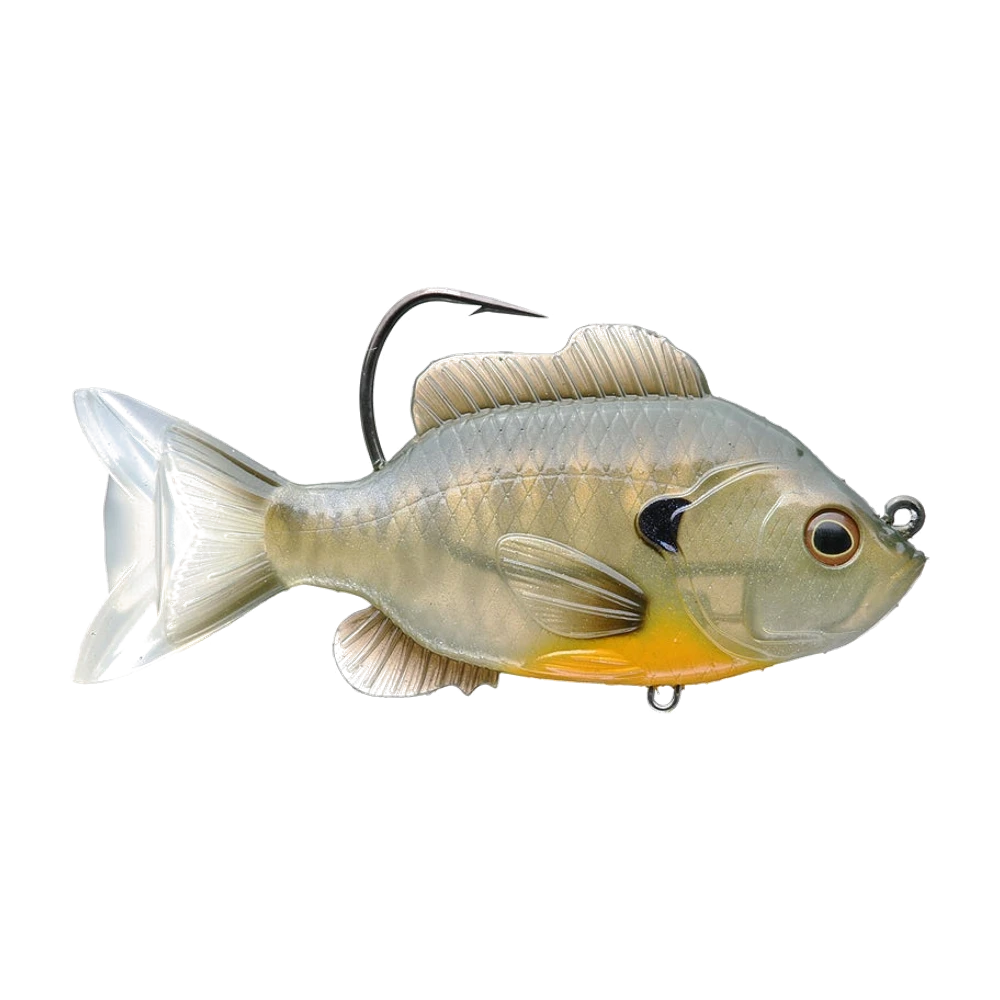
The hook is a heavy-wire, extra wide gap model, and its position is the real design decision: it sits behind the dorsal fin with the point riding out of the back. In the photo, the shank emerges just behind the dorsal and the bend closes forward, the point staying clear above the fin. The maker explains that the dorsal fin acts as a weedguard, and that's exactly what you see: the point sits sheltered behind a ridge of soft plastic rather than buried in it.
The belly pin, where the real flexibility lives
Along the belly, the lure carries an accessory pin. The maker gives it two explicit uses. The first: hanging an additional hook for short-striking fish, the ones that hit the tail and never reach the dorsal hook. If you're stacking up strikes without connecting, that's the first thing to try before changing lure.
The second use is more interesting still: fitting a spinner blade, to add flash and vibration. You turn a discreet swimbait into a lure that signals at range, without altering its base swim at all. In stained water or on a windy day, that's a modification costing a couple of euros that changes how far the lure reaches.
Only fit the blade after fishing the bait bare for half an hour. The opposite reflex — adding everything on the first cast — stops you knowing what actually triggered the bite, and on educated fish the extra flash sometimes does the exact opposite of what you're hoping for.
How to work it, and where
A slow straight retrieve is the baseline and often enough: cast, let it sink on a count, then retrieve at the slowest speed that keeps the tail working. Count on every cast and note the count that produced the bite — with a steady sink rate, the count becomes a depth measurement.
The second retrieve comes straight out of the stated density: because the lure sinks moderately, you can reel three turns, stop for two seconds, go again. During the stop it drops level with the tail still moving, and that's where most bites land. Worked along a break or a weed edge, that saw-tooth covers a far wider slice of water than a flat retrieve.
For spots, look for what a sunfish looks for: the weed edge, the base of a drowned tree, a dock, a rock pile. Sunfish don't live in open water, they live against something, and a sunfish imitation swimming ten metres from any structure is telling a story the bass doesn't believe.
The classic mistake
Retrieving too fast because you can't feel anything in the rod. A soft swimbait of this type doesn't transmit the sharp buzz of a crankbait: you get a dull thump, sometimes barely readable through fluorocarbon. The reflex is to speed up until you feel something, and at that speed the lure is already too fast for a passive fish. Trust the count and the rod tip, not the feel in the handle.
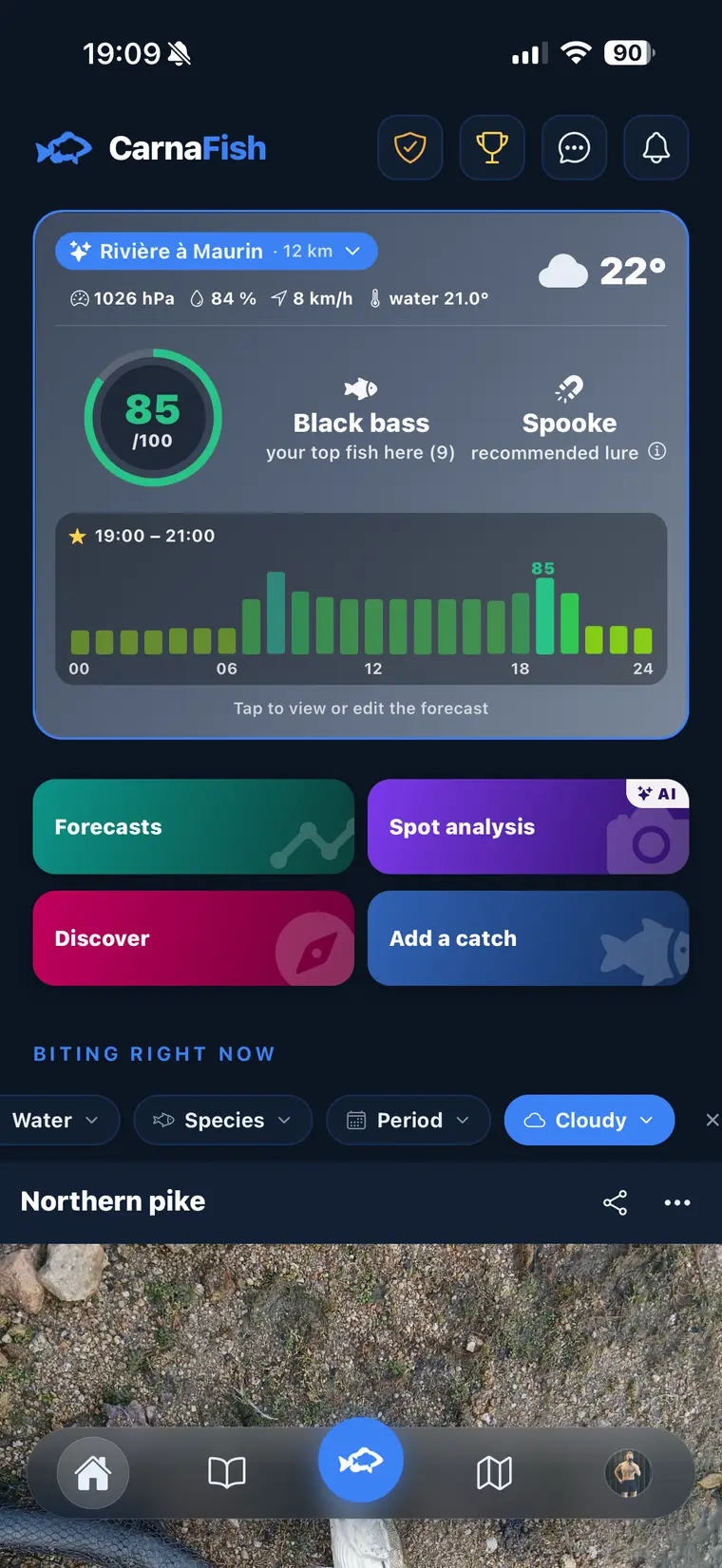
Not sure what to tie on?
Photograph your spot: CarnaFish reads the scene, cross-checks the conditions and gives you the zone, the lure and the retrieve. Free on iOS and Android.
Colours by water clarity
LiveTarget advertises a range of highly accurate colour schemes without listing them in this description. So reason in families of finish:
- Clear water: the natural sunfish finish, the one in the photo — pearl grey flanks with gold highlights, bright orange belly, black spot behind the gill plate. It's the literal copy, and in clear water that's what works best.
- Stained water: versions with a wider orange belly. Orange is the one warm colour that stays readable once visibility drops below a metre, and it's also the signal a spawning sunfish sends naturally.
- Low light or deep water: a dark, high-contrast back. Seen from below it's the contrast, not the hue, that makes the silhouette readable.
Where it sits among other sunfish imitations
Against a jointed Bucca Baby Bull Gill 3.75 or an Imakatsu Gill Soft 130, the Sunfish Swimbait sits in the middle ground: less sophisticated than a multi-section glide, far more detailed than a generic shad, and above all simpler to fish than either. If you want the same silhouette on top, the LiveTarget Sunfish Hollow Body covers the same imitation above the mat.
Knowing which depth to target and which structure to attack matters as much as the lure choice, and that's what CarnaFish is for: one photo of the spot, and the AI suggests the zone, the depth and the lure type that match the day's conditions. For tackle basics and reading water, our guide to getting started with bass fishing covers the rest.
Key takeaways
- An oscillator at the tail base rather than a plain paddle: the tail works at speeds where a standard shad body goes dead.
- Three sizes, 8.9 cm / 14.2 g, 11 cm / 24.8 g and 12.7 cm / 37.8 g, all rated medium-slow sink.
- The wide gap hook rides out of the back behind the dorsal, which acts as a weedguard: fine in light cover, but not a true Texas rig.
- The belly pin takes a trailer hook against short strikers, or a blade for flash and vibration.
FAQ
Which size should I start with?
The 8.9 cm / 14.2 g. It casts on an ordinary baitcasting outfit, covers most situations and doesn't force you to rethink your tackle. The two larger sizes sort for better fish but demand a much heavier rod.
Do all three sizes sink at the same rate?
Yes, the maker rates all of them medium-slow sink. Changing size changes the silhouette and the casting distance, not the drop rate, which makes moving between formats straightforward.
Why are the dimensions given in thirds of an inch?
Because the range was almost certainly drawn in millimetres, around 110 mm and 38 g, then converted to inches and ounces for the American catalogue. The metric values are reliable orders of magnitude rather than unit-accurate weights.
Does it really come through weed?
In light to moderate cover, yes: the dorsal fin shields the point and the bait slips through brush and scattered weed. In a dense mat, a full Texas rig or a hollow body remains the better tool.
What's the ring under the belly for?
The maker gives it two roles: taking an additional hook when fish hit the tail without getting pinned, or a spinner blade to add flash and vibration. Both fit and come off in seconds.
Do I need a wire leader?
Only if pike use the spot. On pure bass water a heavy fluorocarbon leader stays more discreet and is plenty, especially as discretion is this lure's main argument.
The full bass lure guideSeason-by-season strategy: which family of lure, when, and why.Go from theory to fish
CarnaFish reads your spot from a photo and gives you the game plan: zone, lure, retrieve. Free on iOS and Android.