Lucky Craft Bevy Shad: a deep profile where everyone else fishes a torpedo
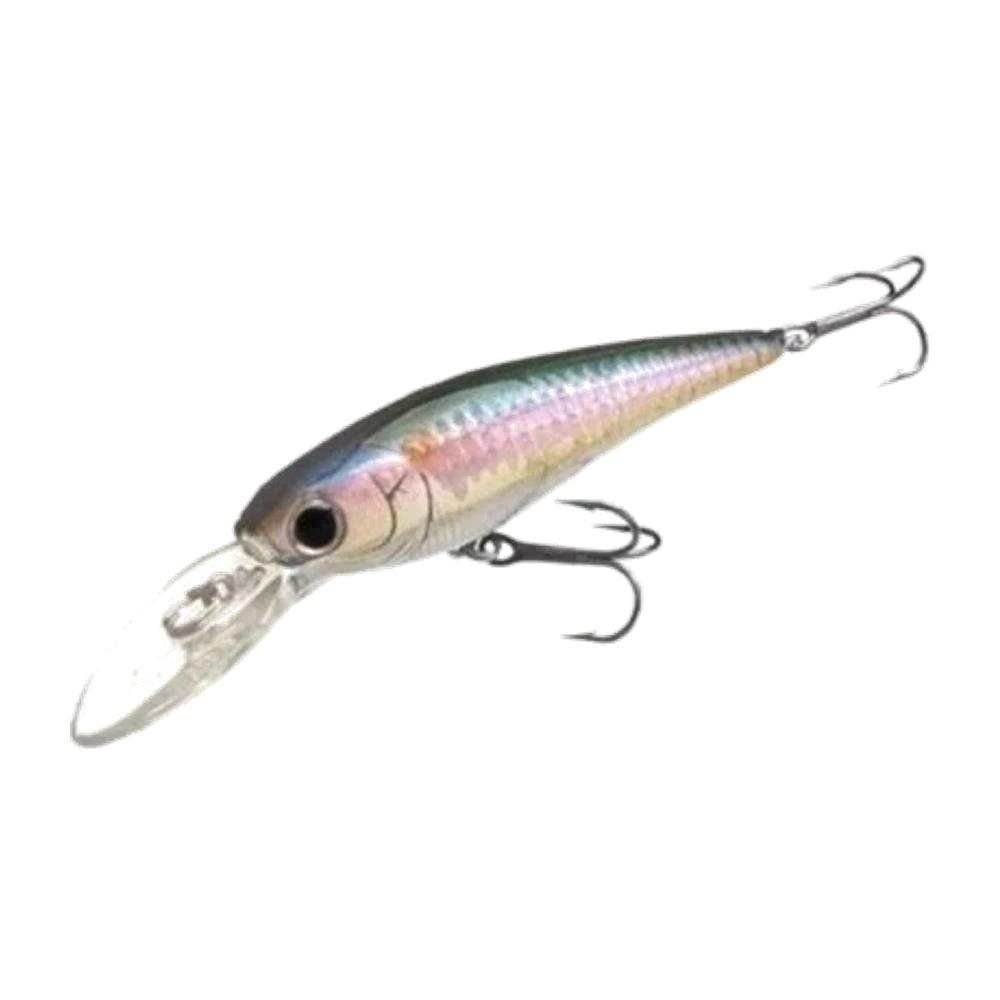
This lure shines under specific conditions. CarnaFish tells you in 10 seconds if today is one of them.
Over a shoal of young roach, it happens regularly that a slim, elongated minnow catches nothing. Perch are hunting in front of you, you cast right through them, they ignore the lure. The problem is not colour or length in centimetres: it is the silhouette seen head-on and side-on. A long, narrow torpedo looks nothing like a young roach, which is a short, deep, flat-sided fish.
The Bevy Shad fixes that mismatch. Over a modest length, it offers a distinctly deeper and flatter body than the average minnow. The consequence is twofold: the silhouette finally matches the dominant prey in cyprinid waters, and the wider flank throws back far more reflective surface than a torpedo of the same length.
It is a lure built on apparent volume, not on length.
What a deep, flat body changes
Three concrete effects, obvious the moment it hits the water.
A more pronounced roll. A deep section pivots further around its long axis on every snap. The lure shows its flank clearly instead of vibrating tight and staying upright. On perch hunting by sight, that wide flash is the main trigger.
More resistance in the water. The body brakes harder, so it travels less per snap. You can string six or eight twitches together without the lure covering three metres. That is precious for working a tight spot: under a jetty, against a fallen tree, at the edge of a weed bed.
A credible silhouette against the light. Seen from below, which is a predator's natural holding position, a deep body cuts out an identifiable shape instead of a line.
The trade-off is casting distance: a bulky, light body catches the air. Internal weight transfer systems compensate in part, but do not expect to cast as far as with a weighted torpedo of the same weight.
The retrieve: the tight twitch
The Bevy Shad is not fished like a jerkbait with long pauses. The rhythm is livelier and tighter.
- Cast and wind two or three turns to bring the lure between 80 cm and 1.5 m.
- String three to five short twitches together, rod tip down, only 15 to 20 cm of amplitude. The wrist is enough.
- Pause of one to two seconds. The lure stays roughly in its layer and finishes its roll.
- Start another series immediately, without adding a turn of the handle if you want to stay in place.
- Finish the pass with a slow straight retrieve over the last two metres: plenty of perch follow without committing and attack on the change of pace.
Two useful variants. On bass in the margins, slow down: two twitches, a three-second pause, and let the lure breathe near cover. On hunting perch, do the opposite — cut the pauses almost entirely and run a continuous series of small snaps, which mimics an isolated fry in a panic.
On the water: when perch are busting the surface and refusing the lure, do not speed up and do not change colour — move over. Let the lure pass through the melee then stop it a metre or two beyond, outside the shoal. The fish that take are almost never the ones in the middle of it, but the ones patrolling the edges picking up the injured.
Choosing the size and the line
| Size | Weight | Main target |
|---|---|---|
| ~5 cm | around 3.5 g | wary perch, very clear water, canals |
| ~6 cm | around 5 g | the pivot size, perch and small bass |
| ~7.5 cm | around 9 g | bass, wind, big waters |
Line matches the size. 0.18 mm fluorocarbon on the smallest: any heavier and you restrict the roll. 0.20 to 0.22 mm on the middle size. 0.25 mm on the big one, especially if you are fishing near cover.
Two details that matter. The Bevy Shad is tied straight to the line in the small sizes; a snap, even a light one, weights the front of a 3.5 g lure and flattens its roll. And if you replace the trebles, stay with fine-wire models: heavier hooks sink the lure on the pause and kill the near-suspension that gives the fish time to come.
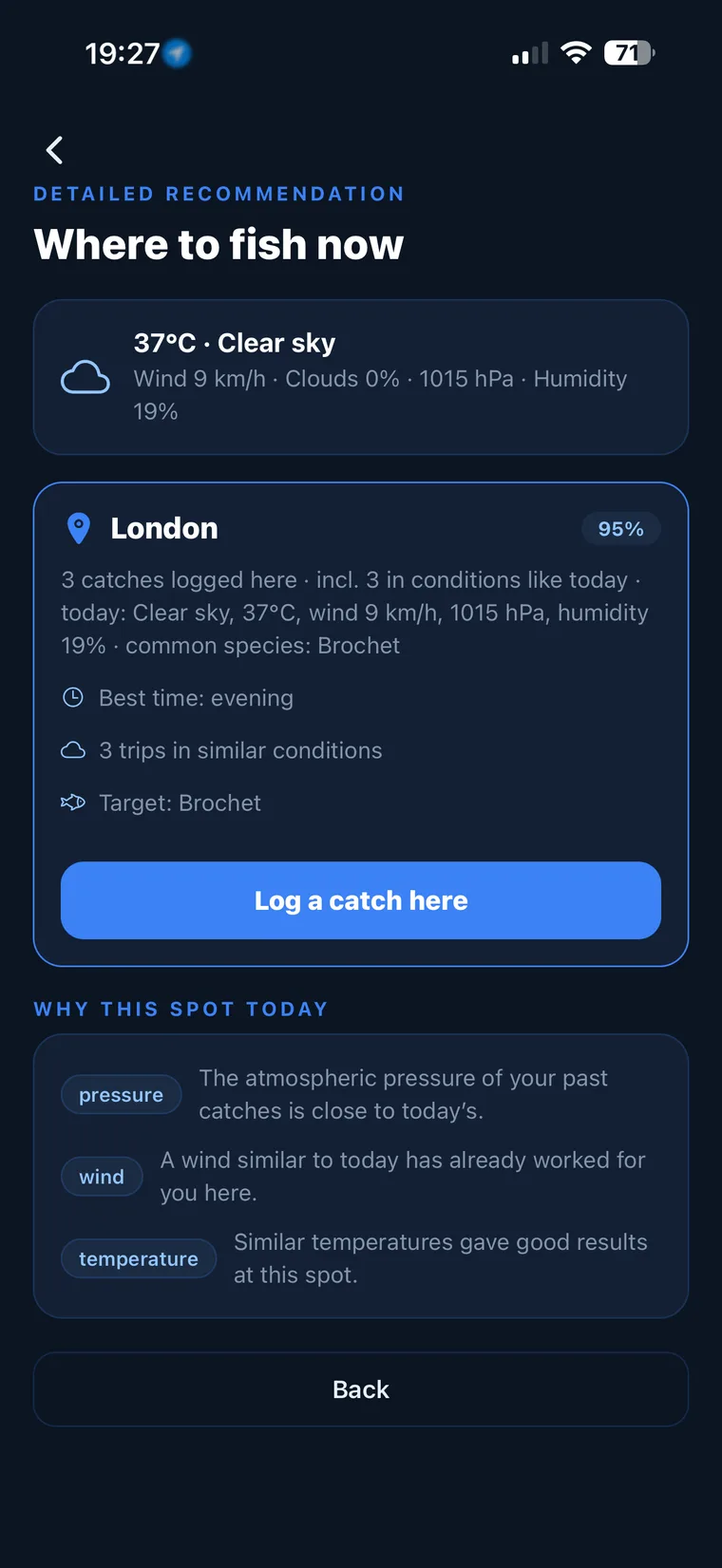
Not sure what to tie on?
Photograph your spot: CarnaFish reads the scene, cross-checks the conditions and gives you the zone, the lure and the retrieve. Free on iOS and Android.
Where it excels, where it suffers
Its window is both precise and broad.
- Roach and bleak waters: canals, gravel pits, small slow rivers, anywhere the dominant prey is short and deep.
- Tight spots you want to work at length without the lure escaping.
- Hunting perch in late summer and autumn, over shoals of fry.
- Bass margins in spring, on a slow retrieve close to structure.
At the other end, it is penalised by wind and distance: its bulk brakes the cast, and over a big windy expanse you lose too much range. It is also poorly suited to deep water — a short lip does not dive, and to reach a fish at three metres you need another lure. Finally, in very murky water, its tight action produces less signal than a lipless or a spinnerbait.
Bevy Shad, Pointer 78 or Rigge 56
The Lucky Craft Pointer 78 shares the badge but not the logic: it is a torpedo, built to move sideways and hold long pauses. It covers more water and suits cold water better. The Bevy Shad stays put, shows a wide flank and plays the young roach card.
The ZipBaits Rigge 56 is the opposite profile: very slim, very discreet, deadly on educated perch in clear calm water. Between the two, the choice comes down to the prey present and water clarity — a deep silhouette when there are young roach about, a slim one when the fish refuse everything.
The Illex Squad Shad 65 fills a nearby slot with a compact, deep body of its own; the difference is in the retrieve rhythm, which is crisper on the Bevy Shad.
Our guide to lure fishing for perch places the compact minnow against soft plastics and spoons. And if you are torn between a slim and a deep profile when you reach the bank, CarnaFish analyses a photo of the spot and answers.
Key takeaways
- Short, deep body: a young roach silhouette, a wide flank, a very pronounced roll.
- It travels little per snap, so it lets you work a tight spot for a long time.
- Short 15 to 20 cm twitches in series of three to five, with brief pauses.
- Fluorocarbon 0.18 to 0.25 mm depending on size, tied straight on the small models.
- Penalised by wind, distance and depths beyond a metre and a half.
FAQ
What size Bevy Shad should I choose for perch?
The size around 6 cm covers the most situations. Drop to 5 cm in very clear water or on fish that have already refused several lures, and keep the 7.5 cm version for bass and windy conditions.
How deep does it swim?
Between about 80 cm and 1.50 m depending on size and line diameter. It is not a deep lure: beyond two metres you need a long-lipped model or a weighted soft plastic.
Should I use a snap?
Not on the small sizes. A few tenths of a gram at the nose of a 3.5 g lure is enough to flatten the roll that makes it worth fishing. On the 7.5 cm version, a fine snap is acceptable.
What retrieve rhythm should I use?
Series of three to five short twitches, 15 to 20 cm of wrist amplitude, separated by one to two seconds of pause. On actively hunting perch, cut the pauses almost entirely and keep the snaps coming.
Why a deep profile rather than a slim minnow?
Because it matches the real shape of young roach and bleak, and because a wide flank throws back far more light on every roll. In cyprinid waters, that mimicry often makes the difference on fish that refuse a torpedo.
Does it work in murky water?
Only moderately. It relies on flash and silhouette, two assets that fade as visibility drops. In coloured water, a lure with strong vibration covers the ground better.
The full perch lure guideSeason-by-season strategy: which family of lure, when, and why.Go from theory to fish
CarnaFish reads your spot from a photo and gives you the game plan: zone, lure, retrieve. Free on iOS and Android.