Strike King Rocket Shad: the compact spinnerbait built to burn
The right lure in the wrong spot still catches nothing. CarnaFish spots the zone that works, from a single photo.
There are two ways to fish a spinnerbait, and they have almost nothing in common. The first is to let it sink and crawl it back just off the bottom, blade thumping. The second is to cast it upstream of a current seam and reel fast, very fast, so the fish decides without thinking. The Strike King Rocket Shad is built for the second, and its name leaves little doubt about the intent. What matters is what that changes on the water.
A spinnerbait, not a swimbait
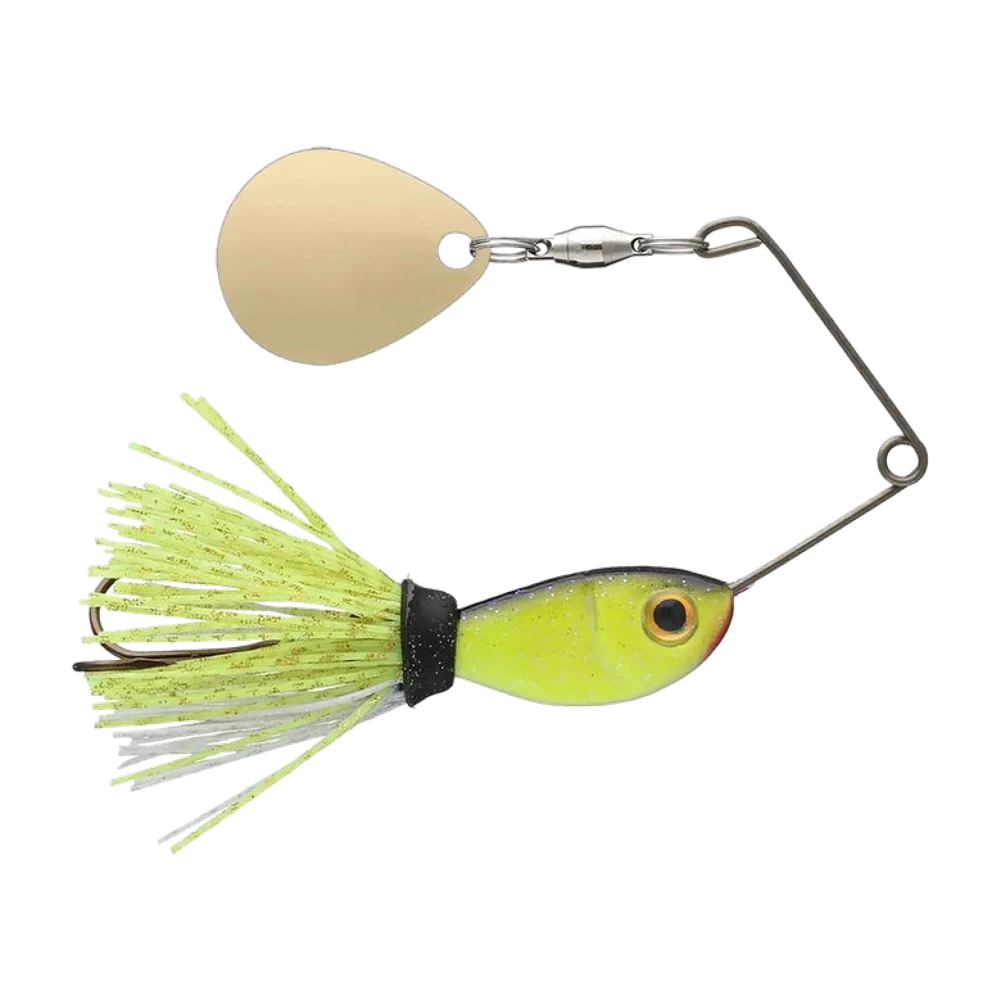
First clarification, because the shelf category invites confusion: despite its name, the Rocket Shad is not a soft plastic or a swimbait. It is a conventional spinnerbait in construction — a safety-pin wire, a painted lead head on the lower arm, a silicone skirt, a single hook moulded into the head, and a blade on the upper arm. In the product photo the lure carries one blade only, Colorado-shaped, gold, linked to the arm by two split rings and a barrel ball-bearing swivel. One bronze single hook, point up, with no trailer hook fitted — an observation from a product photo, not a specification.
The head is painted as a small fish, with a pronounced eye and a dark back, where a classic spinnerbait makes do with a cone or bullet head. Strike King credits that head shape with keeping the lure balanced when it is burned back. That is the manufacturer's argument, and it is plausible enough: a streamlined head offers less lateral surface than a round one.
The speed question, and a tension worth keeping in mind
The description makes one point insistently: the lure is claimed to track true at all speeds, including full throttle, and to be especially suited to fast-moving current.
A tension the description does not resolve is worth flagging all the same. A Colorado blade is the roundest and widest blade shape: it turns slowly, sweeps a wide circle around the wire and generates a lot of lift and vibration. It is traditionally the slow-roll, dirty-water blade, not the one you pick to burn a lure. A willow blade, narrow and elongated, offers far less water resistance and handles very fast retrieves much better. The manufacturer nevertheless states that this build holds speed. I am not calling it either way: it is a promise to verify on your own water, and the first cast will tell you plenty — if the lure blows out or spins at a certain speed, you will know where you stand.
What the combination does deliver for certain is lift. A Colorado pulls the lure upward. At high speed the Rocket Shad therefore stays high in the water column, which is exactly what you want along a current edge, at the tail of a rapid or below a dam outflow.
What the manufacturer does not publish
It has to be said plainly: no length and no weight are published, and there is no size chart anywhere in the description. For a spinnerbait that is awkward, because head weight is the figure that drives everything else: casting distance, running depth at a given speed, the rod that suits it. The description only states a smaller than average profile, described as bite-sized.
So do not buy this lure assuming a weight. Check the packaging or the retailer's listing when you order, and if the information is missing there too, weigh it when it arrives. I would rather leave you with that caution than quote a number that is written nowhere.
Not sure what to tie on?
Photograph your spot: CarnaFish reads the scene, cross-checks the conditions and gives you the zone, the lure and the retrieve. Free on iOS and Android.
How to fish it
In current
This is the use the manufacturer highlights. Cast across or slightly upstream, let the current load the lure and reel just fast enough to feel the blade turning constantly. The vibration should be continuous in your wrist: the moment it stops, the blade has stalled and the lure is no longer fishing. The water worth covering is the seams, the downstream side of bridge pilings, the eddies behind any obstruction.
In still water, along an edge
On a lake or a pond the Rocket Shad gets pulled along a hard edge — riprap, a quay wall, a line of docks — at a brisk pace, rod high to stay in the top metre. Its edge over a double-willow spinnerbait such as the Booyah Blade Double Willow is the low-frequency signal of the Colorado, which fish pick up from further away in poor clarity.
The contact that triggers
Like any spinnerbait, it is at its most dangerous the moment it hits something. Run it deliberately into a stump, a submerged branch, a rock: the abrupt deflection after the collision accounts for a good share of the bites. It is the same logic as a squarebill crankbait, except that the safety-pin wire shields the hook and lets you keep working the wood.
If you miss several bites in a row, add a trailer hook to the main hook before changing lure. On a spinnerbait retrieved fast, fish often strike short, behind the skirt, and it is the trailer hook that catches them. It costs a few more snags in the wood, but it converts.
The classic mistake
Reeling too slowly out of caution. Many anglers apply to the Rocket Shad the slow retrieve taught for the classic spring spinnerbait, and end up with a lure that drags along the bottom without ever doing what it was built for. If you want to fish a Colorado slowly, pick a heavy model designed for slow rolling. This one wants tempo.
Second mistake: tying straight onto the bend of the upper arm and cinching it down hard. The line has to be able to slide a little inside the loop so the lure's attitude can adjust as it swims. A round snap does the job perfectly.
Colours by water clarity
- Stained water: chartreuse and white, the colour shown in this page's photo, with gold-flaked chartreuse strands mixed with white ones. It is the compromise that works most often once visibility drops below a metre.
- Clear water: a plain silver white, which lets the gold blade do the signalling without overloading the silhouette.
- Very dark water or low light: all black. In very poor clarity it is the contrast of the silhouette against the sky light that counts, not the colour.
The right lure never replaces reading the spot, especially in current where a few metres change everything. That is precisely what CarnaFish offers: a photo of the spot, and the AI suggests a zone, a depth and a presentation consistent with the conditions of the day. To widen out to the other lure families that work the same water, our guide to lure fishing for perch gives a good overview.
Key takeaways
- It is a single Colorado blade spinnerbait on a ball-bearing swivel, not a swimbait despite the name.
- The manufacturer aims it at fast retrieves and strong current, and claims a true track at full throttle.
- A Colorado is traditionally a slow-fishing blade: that speed claim deserves checking on the water.
- Neither length nor weight is published: check the packaging before buying, and do not infer weight from price.
FAQ
How much does the Rocket Shad weigh?
Strike King publishes neither weight nor length for this model, and the description contains no size chart. It only states a compact, smaller than average profile. Check the packaging or the retailer listing, and weigh the lure if the information is still missing.
Is it a soft plastic or a spinnerbait?
It is a spinnerbait: safety-pin wire, painted lead head, silicone skirt, single hook and a blade on the upper arm. The word shad in the name describes the head shape, not a soft-plastic category.
Why a Colorado blade for a fast retrieve?
That is exactly the point that raises an eyebrow. The Colorado is the widest, most water-resistant blade, traditionally paired with slow retrieves in dirty water. The manufacturer states the lure keeps a true track even at full speed; it is on you to check that on the first cast on your own water.
Should you add a trailer hook?
None is fitted in the product photo. On a fast retrieve fish often strike short, behind the skirt, and a trailer hook converts noticeably better. The downside is more snags when you keep working the wood.
Does it suit perch?
Yes, provided the actual weight matches your fishing. A compact Colorado spinnerbait is a good search lure for perch hunting along a hard edge, and the slow thump carries a long way in stained water.
How does it differ from a bladed jig like the Thunder Cricket?
The Strike King Thunder Cricket transmits its vibration through a flat blade fixed at the nose, which makes the whole body swing side to side. Here a blade mounted on an independent arm rotates, and the body stays far more stable. Two different signals, two different responses depending on the day. For an even faster retrieve with no blade at all, a lipless such as the Strike King Red Eyed Shad covers a different register.
The full bass lure guideSeason-by-season strategy: which family of lure, when, and why.Go from theory to fish
CarnaFish reads your spot from a photo and gives you the game plan: zone, lure, retrieve. Free on iOS and Android.