Lucky Craft LV 500: the dense lipless that reaches 4.6 m
The right lure in the wrong spot still catches nothing. CarnaFish spots the zone that works, from a single photo.
A lipless crankbait is judged first on its density. Two models of the same length can behave in completely different ways depending on whether they weigh 11 or 21 g, because density decides the sink rate, the depth reached and the casting distance. The Lucky Craft LV 500 is 7.6 cm for 21.3 g, and that's the figure to hold on to before any other: nearly three grams per centimetre of lure. This is a deep-water, fast-searching tool, not a bank-edge lipless.
What that density actually does
The maker's spec table is short but unambiguous: one size, 3 in and 3/4 oz, that is 7.6 cm for 21.3 g, rated sinking. The body text repeats the same figures, which isn't always the case.
Three practical consequences follow. The first is casting distance: 21 g in a short, compact body goes a long way and cuts through wind, and the maker stresses a forward weighting that stabilises the lure in flight instead of letting it helicopter. A lipless that spins in the air loses half its theoretical distance; this one is drawn not to.
The second consequence is sink rate. A lure this dense drops fast, which is an advantage when you want to reach 4 m in a few seconds, and a drawback when you're fishing cluttered bottom where every pause costs you a snag. Count your drop on every cast and note the number: that's the only way to fish a lure sinking at this rate cleanly.
The third is the stated working depth: the maker says the lure is equipped to handle depths down to 15 ft, about 4.6 m. That's a working range on the retrieve, not a fixed running depth. Unlike a billed crankbait that dives to a depth dictated by its geometry, a lipless reaches whatever depth you allow it before you start reeling.
Brass and glass: why the mix
The maker advertises brass and glass rattles, and describes the result as a loud, unique sound. That isn't just a phrase: the two materials don't produce the same frequency. Brass, dense and heavy, gives a low knock that carries a long way through water. Glass, lighter and harder, produces a high click that is mostly heard close in. Mixing both in the same chamber gives a wide spectrum rather than a single note.
Why that's useful: a fish that has heard the same steel-ball rattle a hundred times eventually stops reacting to it, especially on heavily fished water. A different timbre isn't a gimmick, it's a way of standing apart in a lure family where everything sounds alike.
The trade-off worth knowing: a loud lipless loses its edge in very clear water and on passive fish. When the sound becomes the limiting factor rather than the selling point, that's the moment to switch to a silent or single-rattle lipless.
The lure in the photo carries no hooks
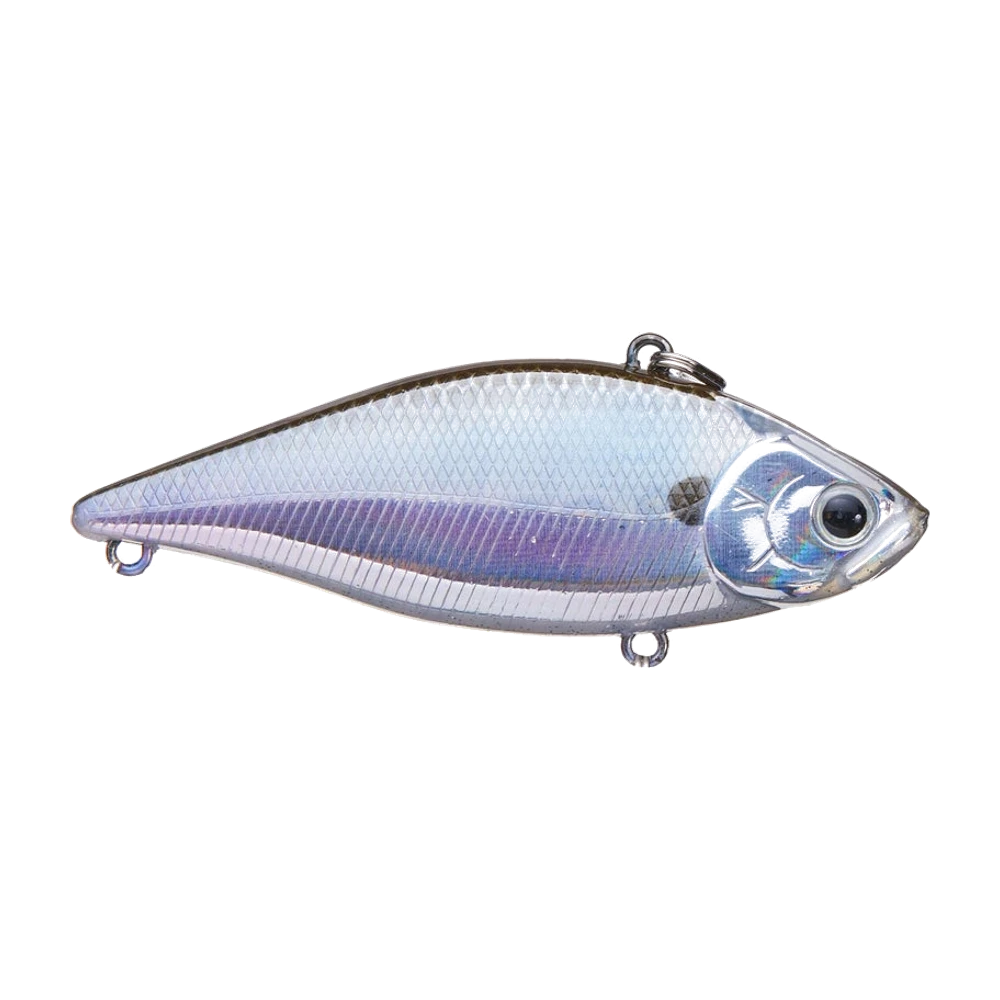
A word on the image: the LV 500 is shown bare. Both hook hangers, belly and tail, are empty wire eyes, and only the line tie split ring is fitted to the dorsal eye. It's a product studio shot, not a picture of a lure ready to fish.
On a dense lipless, replace the rear treble before the belly treble if you're only changing one. It takes most of the chasing strikes, and it's the one doing the work when the lure falls vertically during a pause — the belly hook spends its life scraping bottom and dulls anyway.
How to fish it
The searching retrieve
The baseline method, and the most productive on unfamiliar water: cast long, let it sink on a count, retrieve at a steady speed. The body produces a tight wobble and a continuous vibration you feel permanently in the rod. As long as you feel it, the lure is working. Moderate to fast speeds suit it, and that's exactly its strength: covering a lot of water while holding a stable depth.
The saw-tooth near the bottom
This is the retrieve that makes the difference on inactive fish. Reel three or four turns, stop, let it fall flat still vibrating, then rip it back up with a sharp rod stroke. The LV 500's density makes that fall fast and vertical, which imitates a stunned baitfish dropping out of the school. It's the classic way to fish a lipless along a break or over bottom-hugging weed, and it works as well for zander as for bass.
Ripping it out of weed
When you feel the lure touch vegetation, don't pull progressively: give one sharp lift to tear it free, then let it drop straight back. The lure releases, throwing strands clear, and starts vibrating again — and the strike often comes within the second after. That's the signature lipless retrieve in spring, before the weed has grown to the surface.
The classic mistake
Fishing this model like a light lipless, that is, tight to the bank and just under the surface. At 21 g it drops too fast to work over a metre of water: you spend the whole retrieve stopping it from hitting bottom, and you use none of what it was drawn for. If your spot is under two metres, take a lighter model and keep this one for breaks and deep flats.
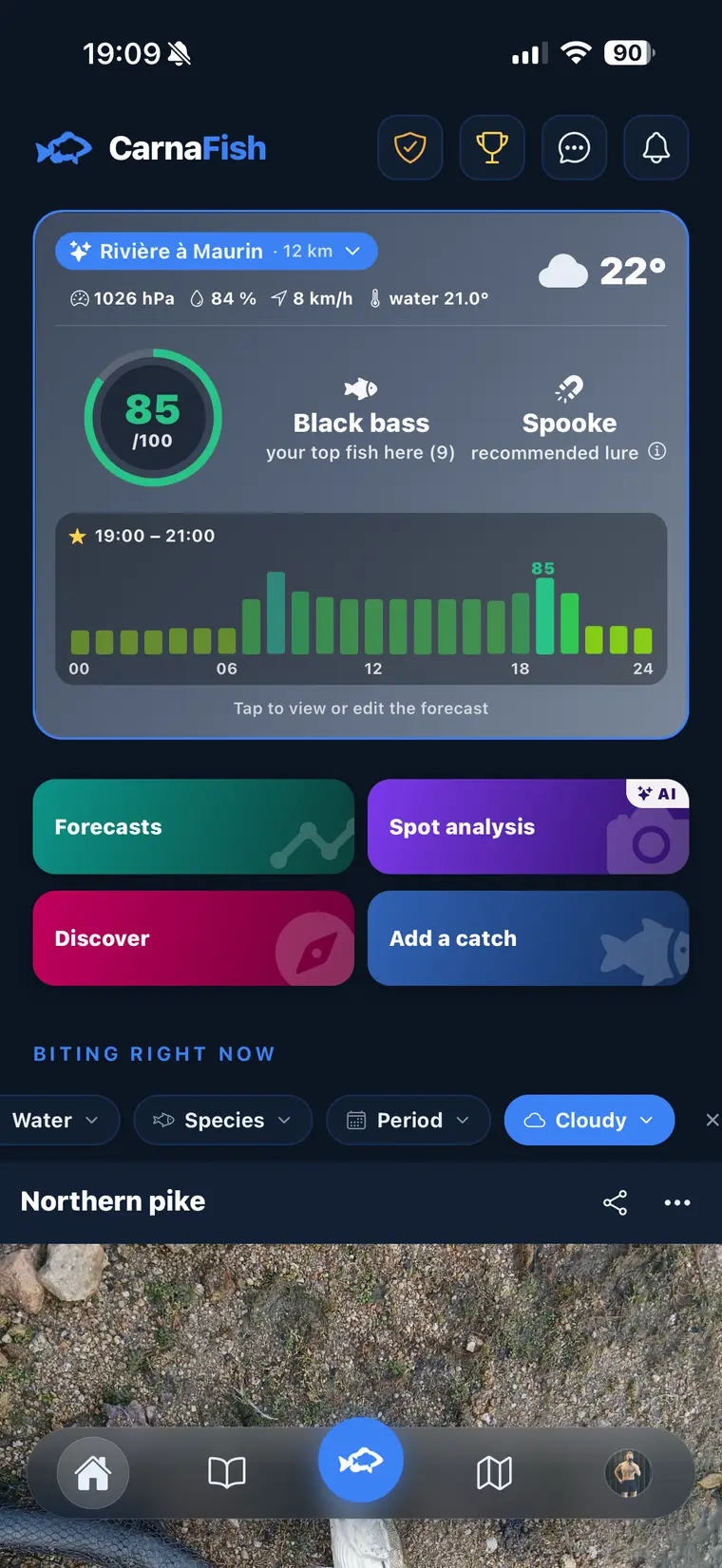
Not sure what to tie on?
Photograph your spot: CarnaFish reads the scene, cross-checks the conditions and gives you the zone, the lure and the retrieve. Free on iOS and Android.
Colours by water clarity
The description praises a wide range of finishes without publishing the list. So reason by type of finish:
- Clear water: the translucent and pearl finishes, like the one in the photo — dark olive back, pearl flanks with lavender highlights, near-transparent head. In clear water a lure that lets light through looks less bulky than an opaque body of the same volume.
- Stained water: warm, high-contrast tones, red craw or chartreuse with a dark back. A lipless is a searching bait, and in stained water the silhouette has to read fast.
- Low light or deep water: chrome. At 4 m the available light is weak and directed downwards, and a reflective finish catches what little is left.
Where it sits among lipless baits
Against the small, light Lucky Craft Bevy Vibration, the LV 500 plays the exact opposite tune: shorter but far denser, built to go down rather than stay high. Against the American classics, the Bill Lewis Rat-L-Trap and the Cotton Cordell Super Spot, its distinguishing feature is the timbre, brass and glass against steel. A detail that counts on heavily fished water.
Whether the spot even justifies a lure that reaches 4.6 m is another question, and that's what CarnaFish answers: one photo of the spot, and the AI suggests the zone, the depth and the lure type that match the day's conditions. For the groundwork on zander lures, one of this lipless's best targets in Europe, our guide to getting started with zander lure fishing covers the rest.
Key takeaways
- One size only, 7.6 cm for 21.3 g, sinking: a high density that defines everything else about its behaviour.
- Stated working depth down to about 4.6 m, reached by counting the drop rather than by a diving lip.
- Brass and glass rattles: a composite timbre wider than the single steel ball most competitors use.
- The number 500 is a series marker, not a length: the only dimension that counts is the one in the table.
FAQ
What size is the LV 500 really?
7.6 cm, that is 3 in, for 21.3 g. The number 500 is a Lucky Craft series marker and corresponds to neither a length in millimetres nor a weight. The spec table is what counts.
Does it float or sink?
It sinks, and the maker rates it explicitly as sinking. At 21.3 g for 7.6 cm it's a particularly dense lipless, dropping fast and level during pauses.
How deep can you fish it?
The maker states it is equipped to handle depths down to 15 ft, about 4.6 m. Unlike a billed crankbait, the depth isn't imposed by geometry: you choose it by counting the sink before you start reeling.
Why brass and glass rattles?
Because the two materials emit different frequencies. Brass gives a low knock that carries far, glass a high click heard closer in. The mix produces a wider timbre than the single steel ball many competitors use.
Does it suit zander and pike?
Yes, it's a good profile for both in Europe: the density lets it hold bottom along a break, and continuous vibration remains an effective signal in stained water. Add a wire leader as soon as pike might be around.
Does it come with treble hooks?
In the photo of this model the lure is shown with no hooks at all, both hangers empty. Check the hooks on the one you buy, and consider an upgrade to better trebles: this is a lure family where plenty of fish shake free.
The full bass lure guideSeason-by-season strategy: which family of lure, when, and why.Go from theory to fish
CarnaFish reads your spot from a photo and gives you the game plan: zone, lure, retrieve. Free on iOS and Android.