Booyah XCS1: the silent squarebill that backs out of cover
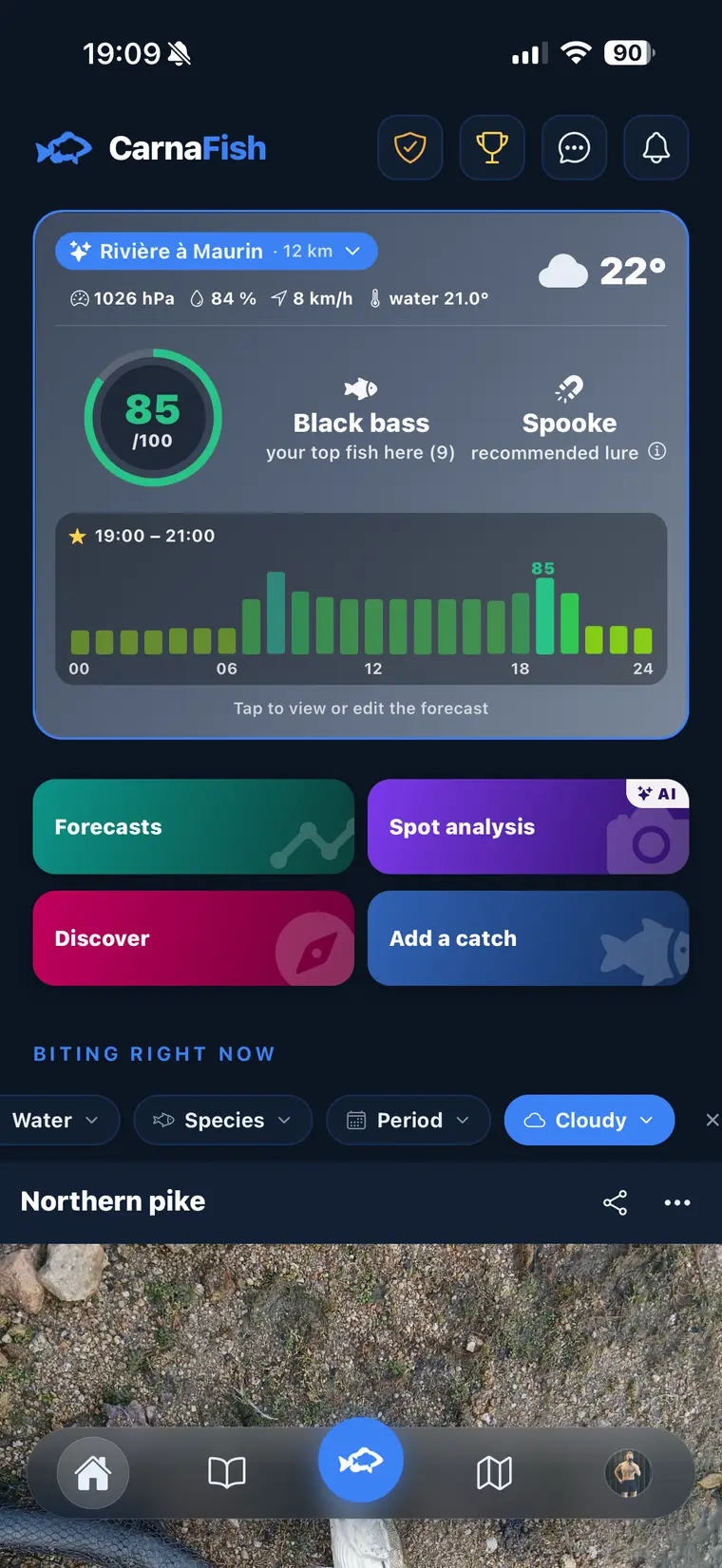
Before tying this one on, it helps to know if the spot actually calls for it. CarnaFish reads the scene from a photo.
There's a precise moment, along a stump line or over a rock shelf sitting 80 cm / 2-3 ft down, when a crankbait stops being a search bait and becomes a contact bait. You're no longer trying to wind it straight back: you're trying to hit something. And at that game, two details matter more than anything — how the lure backs out of cover, and how much noise it makes on the way in.
A crankbait that deliberately makes no noise
The XCS1 is Booyah's revival of a model from the old Xcalibur line-up, put back into production at the request of tournament anglers. The technical choice that sets it apart from most current squarebills comes down to one sentence: it has no rattle chamber. No BBs, no knocker, no sound other than the body colliding with cover.
That's a design position, not a cost saving. On waters where fish hear noisy baits all year, a silent crankbait arrives unannounced: the bass only picks it up at the last second, from water displacement and sight. The strike becomes a reaction rather than a decision. It's the exact inverse of the logic behind a lipless like the Booyah One Knocker, which bets everything on an acoustic signature. Carrying both means you can flip between registers inside the same day.
In cold, clear water, late winter or right after a cold front, the silent bait usually wins. In stained or wind-churned water, the advantage swings back to the noisy one. Test both on the same bank before drawing conclusions.
The stated numbers, and what they mean on the water
The manufacturer's table gives a single line: 2-5/16 in, 1/2 oz, 0-3 ft. Translated, that's roughly 5.9 cm for 14 g, with a 0 to 0.9 m running range. The "XCS1 Series" name suggests a family covering several diving depths, but only one reference is documented here — if you need to cover 2 or 3 m / 6 to 10 ft, you need a different bait.
Fourteen grams on under 6 cm means a short, dense body: it casts remarkably well for its size, even into a headwind, which genuinely matters when you're fishing from the bank and need to reach a stump twenty metres out.
The square lip, wide and set at a shallow angle, isn't there to dive fast: it's there to kick the nose up on contact and make the bait bounce rather than bury itself. Paired with deliberately strong buoyancy, it means the lure rises the moment you stop winding.
When you feel the lip wedge into a branch, stop reeling dead for a full second. The strong buoyancy floats the bait straight up and usually frees it on its own, with no pulling — pulling is how you drive a treble into the wood.
The technique: forcing the deflection
A squarebill wound cleanly through open water, touching nothing, catches about a third of what the same bait catches when it collides. The point of every cast is therefore to find something hard: a stump, a rock, a piling, the edge of a slab.
The semi-rolling action the manufacturer describes throws a steady lateral flash off the pearl flanks. But everything hinges on the impact: the bait veers hard off line, changes axis, and that stumble is the trigger. Retrieve at a steady medium pace — not too slow, or the lip stops working, and not too fast, or the bait climbs to the surface.
Where to run it first
The cluttered first metre of water, and nowhere else. Stump lines, riprap, isolated boulders on a shallow plateau, bridge pilings, laydowns. In spring over hard bottom, when crawfish come out, a squarebill grinding gravel is deadly. In summer it keeps its value early and late, before the fish drop back down.
Over clean bottom with no cover at all, switch to a round-billed crankbait or to a Bomber Square A if you want to stay in the same family with a different signature: without contact, a squarebill loses most of its point.
Not sure what to tie on?
Photograph your spot: CarnaFish reads the scene, cross-checks the conditions and gives you the zone, the lure and the retrieve. Free on iOS and Android.
Rigging, hardware and what the photo shows
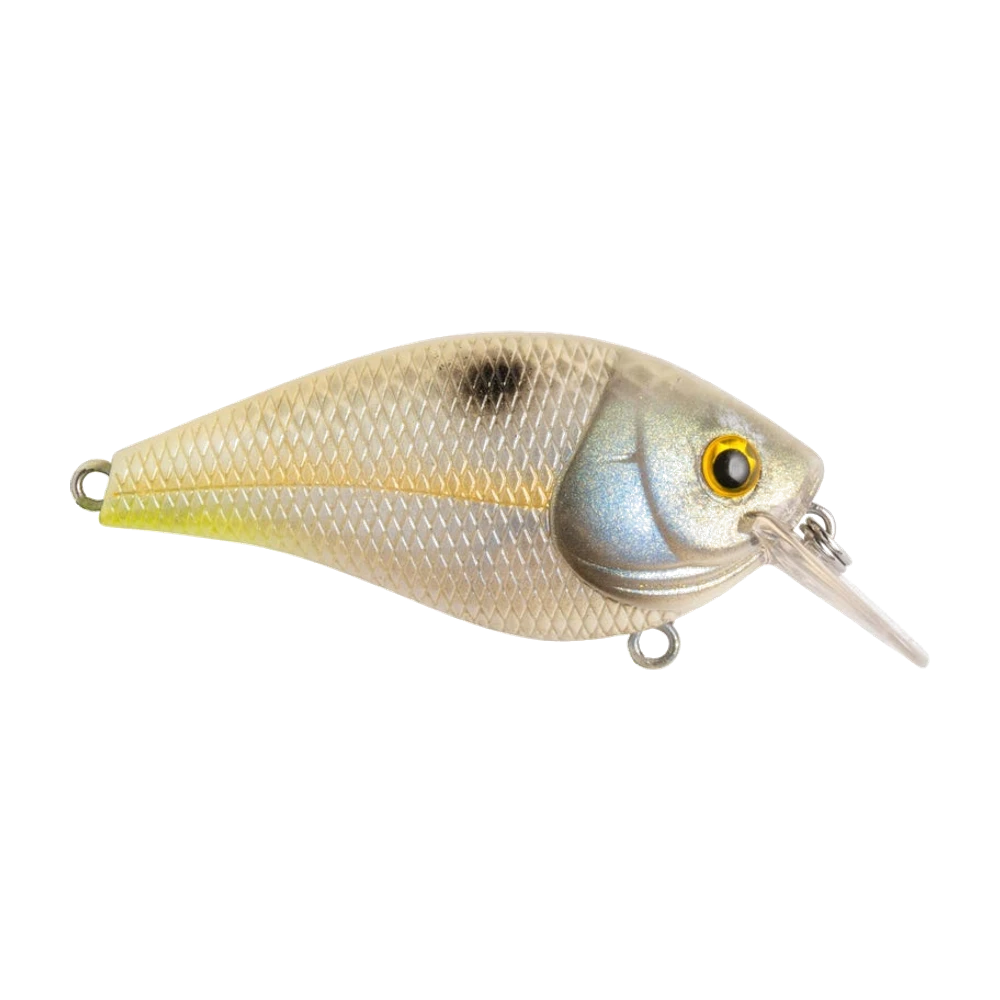
The description states razor-sharp trebles mounted so they ride up against the body, which cuts snagging noticeably — consistent with a bait built to crash into branches. In the catalog photo, though, the lure appears bare: both hangers, belly and tail, are empty. Only the line-tie ring on the lip is fitted.
For line, stay on 30 to 35/100 fluorocarbon. It sinks slightly, it takes abrasion against wood and it keeps the bait inside its depth band, where a bare braid would tend to lift it. Tie a loop knot or use a small snap: a knot cinched tight to the eye chokes the rolling amplitude.
The mistake that costs bites
Slowing down out of fear of snagging. It's the natural reflex when you hear the lip scraping, and it backfires: at reduced speed the bait loses its ability to bounce and simply wedges instead of backing out. Keep a positive speed and let the buoyancy do its job on the pauses.
Colors by water
- Clear to lightly stained water: the pearl finish with olive back and yellow lateral line from the photo, imitating a roach or a shad without piling on color.
- Spring, hard bottom, cool water: a craw pattern, red-brown through orange. That's when bass root through gravel, and a squarebill grinding the bottom is the most believable bait going.
- Muddy water or spring flood: chartreuse with a black back, the only pairing that keeps readable contrast under 50 cm / 20 in of visibility.
What's left is knowing where the good cover actually sits, which is exactly what CarnaFish makes easier: photograph the spot and the AI suggests the zone, the depth and the lure family that match the conditions. To learn to identify a productive bank before you even cast, our guide to reading a fishing spot lays out the method.
The short version
- No rattle chamber: a silent squarebill, to be pulled out when fish are jaded by noisy baits.
- One documented size only: roughly 5.9 cm / 14 g, with a stated 0 to 0.9 m range.
- Strong buoyancy lets you free a wedged bait simply by stopping the retrieve.
- Without contact against cover this bait loses most of its value: aim at hard stuff, not open water.
FAQ
Why pick a crankbait with no rattle?
Because silence turns into an advantage on heavily fished water. A noisy bait announces itself from a distance; a silent one arrives at the last second and provokes a reflex strike. In clear, cold water, the silent option is often what makes the difference.
How deep does this bait run?
The manufacturer states 0 to 0.9 m / 0-3 ft. It's a first-metre bait built for contact with shallow cover. To cover anything deeper you need a long-billed crankbait — the XCS1 simply won't get down there.
Does it snag much in branches?
Less than you'd fear. The square lip bounces the bait off cover instead of burying it, and the trebles are specified to ride against the body. If it does wedge, stop reeling: the strong buoyancy floats it up and usually frees it on its own.
What retrieve speed should I use?
Medium and steady, fast enough for the lip to work and for the bait to deflect sharply off cover. Slowing down out of caution is counterproductive: the bait wedges more and loses the deflection, which is precisely what triggers the strike.
Braid or fluorocarbon?
Fluorocarbon in 30 to 35/100. It handles abrasion against wood and rock and keeps the bait inside its depth band. Bare braid, which floats, would tend to lift it and would transmit impacts too harshly.
Does it suit perch in Europe?
Yes, in shallow cluttered zones, riprap or boulder edges. Six centimetres at 14 g stays a size a good perch will happily attack, even though the bait was designed with bass in mind first.
The full bass lure guideSeason-by-season strategy: which family of lure, when, and why.Go from theory to fish
CarnaFish reads your spot from a photo and gives you the game plan: zone, lure, retrieve. Free on iOS and Android.