Lunker City Slug-Go: the original soft jerkbait, 11.4 to 22.9 cm
Rather not fish it blind? Photograph your spot — CarnaFish cross-checks the conditions and points you the right way.
A soft plastic with no tail, no paddle, no appendage: nothing that moves on its own, nothing that vibrates, nothing that sings through the blank. The first Slug-Go you rig on a single hook looks like a manufacturing error. Then you give it two rod strokes, watch it slide left, come back right, stop crossways in the current — and you understand why this piece of plastic founded an entire family of lures.
A lure that does nothing on its own, and that is the point
Lunker City claims a precision-balanced body designed to produce the injured-prey action that triggers a reflex strike. The idea is simple and it is old: a healthy baitfish swims straight, an injured one breaks sideways with no control. The Slug-Go does not imitate swimming, it imitates the loss of control.
The practical consequence is worth accepting up front: on a straight retrieve this bait produces nothing at all. No vibration, no thump, no information in the rod tip. All of the action comes from your hands. That is what makes it demanding for the first few sessions and irreplaceable afterwards, because you decide every single dart instead of putting up with them.
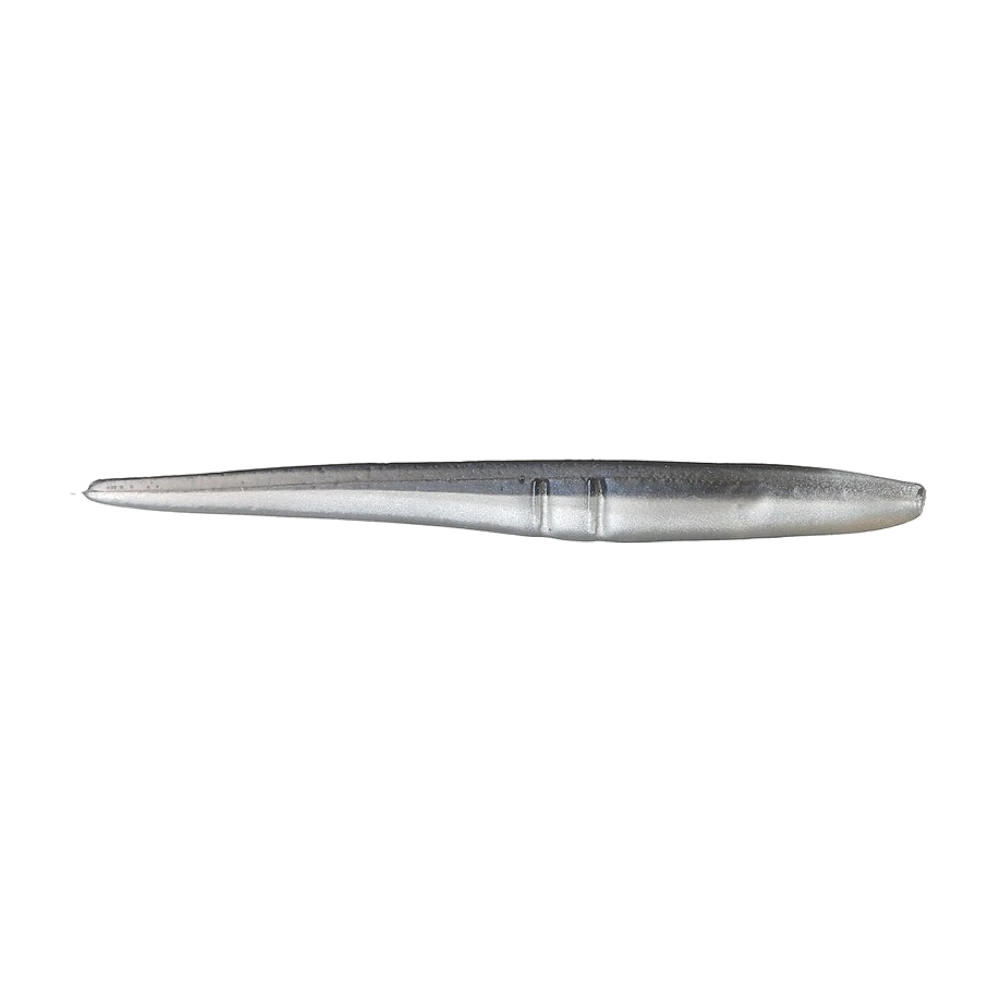
In the photo you can make out two transverse notches moulded under the belly, around mid-body. The maker documents them nowhere in its spec sheet; in practice they serve as an exit mark for the hook point and give the body a natural hinge during the glide. Take that for what it is: an observation, not a stated feature.
Four sizes, and a column to read as a count
The maker's table pairs a length with a number of baits per bag. Not a weight, not a hook size:
- 4.5 in / 11.4 cm, 8 per bag. The size for bass and for sea bass along the edges, and the easiest one to rig on a 3/0 hook.
- 6 in / 15.2 cm, 8 per bag. The most versatile size in Europe: big enough for a decent pike, discreet enough for sea bass in clear water. Note that the count does not drop between 11.4 and 15.2 cm, it stays at eight.
- 7.5 in / 19.1 cm, 5 per bag. The big-predator size, which calls for a 7/0 or 8/0 hook and a rod that can take it.
- 9 in / 22.9 cm, 3 per bag. The trophy-hunting size, slow to work and heavy to cast even without a weight.
The maker also states that the bait is made in the USA, which fits the history of the lure: the Slug-Go is Herb Reed's creation, the founder of Lunker City, and the range is still sold under its original name.
What is missing, though, is any published weight and any buoyancy rating. That absence is a paradox for a bait whose copy makes a point of its balance, and it has a concrete consequence: you cannot know in advance how fast your Slug-Go will sink. Rig one, drop it into a metre of water at the bank and watch for a few seconds. You will then know whether your bag glides slowly or drops decisively, and that is the piece of information that drives your retrieve.
The retrieve: two strokes, one dead beat
The base rhythm
Rod at 45 degrees, line slightly slack. Two crisp, short rod strokes — twenty centimetres, no more — then give line back and touch nothing for two seconds. The bait slides sideways during the stroke, then keeps coasting through the dead time. That is when most strikes come.
Making the glide last
The slacker your line when you strike, the longer and the more disorderly the glide. A tight line passes your movement straight to the bait, which then runs in a straight line towards you. That is mistake number one, and it is corrected by moving the rod back before you strike rather than by striking harder.
The weedless rig
A wide-gap hook with no weight, in through the thick head, out a centimetre along, rotated, back in through the back with the point sitting flush. Size 3/0 for the 11.4 cm, 5/0 for the 15.2 cm, 7/0 to 8/0 beyond that. With no weight at all the bait stays high in the layer and glides furthest; with a small 3 to 5 g bullet it dives between strokes and covers mid-depth.
If you are fishing for pike with the larger sizes, do not economise on the leader. The Slug-Go works slowly and the fish has all the time it needs to swallow deep. Heavy fluorocarbon is enough for bass, but on a confirmed pike spot it is wire or titanium, no argument.
What this bait can and cannot do
Lunker City's copy mentions fish from bass to musky and from skipjack to tarpon. That is a way of saying the slim silhouette works on a wide variety of predators, which is true — but it does not mean the same model suits every situation. In Europe, remember three uses above all: the 11.4 cm for bass in clear water and for sea bass over rocky edges, the 15.2 cm as the catch-all size, and the two biggest for pike when you are hunting a big fish.
What the Slug-Go does not do is cover water fast. The retrieve demands precision and dead time, so you cover very few metres per minute. It is a lure for a spot you have identified, not a searching lure. To cover ground, a shorter Lunker City Fin-S Shad, or a bait with a swimming action of its own, will be more efficient.
Not sure what to tie on?
Photograph your spot: CarnaFish reads the scene, cross-checks the conditions and gives you the zone, the lure and the retrieve. Free on iOS and Android.
Colours by water clarity
- Clear water: translucent pearl with a smoky grey back, as in the photo. The body passes light, and the glide does the rest.
- Lightly stained water: solid pearl white, the most readable colour that never looks loud. It is the default choice if you only buy one.
- Dirty water or flood: the maker also offers high-visibility colours, chartreuse first among them. They serve you as much as the fish: tracking the bait's path with your eyes completely changes how you read slack-line bites.
The original and its descendants
The Slug-Go served as the model for almost every soft jerkbait that followed, and the comparison still teaches something. A Zoom Super Fluke is thicker, with a split tail that adds a little resistance and shortens the glide. A Z-Man Scented Jerk ShadZ relies on a far more elastic material that survives more fish per bait. The Slug-Go stays the slimmest and the slipperiest of the three — its advantage on wary fish, and its weakness when the plastic tears.
The lure is only ever half the work: reading the swim before you cast counts at least as much, which is exactly what CarnaFish makes easier — one photo of the spot and the AI suggests the zone, the depth and the kind of presentation that match the day's conditions. If you are after pike with the bigger sizes, our guide to choosing a pike lure places the soft jerkbait among the other families.
Key takeaways
- No action of its own: everything comes from the rod, in two crisp strokes followed by dead time.
- Four published lengths — 11.4, 15.2, 19.1 and 22.9 cm — and the second figure in the table is the count per bag: 8, 8, 5 and 3.
- The copy claims precision balance but publishes neither weight nor buoyancy: test your own bag before building a retrieve on it.
- A lure for identified spots, not for fast searching: every metre fished takes time.
FAQ
Which Slug-Go size should I start with?
The 6 in / 15.2 cm. It is the most versatile: big enough to interest a decent pike, slim enough not to spook a bass or a sea bass in clear water. The 11.4 cm takes over when fish get difficult.
Does the Slug-Go swim on a straight retrieve?
No, and that is not a flaw. It has no tail and no appendage: wound straight, it comes back in a straight line producing nothing. All the action comes from your rod strokes, followed by the dead time in which the bait keeps coasting.
How do I get a really wide glide?
Keep the line slightly slack when you strike, and strike short rather than hard. A tight line passes the movement straight to the bait, which then runs towards you instead of sliding off to the side.
How many baits are in a bag?
Eight in the 4.5 in and the 6 in, five in the 7.5 in, three in the 9 in. The right-hand column of the maker's table is a piece count, not a weight.
Do I need a wire leader with the Slug-Go?
On a spot that holds pike, yes, without hesitation: the retrieve is slow and the fish swallows deep. For bass or sea bass in clear water, heavy fluorocarbon remains sufficient and far more discreet.
Who created the Slug-Go?
Herb Reed, the founder of Lunker City. The bait is still sold as the Original Slug-Go, and the maker states that it is made in the USA.
The full bass lure guideSeason-by-season strategy: which family of lure, when, and why.Go from theory to fish
CarnaFish reads your spot from a photo and gives you the game plan: zone, lure, retrieve. Free on iOS and Android.