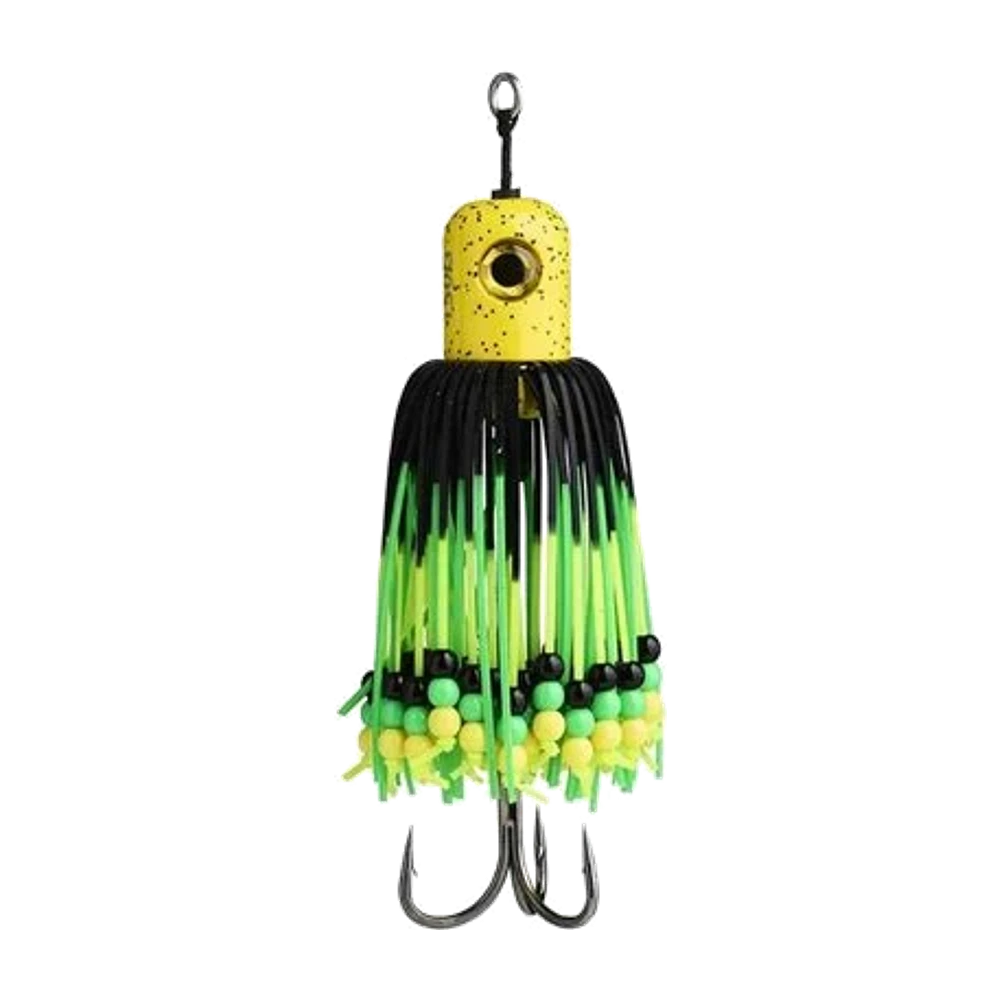
MadCat Tube Teaser: hunting catfish on the cast, from the bank
Not sure this lure fits YOUR spot today? CarnaFish tells you in 10 seconds, from a photo.
Almost everything written about lure fishing for catfish assumes a boat. A sounder to read the marks, a drift to walk the lure along, a clonk to call. Except that most catfish anglers fish from rock armour, a dyke or a gravel pit bank, with one casting angle and obstacles everywhere.
From the bank the constraints reverse. You cannot follow the fish, you cannot drop straight down, and you have to keep a big profile alive on a slow retrieve without it spinning or snagging every metre. Most big paddle-tail shads fail that brief: they need a speed the spot will not allow.
The Tube Teaser takes the problem from another angle. It is not a fish, it is a bundle of tentacles on a hollow body — a profile that imitates nothing in particular but that moves even when your line is almost still.
A hollow body, and everything changes
The difference comes down to one sentence: the inside of the lure is empty. Three practical consequences that solid lures cannot offer.
You put the weight inside. A bullet lead, a piece of tungsten, a jig head pushed in to the hilt: the weight disappears inside the body. You go from 40 to 100 g without changing lure, without altering the silhouette, without adding anything that catches on the bottom. On a spot where the current changes with the dam release schedule, that is decisive.
The catfish closes on nothing. When it engulfs the lure, it shuts its mouth on a soft wall that collapses. It meets no hard lead and no solid body. So it holds the lure a fraction of a second longer — and in a fishery where the bite often shows up as nothing more than added weight, that fraction of a second is enough to land a hookset.
The tentacles work at zero speed. A bundle of fine strands reacts to the slightest trickle of water. Lure on the bottom, line just tight, it is still moving. That is exactly what you want from the bank, where half your fishing time is spent on the pause.
The rig: what you put in the tube
The Tube Teaser is not ready to use, it is a component. Two schools, depending on the bottom.
- Internal weight plus a single hook through the body. You slide a lead into the cavity, push a heavy 8/0 single through the body and bring the point back out on top. Compact rig, low snagging, ideal over a boulder bottom.
- Inserted jig head. A 60 to 100 g catfish jig head, pushed in until the collar sits flush. Faster to change, better at holding the lure in line, but the hook stays exposed.
- Offset Texas weight. A sliding bullet on the main line, a stop, then the tube rigged unweighted. The lure lifts and glides back down: the slowest of the three presentations.
Whichever you choose, the leader is not up for debate: fluorocarbon or coated braid of 0.80 to 1.00 mm minimum, over thirty centimetres or so. A forty kilo catfish crosses a rocky margin during the fight, and that is where lines break, not on the hookset.
| Bank situation | Total weight to aim for | Recommended rig |
|---|---|---|
| Gravel pit, clean bottom, no current | 40 to 60 g | Offset weight, gliding drop |
| River, moderate current, 4 to 8 m | 70 to 90 g | Internal weight plus single through the body |
| River in fast water, bottom over 8 m | 100 to 120 g | Inserted jig head |
On the water: do not try to feel the bite in the rod. From the bank, on a big tube, nine times out of ten it shows up as the line easing off sideways, with no jolt, as if the current had picked up. Strike on that sideways movement, not on a knock — by the time you feel a knock, the catfish has already spat it out.
The retrieve: four movements, a lot of waiting
- Cast and let it sink on a tight line, rod high, counting. The tube glides, it does not drop like a stone: count double what you would with a bare jig head.
- Take up the slack and wait ten seconds, lure on the bottom, doing nothing. The tentacles keep breathing.
- One long, slow pull, the rod going from ten o'clock to twelve over three full seconds. You lift the lure thirty to fifty centimetres, no more.
- Let it drop back on a semi-tight line and start again. Over a full retrieve you only make ten or so pulls: that is normal, you are fishing a lane, not an area.
The classic mistake is working it like a pike lure, in sharp, closely spaced pulls. The catfish locates a mass moving slowly just off the bottom, closes in on it, and inhales it: a twitchy retrieve carries the lure through its detection field too fast.
Not sure what to tie on?
Photograph your spot: CarnaFish reads the scene, cross-checks the conditions and gives you the zone, the lure and the retrieve. Free on iOS and Android.
Where it pays, and where it is no use
The Tube Teaser is a lure for static bank fishing and slow vertical work, not a searching tool.
- Pool tails you can reach on foot, where the bottom comes up from 8 to 4 m: you drop the lure at the top of the drop-off and step it down.
- Rock armour and bridge piers, where the catfish sits at the edge of the current. The internal weight rig slips between the boulders without catching.
- Night and coloured water, in late spring and summer, when catfish move up onto shallower spots.
Conversely, it is unsuited the moment you need to cover ground. On a big plateau where the fish are spread over kilometres, you will never find them stringing together fifty centimetre pulls: that is the domain of the MadCat CatDiver, which trolls behind a boat and sweeps continuously.
Tube Teaser or Clonk Teaser
Both are MadCat soft plastics for catfish, and yet they never cross paths on the water.
The MadCat Clonk Teaser is designed to hang under a drifting hull at a fixed depth while the clonk calls fish in. It has to hold the vertical axis without spinning and beat at zero speed: its tail does all the work, and it is of no interest at all cast from a bank.
The Tube Teaser does the opposite. You cast it, it settles, it works in contact with the bottom, and its signal is not a tail but a mass of strands. It handles the snaggy ground a vertical rig cannot cope with, and it lets you fish without a boat.
If you are fishing from a fixed spot and want to present mid-water rather than on the bottom, the Black Cat U-Float rig is the logical companion to the tube: same bank, same rod, different water layer. Our guide to lure fishing for catfish covers how fish are distributed through the seasons. And if you are unsure which stretch of bank to attack first, CarnaFish analyses a photo of the spot and answers.
Key takeaways
- The hollow body does two things: it houses the weight inside and it lets the catfish close on nothing.
- Leader of 0.80 to 1.00 mm minimum: breakages happen along the margins, during the fight.
- Work it in long slow pulls of 30 to 50 cm, never in sharp twitches.
- The bite reads as the line easing off sideways, not as a knock.
- A lure for specific spots and margins, not for searching: to cover ground you have to troll.
FAQ
Can you lure fish for catfish without a boat?
Yes, provided you pick spots where the depth is reachable from the bank: pool tails, bridge piers, rock armour, dock entrances. The Tube Teaser weighted to 60 to 100 g lets you hold the bottom and fish slowly over those zones.
How much weight should I put in the Tube Teaser?
Between 40 and 120 g depending on depth and current. Reckon 40 to 60 g in a gravel pit with no flow, 70 to 90 g on a river with moderate current, and up to 120 g in fast water over more than eight metres.
What hook should I use?
A heavy single of 6/0 to 10/0, run through the body of the lure and back out on top. A heavy gauge single holds better than a treble on a fish that size, and it catches far less in the boulders.
How do I detect the bite with such a big lure?
It rarely comes as a shock. Most often the line moves slowly to one side or goes abnormally heavy. Strike on that movement, hard and two or three times in a row, without waiting to feel a clear knock.
What is the difference with the Clonk Teaser?
The Clonk Teaser is built to hang vertically under a drifting boat while you clonk. The Tube Teaser is cast from the bank and works in contact with the bottom, over snaggy spots where a vertical rig cannot get down.
What time of year should I use it?
Mainly from late May to September, when the water goes above 18 °C and catfish use zones that are reachable from the bank. Night, and the hours following a coloured spate, are the most productive windows.
The full catfish lure guideSeason-by-season strategy: which family of lure, when, and why.Go from theory to fish
CarnaFish reads your spot from a photo and gives you the game plan: zone, lure, retrieve. Free on iOS and Android.