Delalande Buster Shad: tune the wave, not the colour
One lure, endless conditions. CarnaFish reads your spot from a photo so you are not just guessing.
In coloured water, lure colour is not the first problem. A pike hunting in forty centimetres of visibility is not choosing between white and chartreuse: it first detects a disturbance through its lateral line, homes in on it, and only sees the silhouette in the final moments. The catfish goes further still — it regularly hunts at night, in opaque water, and most of its information is mechanical, not visual.
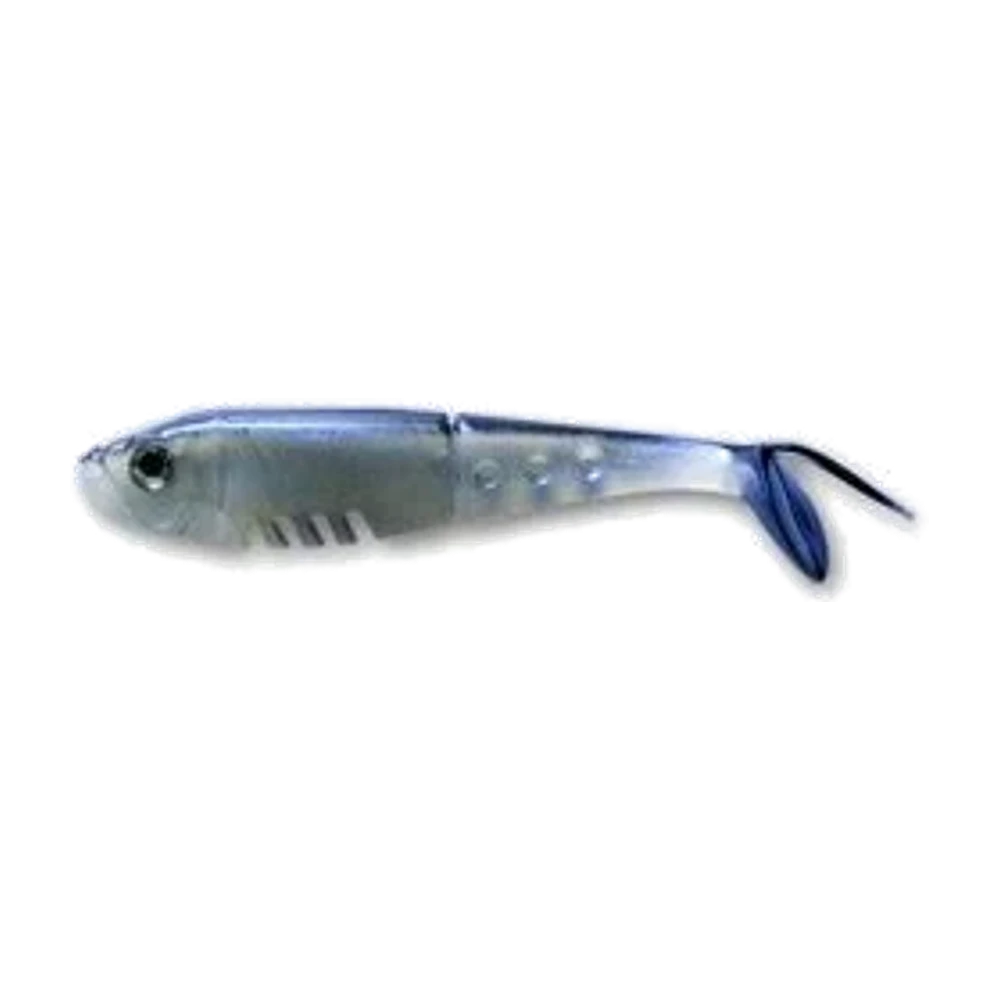
The Buster Shad is built for that kind of information. Its broad, soft tail beats slowly and shifts a lot of water on every stroke. This is not a lure that flutters: it is a lure that pushes, and the whole way you fish it consists of tuning the power of that push so it stays detectable without becoming saturated.
Why a big tail does not produce the same wave
Two shads of the same length with different tails are not two cosmetic variants of the same lure.
- A small, stiff tail beats fast and short. It generates a high-frequency vibration, very readable in clear water and at close range, but it fades quickly and gets lost in the background noise of a coloured river.
- A broad, soft tail beats slowly and far. The wave it produces is low-frequency and high-amplitude, and it carries: exactly the kind of signal a predator picks up several metres away with no visibility at all.
On the Buster Shad, that tail sits on a thin wrist, which has two practical effects. First, the lure starts working at very low speed: you can crawl it back without it going inert, which is decisive in cold water and on apathetic fish. Second, the body rolls slightly in the wake of each beat, adding an irregular flank flash whenever the light allows.
Feel as your tuning instrument
This is the heart of this page: you do not need to see the lure to know whether it is working properly. Everything is in the rod tip.
A broad tail correctly worked transmits a regular, clearly separated tapping, like a finger knocking on the rod at a constant interval. From there, three diagnoses:
- You feel nothing. The lure is too heavily weighted for the speed, or the tail is fouled with weed. Speed up slightly; if nothing comes back, reel in and check.
- You feel a continuous, blurred tremble. You are going too fast. The tail has stalled, it is buzzing instead of beating, and you have lost the low-frequency wave that is the whole point of the lure. Slow down by a third.
- You feel a crisp, spaced-out beat. That is the right setting. Memorise that speed, it is your reference for that weight.
On the water: in dirty water, look for the slowest speed at which you can still distinctly feel every tail stroke — then fish one notch below that, compensating with a lighter head. A pike does not need the lure to be fast, it needs the wave to be broad and it needs time to trace it back to its source.
Weights and rigs
| Target / context | Size | Jig head | Rig |
|---|---|---|---|
| Pike, margins and weed, under 2 m | 10 to 12 cm | 10 to 20 g | Plain head, optional stinger |
| Pike, flats and drop-offs, 3 to 5 m | 15 cm | 25 to 40 g | Plain head plus rear stinger |
| Pike, big lake or cold water | 20 cm | 40 to 60 g | Heavy head, long lifts |
| Catfish, river, drifting or casting | 20 to 25 cm | 60 to 120 g | Reinforced rig, double stinger, heavy-wire hooks |
| Catfish, vertical over a hole | 20 to 25 cm | The heaviest you can hold | Permanent bottom contact |
The basic set-up is the one described in our plain jig head rigging page. Two adaptations matter here. For pike, a stinger is necessary from 15 cm up: on a bulky body, sideways takes are common. For catfish, everything has to be oversized — heavy-wire hooks, welded split rings, braid of at least 0.50 mm — because the fight lasts a long time and it is the weakest link that decides the outcome.
The retrieve: three ways to make it work
Slow and straight, for searching out pike. Cast, let it sink to the target layer, and retrieve at the minimum speed where you can feel the beat. Every ten turns of the handle, stop for a second: the lure noses down, the tail restarts as you pick up again, and that break triggers a lot of takes.
On long lifts, for cold water and deep ground. Lift the lure 80 cm to a metre with the rod, follow it down on a semi-tight line, take up the slack. The tail keeps beating throughout the fall — that is the most productive phase.
In permanent contact with the bottom, for catfish. A very slow retrieve, letting the lure scrape and bounce. Catfish often sit on precise features, and the noise of the lead on the substrate adds to the wave from the tail. Our guide to lure fishing for catfish sets out the spots and the periods where this approach works best.

Not sure what to tie on?
Photograph your spot: CarnaFish reads the scene, cross-checks the conditions and gives you the zone, the lure and the retrieve. Free on iOS and Android.
Where it does not belong
Three situations where the Buster Shad is the wrong choice. In very clear water on educated fish: a strong wave and a big tail are precisely the signal fish have learned to avoid; a slim shad with a discreet tail will catch more. In strong current with a light head: the lure planes and rises, you lose bottom contact and the wave distorts. On a fast retrieve: completely beside the point, the tail stalls and all you have left is a piece of plastic buzzing.
Buster Shad or Sandra
Within Delalande's range, the Sandra 12 plays a very different role: a curl tail, continuous undulation through the body, a signal that rolls rather than punches. It excels on zander and on fish that refuse a pronounced vibration, particularly in clear water and finesse work.
The Big Sandra XXL is the large-format version of that curl-tail logic, built for pike and catfish, with a long slow undulation on a very bulky body.
The Buster Shad plays another card: a crisp, separated, repeatable beat. Where the Sandras produce a continuous undulation, it produces a series of distinct pulses, far easier for a fish in opaque water to locate. In practice: clear water and wary fish, take a Sandra; dirty water, night, a flood on the drop, take the Buster. And if you are unsure what size to fit when faced with coloured water, CarnaFish analyses a photo of the spot and answers.
Key takeaways
- The broad tail puts out a low-frequency wave that carries far in coloured water, where a fine vibration gets lost.
- Set your speed by feel: a crisp, spaced-out beat in the rod tip, never a continuous tremble.
- Stinger mandatory for pike from 15 cm up; a fully oversized rig for catfish.
- The fall during long lifts is the most productive phase in cold water and at depth.
- A bad choice in very clear water on educated fish, and on a fast retrieve.
FAQ
What jig head for the Buster Shad?
10 to 20 g along the margins, 25 to 40 g between 3 and 5 m, and well beyond that for the big sizes and for catfish. The right benchmark is not a number but a feeling: the correct head is the one that lets you feel every tail stroke at slow speed.
Do I need a stinger with this lure?
For pike, yes from 15 cm up, because sideways takes are common on a bulky body. For catfish, plan on a reinforced rig with heavy-wire hooks; the fight comes down to the strength of the whole set-up.
Is the Buster Shad really suitable for catfish?
Yes, in the large sizes and with the right rig. The low-frequency wave from the tail is exactly the kind of signal a catfish picks up through its lateral line in opaque water or at night.
Why can I no longer feel the lure working?
Two usual causes: weed is fouling the tail, or you are retrieving too fast and the tail has stalled, replacing the beat with a blurred tremble. Slow down by a third before you check the lure.
What colour in dirty water?
White, yellow or fluo, which give the most contrast in coloured water. In clear water or at night, natural and dark tones, seen as a silhouette, are often more consistent.
What is the difference with a Sandra?
The Sandra undulates continuously thanks to its curl tail, with a rolling, discreet signal suited to clear water. The Buster Shad punches in separate pulses and carries much further in coloured water.
The full pike lure guideSeason-by-season strategy: which family of lure, when, and why.Go from theory to fish
CarnaFish reads your spot from a photo and gives you the game plan: zone, lure, retrieve. Free on iOS and Android.