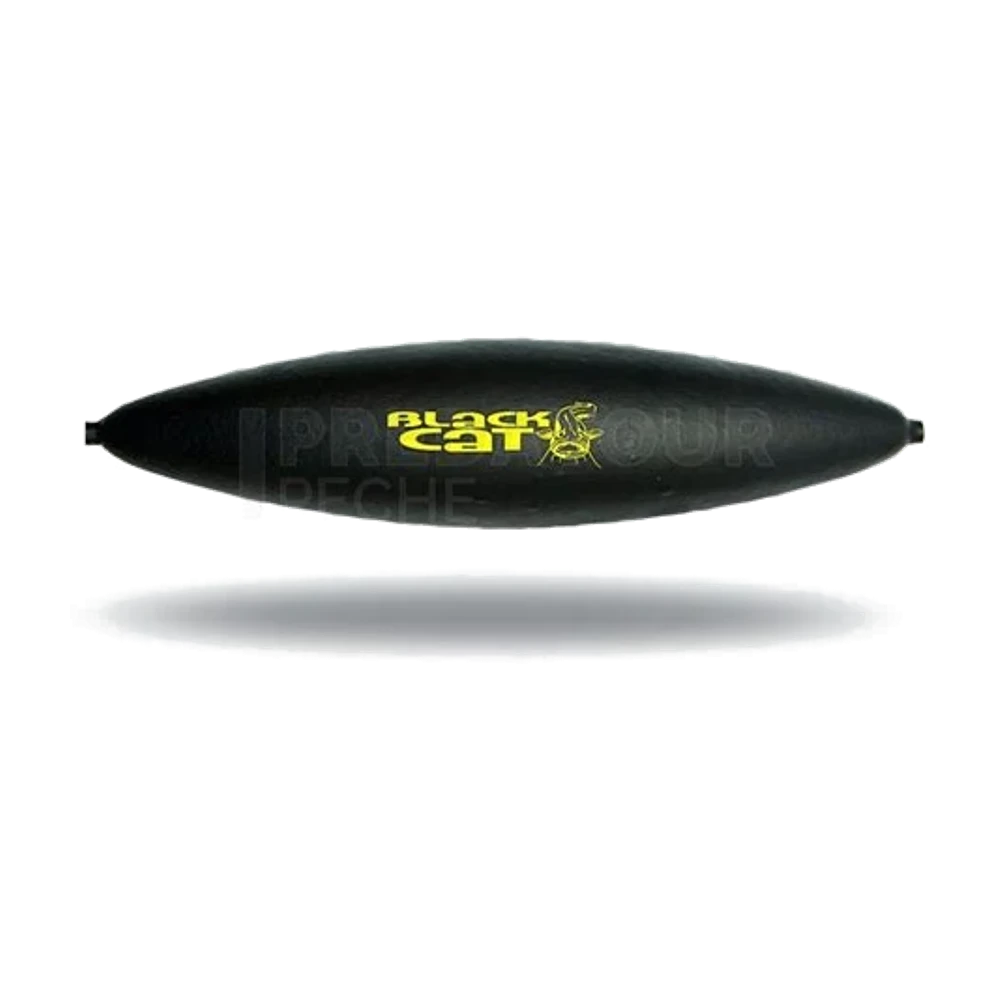
Black Cat U-Float: presenting bait in mid-water, above the bottom
This lure shines under specific conditions. CarnaFish tells you in 10 seconds if today is one of them.
There is one situation neither casting nor vertical fishing solves: a spot where the bottom is unfishable. Sunken branches, a bed of boulders, an old collapsed jetty, dense weed. You know the catfish is there — that is precisely why it is there — and every presentation laid on the bottom costs you a rig.
The other limit is stillness. From the bank, on a known spot, there are evenings when the right move is not to search but to wait, bait in mid-water, for two hours. No lure does that.
The U-Float is not a lure: it is a high-buoyancy float that lets you suspend a bait or a big soft plastic at a chosen depth, to the centimetre, and leave it there to work. Set up properly, it turns an unreachable spot into a fishable one.
What the float actually solves
Three problems at once, which is why anglers keep coming back to it despite its apparent simplicity.
It removes contact with the bottom. Your bait sits a metre above the snags. No more hang-ups, no more lost rigs, and above all the option of working the same place for an hour without breaking anything.
It puts the bait in the right layer. A catfish rises to attack, it almost never drops down. A bait lying on the bottom in two metres of silt is outside its hunting field; the same bait suspended a metre and a half off the bottom is right in line with it.
It makes the bait mobile. A crayfish, a big worm or a deadbait held in mid-water turns, undulates, and occupies a volume. A bait lying on the bottom sinks into the silt and disappears.
The U shape does the rest: buoyancy is high enough to carry a heavy bait and a substantial weight, but resistance to being pulled stays low, so the float dives decisively on the bite instead of acting as a brake.
The rig, top to bottom
- Float stop on the mainline (0.40 to 0.50 mm braid). It is what sets the depth, and it alone: move it and you change layer in ten seconds.
- Buffer bead, so the stop does not pass through the float's eye.
- The U-Float, rigged sliding. It runs freely down to the stop during the drop: that is what lets you cast a rig set at five metres without having five metres of line dangling.
- A 40 to 120 g olive sinker below the float, sized so the buoyancy is almost cancelled out. Set right, the float sits flush: only its tip shows.
- A strong barrel swivel, then a 60 to 100 cm leader in 0.80 to 1.00 mm.
- A strong 6/0 to 10/0 single hook or a two-hook rig for an elongated bait.
| Depth of the spot | Stop setting | Weight |
|---|---|---|
| 3 m, cluttered bottom | 2 to 2.2 m | 40 to 60 g |
| 5 to 6 m, margin hole | 3.5 to 4.5 m | 60 to 90 g |
| Over 8 m, current | 5 to 6 m | 100 to 120 g |
The principle is always the same: about one metre above the snags, never just off the bottom, never at mid-depth by default.
On the water: set the weight so the float is on the verge of sinking, with only a centimetre or two above the water. A float riding high resists the pull and the catfish lets go before you set the hook. A float that is almost submerged goes under at the slightest take, and that is what gives you a readable bite.
Fishing the spot: static or on the drift
Static, on a known spot. You put the rig out fifteen metres, rod on a rest, drag backed off or the baitrunner engaged, and you wait. The important thing is to take up slack every ten minutes: wind and current build a bow in the line that absorbs the hookset.
Controlled drift, on a slow river. You cast upstream, let the float run down with the current while following it with the rod, and cover fifty metres of the flow without ever touching the bottom. It is the most effective way to work a long wooded margin. Check the drift slightly from time to time: the bait then rises in the water column, then drops back, and that change of level often triggers a take.
The hookset calls for particular discipline. The float goes under, and the reflex is to strike immediately. Do not. Wait for the run to be decisive and continuous — two to four seconds — then take up the slack by reeling and set hard, rod horizontal, two or three times. A hookset given on the first dive almost always comes back empty.
Not sure what to tie on?
Photograph your spot: CarnaFish reads the scene, cross-checks the conditions and gives you the zone, the lure and the retrieve. Free on iOS and Android.
Where this rig takes over, and where to avoid it
- Cluttered margins: sunken trees, boulders, wrecks, piles. This is its reason for being.
- Known spots at the start of the night, in summer, when catfish move up to hunt in shallow water.
- Slow rivers and canals, where a controlled drift lets you cover a long run.
- Fishing two rods, one on the float while you search actively alongside.
Conversely, it is of no use in a big deep lake, where fish are in open water far from the bank and are located on the sounder. It becomes unmanageable as soon as wind raises a real chop: the float drifts off sideways and the bait leaves its layer. And in strong current, the drift gets too fast for the bait to be seen.
U-Float or a cast lure
A float rig and a lure cover two opposite logics, and the choice comes down to a single question: do you already know where the fish is?
If you do not, you have to search. The MadCat Golden Rattlin Spin sweeps a bank in an hour and tells you where the corridor runs; the MadCat Tube Teaser then lets you work the identified zone on the bottom.
If you do know, and that bottom is unfishable, the U-Float is the only clean answer. It does not search, it occupies. Plenty of bank anglers in fact combine the two in the same session: a float line set on the snag, and a rod in hand to search around it.
Our guide to catfish fishing with lures covers which zones to favour by season, and our method for reading a spot helps you pick out the margins that deserve a set line. And if you are unsure what depth to set when you arrive at a spot, CarnaFish analyses a photo of the spot and answers.
Key takeaways
- The float is there to suspend the bait about one metre above the snags, never just off the bottom.
- Rig it sliding with a float stop: you change layer in ten seconds.
- Add weight until the float is on the verge of sinking: that is the key setting.
- Wait two to four seconds of decisive run before setting the hook, then set several times.
- A rig for known spots and cluttered margins, useless in a big deep lake or in heavy chop.
FAQ
What depth should you set the float for catfish?
About one metre above the bottom or the snags. On a cluttered three-metre spot, set around two metres; on a five to six metre margin hole, between three and four and a half metres. A catfish rises to attack, it does not drop down.
What weight should you use under the float?
From 40 to 120 g depending on depth and current, sized to cancel almost all the buoyancy. You have it right when only a centimetre or two of the float shows above the surface.
When should you set the hook?
Not on the first dive. Let the run confirm itself over two to four seconds, take up the slack by reeling, then set hard two or three times in a row, rod horizontal rather than upwards.
Can you use this rig on the drift?
Yes, and it is often its best use on a slow river. Cast upstream, follow the run down with the rod, and check it slightly from time to time: the bait rises then drops back in the water column, which frequently triggers the attack.
What leader should you plan for?
Sixty centimetres to a metre of fluorocarbon or coated braid in 0.80 to 1.00 mm, joined to the mainline with a strong barrel swivel, with a 6/0 to 10/0 single hook. Abrasion resistance matters more than discretion.
Does this rig work in daylight?
It works, but returns are far better from dusk to the middle of the night in summer, when catfish move up to hunt in shallow water and along the margins. In daylight you need to target deeper spots and stained water.
The full catfish lure guideSeason-by-season strategy: which family of lure, when, and why.Go from theory to fish
CarnaFish reads your spot from a photo and gives you the game plan: zone, lure, retrieve. Free on iOS and Android.