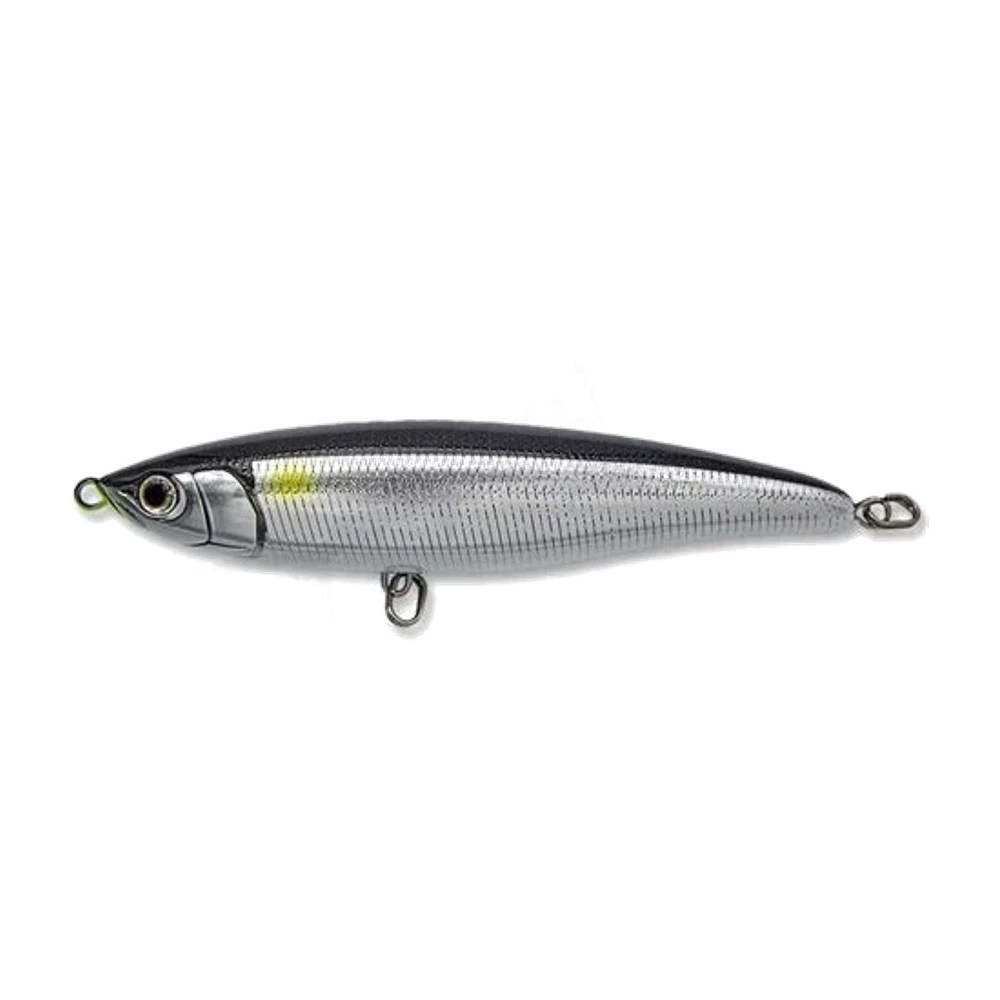
Maria Loaded: the beach minnow that cuts through the breakers
Rather not fish it blind? Photograph your spot — CarnaFish cross-checks the conditions and points you the right way.
A sand beach is the most frustrating spot on the coast. Nothing to read: no rock, no visible drop-off, a band of foam moving in and out and 200 m of identical shoreline. Yet the bass is there, often within 20 m, busy picking up whatever the wave lifts off the bottom. The problem is not finding it, it is presenting a lure that stays in the churned water instead of being thrown out by the first breaker.
A classic floating minnow cannot do it: it rises, it rolls over, it comes out of the foam. The Loaded was designed for exactly this zone — it stays pinned under the surface where the others lift off, and it casts far enough to clear the bar when you need it to.
A dense minnow, not a heavy one
The distinction matters. Plenty of "long distance" minnows earn their range with a ball that slides in a tube. That is effective on the cast, but those models are still floating lures once the ball has returned to its swimming position.
The Loaded works differently: it combines a weight transfer system for casting with a high overall density that holds it low in the column from the first turns of the handle. Two direct consequences on the beach:
- It goes through the foam without being lifted. When a breaker passes over it, it carries on its way instead of being thrown towards the surface.
- It starts swimming immediately, from the first half turn. On a 60 m cast, you do not lose ten metres waiting for it to fire up.
Its action is deliberately tight: a fast, regular roll, with no wide lateral sway. In water loaded with suspended sand, it is continuous vibration that carries best, not amplitude.
Setting the depth without changing lure
This is where the lure becomes interesting to fish. Its depth barely depends on speed at all, but on your rod angle. You cover three levels with the same model.
| Rod position | Approximate depth | Situation |
|---|---|---|
| Tip high, at 45° | 20 to 30 cm | Bass feeding in the foam, visible swirls |
| Tip horizontal | 50 to 70 cm | Standard searching, moderate sea |
| Tip lowered towards the water | 80 cm to 1 m | Deep rip channel, calm water, fish not coming up |
The habit to build: start with the tip horizontal, then correct after three casts based on what you feel. If the lure taps the sand, lift the tip. If it lifts off and rolls over in the foam, drop it.
The retrieve: slow, straight, and above all constant
The Loaded is not a twitching lure. Any attempt at a jerky retrieve breaks its roll and takes it out of its layer.
- Cast across, at 45° to the wave line, never square on to the beach. You want the lure to run along the band of foam instead of crossing it in one second.
- Close the bail and take up the slack immediately, before the next wave pushes a bow into the line.
- Retrieve at a constant speed, about one turn of the handle per second on a 3000-4000 reel. You should feel the roll continuously through the blank.
- Slow down noticeably as you reach the foam, over the last ten metres. That is where 70 % of bites come, and a lure that speeds up there gets refused.
- Do not strike on first contact: let the rod load for half a second then follow through. In the wave, a bass often takes as it turns away.
On the water: on a beach, the ebb is often worth more than the flood. As the water pulls back it empties the rip channels and drags everything that was sheltering there out to sea. Stand at the mouth of a rip channel — the zone where the returning current cuts a channel at right angles to the beach — and fish that channel across, not along its axis. Bass sit there in ambush and there is no need to hunt for them at 80 m.
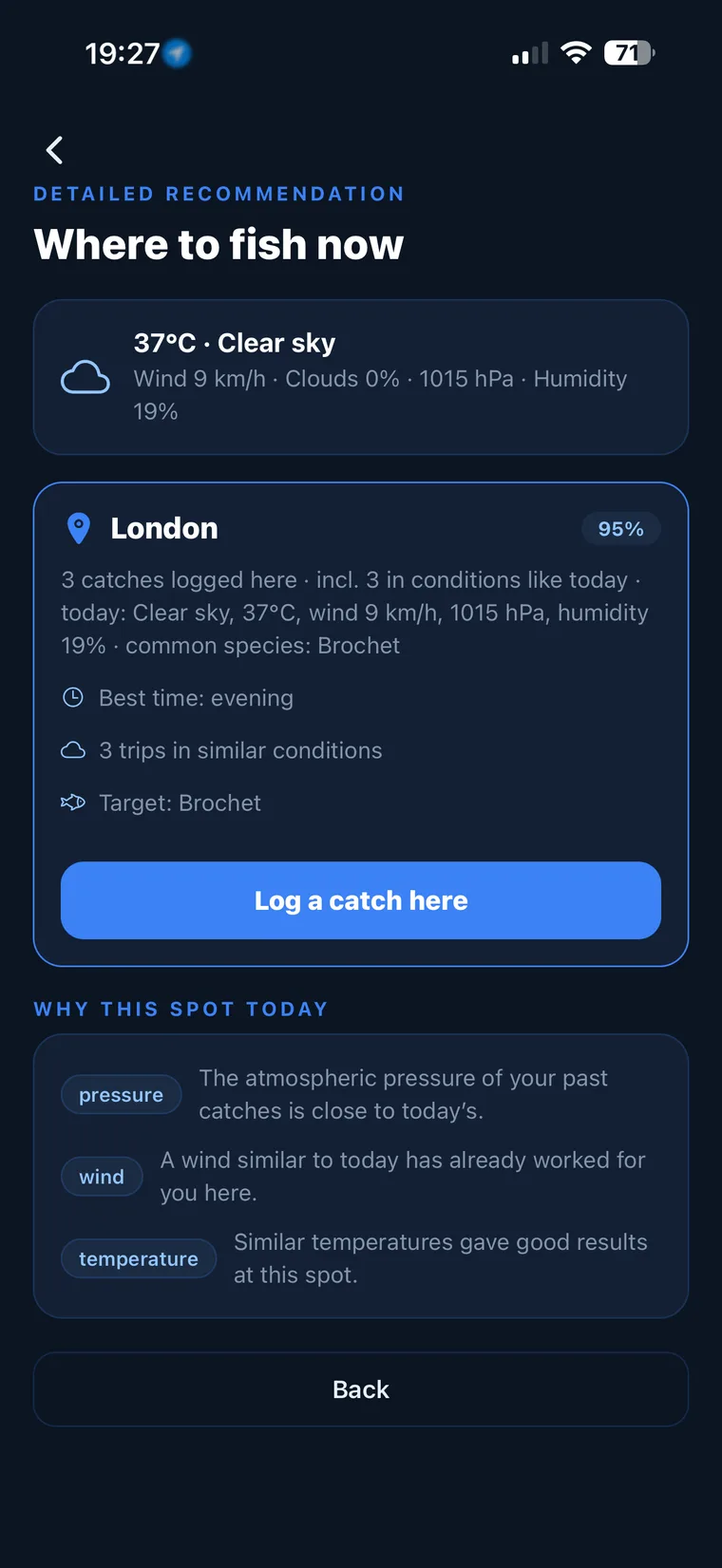
Not sure what to tie on?
Photograph your spot: CarnaFish reads the scene, cross-checks the conditions and gives you the zone, the lure and the retrieve. Free on iOS and Android.
When it excels, and when it is pointless
Its window is clear: churned water, sand bottom, shallow depth, low light.
- Dawn and dusk over the two hours of the ebb. That is the most consistent window.
- After a blow, when the water is still coloured but the sea is starting to lie down. The tight roll carries very well in water with 50 cm of visibility.
- Long flat foreshores, where you need to cover a lot of ground on foot.
On the other hand, it loses all interest:
- Over rock and in weed beds: its high density makes it work low, so it snags.
- On an oily calm in very clear water, where its mechanical roll looks false next to a softer lure.
- For vertical or deep fishing: this is not a water-column lure, it will never go below a metre.
- On educated harbour bass, where slowness and subtlety matter more than distance.
Loaded or a long-casting minnow: not the same job
The Shimano Exsence Silent Assassin shares the distance objective, but it serves it differently: a wider action, more pronounced buoyancy, total silence so as not to alert a wary bass in calm water. It is a flat-sea, clear-water lure. The Loaded is its opposite in terms of ground: dirty water, foam, waves.
The most useful comparison is with the Ima Sasuke, another beach reference. The Sasuke plays on a very unstable, almost floating action that excels in slow current and a slight sea. The Loaded, being denser, takes over as soon as the waves build and the Sasuke starts coming out of the water. Plenty of beach anglers alternate between them by the state of the sea rather than by the time of day.
Our guide to sea bass fishing with lures explains how to string these two families together over a single tide. And if you are unsure which water layer to attack when you get to your beach, CarnaFish analyses a photo of the spot and answers.
Key takeaways
- A dense minnow, not just a heavy one: it stays pinned under the surface in churned water.
- Depth is set by rod angle, from 20 cm to 1 m, without changing lure.
- Straight, constant retrieve, slowed over the last ten metres in the foam.
- Classic spot: the mouth of a rip channel on a sand beach, two hours of ebb at dawn.
- Wrong tool over rock, in weed, on an oily calm and for deep fishing.
FAQ
Does the Maria Loaded sink or float?
It is distinctly denser than a classic minnow and works low from the first turns of the handle. That density is what lets it stay under the surface as a breaker passes, where a floating model would be thrown out.
How far can you cast this lure?
With a rod of 2.70 to 3.00 m and fine braid, 50 to 70 m is routine depending on size and wind. The internal weight transfer does most of the work, so there is no need to force the cast.
What retrieve speed should I use?
A constant speed of about one turn of the handle per second, with no jerks. You should feel the roll permanently through the blank: the moment that sensation disappears, the lure has come out of its layer.
Does it work in very clear water?
Less well. Its tight, mechanical roll is at its best in water coloured up after a blow. On an oily calm in clear water, a lure with a looser action is generally better accepted.
Can it be used with a snap?
Yes, a light forged snap does not spoil its action. Avoid oversized models that weigh down the nose and roll the lure over in the wave.
Which tide is best on a sand beach?
The two hours of the ebb are often the most productive, because the falling water empties the rip channels and carries prey out to sea. Fish the mouth of the rip channel across the current rather than along its axis.
The full sea bass lure guideSeason-by-season strategy: which family of lure, when, and why.Go from theory to fish
CarnaFish reads your spot from a photo and gives you the game plan: zone, lure, retrieve. Free on iOS and Android.