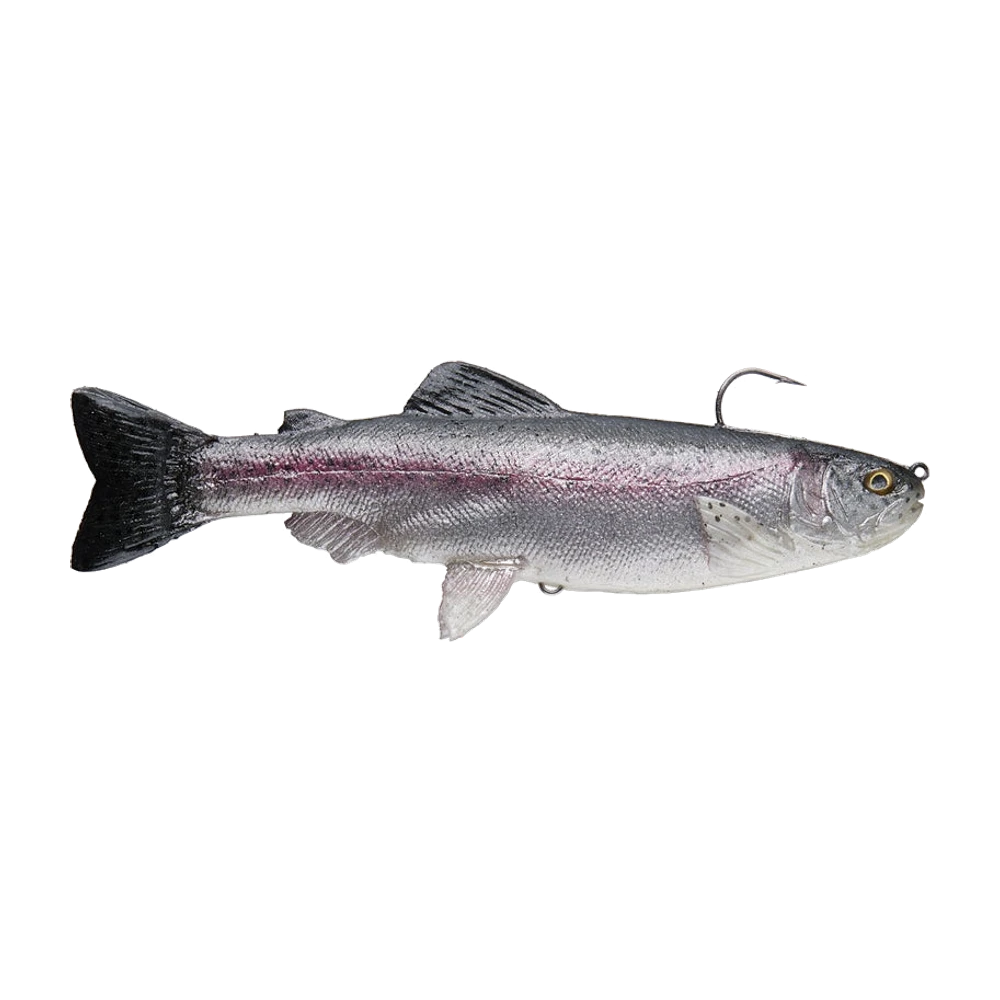
Mattlures Hammer Tail Trout: 25 cm of soft trout on a single hook
Not sure this lure fits YOUR spot today? CarnaFish tells you in 10 seconds, from a photo.
There is a threshold in swimbait fishing, and it sits somewhere around 200 g. Below it a good heavy rod still copes. Above it, casting becomes a skill of its own, the tackle changes completely, and the day's bites can be counted on one hand. The Mattlures Hammer Tail Trout is well past that threshold: 25.4 cm of soft plastic weighing 227 to 241 g depending on the version.
Two densities, one size
The maker's table is two lines long, and it has to be read in the order of its headings: length, weight, class. Both versions measure exactly 10 in, so 25.4 cm. The first weighs 8 oz, about 227 g, and sits in the Slow Sink class. The second weighs 8.5 oz, about 241 g, and moves up to Medium Sink. There is no floating version: both sink, faster or slower.
The gap is 14 g on a bait that weighs 227, six per cent. That sounds trivial, and it is the whole logic of this kind of bait: the volume does not change, the silhouette does not change, only density moves. You are not choosing between two sizes, you are choosing between two sink rates for exactly the same prey. It is the grammar of the Huddleston 8 in Trout, except that Huddleston puts a figure on each version's running depth while Mattlures stops at two words: no running depth is stated here. Slow Sink and Medium Sink describe a fall rate, not a height on the retrieve, so setting that height is entirely down to the angler.
The tail the bait is named after
The name comes straight from what the tail does. Mattlures describes a patented tail design that produces a heavy, attention-grabbing thud alongside a natural swimming motion. That is not just wording. A thin, supple paddle tail puts out a high-frequency vibration, fast and light, which a fish mostly reads from close range. A thick, broad tail like this one does the opposite: a low-frequency wave, spaced out, that carries much further and stays readable by the lateral line when visibility drops to a few tens of centimetres.
You feel it in the rod, thump after thump, regular, almost unpleasant at first. The day you stop feeling it, the tail has folded back on itself or a strand of weed has caught the hook: reel in and check, you are no longer fishing.
The tail beat is your only feedback on this bait. Get into the habit of counting the thumps over the first five metres of every retrieve: if the cadence changes along the way, you have touched something or the bait never restarted properly after the fall.
A swim that holds at every speed
Mattlures makes a point worth noting: the Hammer Tail Trout keeps its balanced swim both slow rolled along the bottom and burned through open water. On a soft bait this size that is not a given. Plenty of big swimbaits roll onto their side the moment you speed up, because the water the tail moves ends up beating what the body can absorb without rolling.
That opens a two-stage way of fishing. You cover water fast at mid depth to trigger a chase. The moment a fish shows itself, you come back slowly along the same line, letting the bait sink between sections of retrieve. The Megabass Magdraft allows the same pattern in far more manageable sizes.
Setting the height by counting
Since no depth is published, you have to measure it yourself, once. Cast over water whose depth you know, count the seconds from the moment the bait lands and let it fall on a free line until it touches bottom: that gives you a seconds-per-metre figure. From then on you fish the height you want by cutting the count short. Repeat the exercise for each version, they will not give the same number.
The single top hook, a deliberate choice
The bait carries one single hook, point up, set into the back just behind the head. Mattlures claims two consequences: it crawls over structure without hanging up, and hook sets are solid because all the energy goes into one point instead of being shared across six.
Both are true, and the trade-off deserves saying. A single top hook is far less forgiving on short strikes, where a fish nips the tail without taking the bait — common on a 25 cm lure. On the other hand, when a fish does take, it takes in the roof of the mouth and almost never shakes free during the fight. The photo also shows a nose ring and a small belly ring that the maker does not document: no treble is fitted to either straight out of the bag.
The classic mistake with this format
Striking straight away. With 25 cm of soft plastic between you and the point, a reflex strike pulls the bait out of the mouth before the fish has closed on it. The right sequence is the opposite: you feel the weight, you keep reeling for half a second while dropping the rod tip, and you set the hook once the rod is properly loaded. The other mistake is under-gunning the rod: a general-purpose heavy will not carry 240 g for long.
Not sure what to tie on?
Photograph your spot: CarnaFish reads the scene, cross-checks the conditions and gives you the zone, the lure and the retrieve. Free on iOS and Android.
Where and when to use it
The Hammer Tail Trout imitates a good-sized trout, which points its use somewhere very specific: water where trout actually exist as forage, deep lakes and reservoirs, often cold, sometimes stocked. That is its home ground in the United States, the one that produces big Californian bass.
In Europe, it is worth being honest: bass big enough to swallow a 25 cm prey item are rare, and this bait will meet a pike far more often than a bass. The slim profile and heavy swim suit big late-autumn and winter pike, when they want one large, calorie-rich meal rather than a string of small ones. The leader has to follow: very thick fluorocarbon as a minimum, wire or titanium in water known for big fish. For an intermediate size and a gliding action, a Deps Slide Swimmer 250 covers other situations.
Colours by water clarity
Mattlures does not publish a finish list in this model's description, and we are not going to invent colour names.
- Clear water: the rainbow trout pattern shown here, speckled grey back, silver flanks and a pink lateral band. A literal imitation, unforgiving in gin-clear water but exactly what you want on an educated fish.
- Stained water: a finish with a more marked back, which keeps a readable silhouette when light struggles to get through.
- Low light: a genuinely dark tone that stands out in silhouette from below. On a bait this bulky, shape counts for more than colour.
Reaching for a bait this size is first of all a bet on big fish being present, and no product page can guess that for you. That is exactly what CarnaFish does: a photo of the spot, and the AI suggests the zone, the depth band and the lure type that fit the day's conditions. To place this format among the other families, our guide to choosing a pike lure sets the frame.
What to remember
- One size, 25.4 cm, and two densities: 227 g in Slow Sink, 241 g in Medium Sink, both sinking.
- The maker states no running depth: you set the height yourself, by counting the fall.
- The tail puts out a heavy, low-frequency beat that carries, and it is your only feedback during the retrieve.
- Single top hook: fewer short strikes converted, but remarkable holding power once the fish is on.
FAQ
Should I pick Slow Sink or Medium Sink?
Slow Sink for shallow work, over structure or weed, because it buys you more time before touching bottom. Medium Sink to reach a lower layer, or when wind and current force you to stay in contact. The size is identical either way.
What rod does it take to cast 240 g?
A rod built specifically for swimbaits, in extra-heavy power, with thick braid and a sturdy casting reel. A general-purpose heavy will not take the load over time: this is the one expense you should not try to work around.
Does the Hammer Tail Trout work for pike?
Yes, and in Europe that is the most realistic scenario for this format. The trout profile and heavy swim suit big late-autumn and winter pike. Use a suitable leader, very thick fluorocarbon as a minimum.
Why one hook instead of two trebles?
Because the bait is designed to crawl over structure without hanging up, which a belly treble makes impossible. The maker also stresses how cleanly a single point sets. The trade-off is real on short strikes.
How fast should I retrieve it?
Both extremes work according to Mattlures: a slow roll in contact with the bottom or a fast burn through open water, the swim stays balanced. In practice, cover water fast to find the fish, then come back slowly over the zone that gave you a sign.
Does the soft plastic last?
Mattlures claims a very durable soft plastic build, meant to absorb violent strikes without losing its action. As on any soft bait, the area where the hook exits is the wear point to watch.
The full bass lure guideSeason-by-season strategy: which family of lure, when, and why.Go from theory to fish
CarnaFish reads your spot from a photo and gives you the game plan: zone, lure, retrieve. Free on iOS and Android.