Mattlures Magnum Hardgill: a resin bluegill in three buoyancies
Before tying this one on, it helps to know if the spot actually calls for it. CarnaFish reads the scene from a photo.
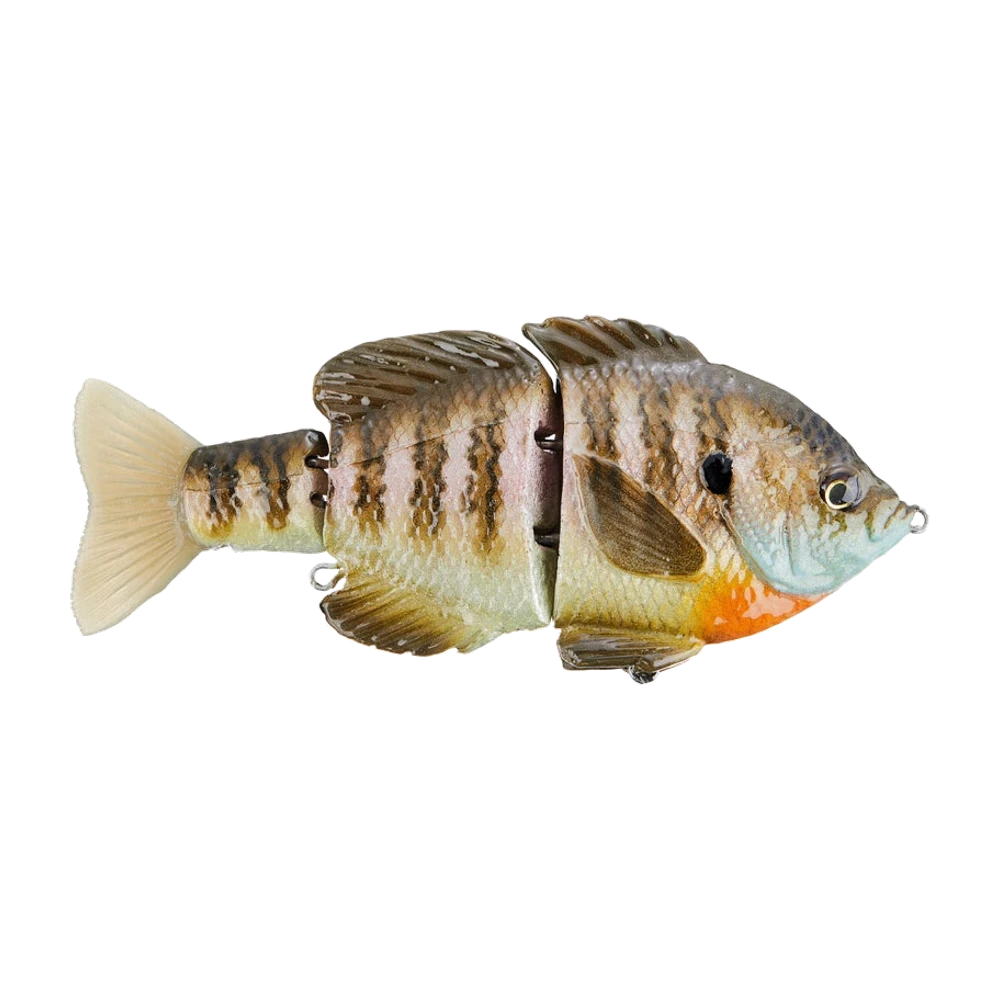
There are waters where bass eat almost nothing but panfish. Hard-bottomed ponds, reservoirs with rocky margins, anywhere the bluegill population runs wild and the big fish settle for one tall, broad, slow mouthful. Against that, a slim shad profile is simply the wrong shape. The Mattlures Magnum Hardgill answers that exact situation: 18.7 cm of jointed resin shaped like an adult bluegill.
Three versions, one weight
The maker's table lists three rows, in the order length, weight, class. All three measure 7-3/8 in, so 18.7 cm. All three are quoted at roughly 4 oz, about 113 g. What changes from line to line is neither size nor mass but the class: Floating, Slow Sink and Medium Sink.
The tilde in front of the weight is not decoration: Mattlures states that these baits are handmade and may vary slightly in both colour and weight. Two examples of the same reference will not be rigorously identical. That is the cost of hand building, and it has a practical consequence: if you own two Magnum Hardgills of the same class, take the time to find out which one falls faster before you mix them in the box.
Splitting buoyancy across a constant size has become the norm on big swimbaits. You are not choosing a bait, you are choosing a slice of water. The Floating to fish high and work above weed, the Slow Sink to hold mid water with no effort, the Medium Sink to drop properly down a break or a bluff. No depth figure is published by the maker, and that is a limit worth knowing before you buy.
A panfish shape, not a standard baitfish
The profile changes everything. A bluegill is tall, flat and short; it does not flee in a straight line like a roach, it pivots, turns side on and tucks in behind cover. A big bass hunting panfish attacks differently too: it comes up from underneath or takes the prey across the flank rather than from behind. That is why a bait of this shape usually works better near a piece of cover than cast into open water.
Mattlures also stresses the paint: carefully applied panfish patterns protected by a thick gloss clear coat that resists hook rash. On a bait at this price that is not cosmetic trivia — it is what keeps a season of fishing from turning the flanks into a scuffed mess. The body itself is built from a reinforced resin the brand calls its super resin, meant to take fish that chew.
If you fish the Magnum Hardgill near hard cover, alternate a fast pass and a slow pass along the same line. Big fish sitting under a limb rarely come out for a bait that goes by once; they come out on the second pass, when the prey seems to have settled in the area.
Two speeds, two different baits
This is the most interesting thing about the Magnum Hardgill. Mattlures describes a smooth, even swim at slow speeds and a distinctly harder action, with a marked thump, as soon as the retrieve picks up. On a jointed bait this size that switch is very real: crawled, the sections undulate one behind the other and the bait glides; wound in briskly, the rear takes on amplitude and sends a beat back up the rod.
That gives you two tools in one box. When the water is cold or the fish passive, you stay slow and let the bait do its own undulating without ever forcing it. When the water warms and fish are actively hunting, you wind hard to trigger a reaction. The same logic works on a Megabass Magdraft, but with a one-piece soft body: here the joints add amplitude a soft bait cannot produce.
Why you should not work it with the rod
The commonest mistake with a jointed swimbait is trying to impose rod strokes on it. A segmented bait is built so each section reacts to the one in front: a sharp pull breaks that chain, the bait folds back on itself and takes several metres to track straight again. Keep the rod low and still, and work purely with reel speed. If you want to break the rhythm, change speed or pause — not with the rod tip.
Hardware, and what the photo actually shows
Mattlures quotes upgraded hardware: sticky-sharp Owner hooks and heavy-duty stainless steel split rings. On the example photographed you can see the nose ring and two belly hangers, one under the head section and one under the middle section — but no treble is fitted in the picture. Bear that in mind when comparing product images: what ships with your bait depends on the reference and the retailer, not on the photo.
As for tackle, a 113 g bait needs a heavy to extra-heavy swimbait rod, thick braid and a casting reel that can take the load. For pike, add a wire or titanium leader: on a jointed bait a side-on strike often puts the teeth right on the line, between two sections.
Not sure what to tie on?
Photograph your spot: CarnaFish reads the scene, cross-checks the conditions and gives you the zone, the lure and the retrieve. Free on iOS and Android.
Where it earns its place, and where it does not
The Magnum Hardgill is built for water where panfish genuinely make up part of the menu: ponds and reservoirs with strong sunfish populations, rocky margins, dock edges, sparse weed. In a flowing river over uniform bottom, a profile this tall takes the current head on and loses much of its appeal next to a slim bait.
In Europe the tall profile also speaks to pike, which readily attack a broad, slow prey item in still or slow water. For the same approach in a far more manageable size, the Megabass Sleeper Gill or the Bucca Baby Bull Gill 3.75 cover the same silhouette without demanding a dedicated casting outfit.
Colours by water clarity
The description does not name the finishes one by one, but it states the direction clearly: realistic panfish patterns, applied in high detail.
- Clear water: the male bluegill pattern shown here, brown bars over greenish flanks, a bluish cheek and an orange throat patch. A literal imitation, justified when the fish has time to look.
- Stained water: a higher-contrast panfish finish that keeps the vertical bars readable as visibility drops.
- Low light: a dark tone that relies on the tall silhouette seen against the sky rather than on the detail of the paint.
Knowing whether a water really holds panfish in numbers is something you read on the bank, not off a package. That is exactly what CarnaFish makes easier: a photo of the spot, and the AI suggests the zone, the depth and the lure family that fit the day. To place this format among the other bass techniques, our guide to getting started on bass lays out the basics.
What to remember
- One size, 18.7 cm, and three classes: Floating, Slow Sink, Medium Sink, all around 113 g.
- The weight carries a tilde because the bait is handmade: two examples can differ slightly.
- The swim changes character with speed — a supple undulation when crawled, a hard thump when burned.
- Do not work it with the rod: a jointed bait is steered with the reel, sharp pulls fold it back on itself.
FAQ
Should I choose Floating, Slow Sink or Medium Sink?
Floating to work above weed or to pause without losing height. Slow Sink to hold mid water with minimum effort. Medium Sink to drop properly along a break. All three measure and weigh the same, only buoyancy changes.
Why is the weight quoted with a tilde?
Because Mattlures builds these baits by hand and states that colour and weight may both vary slightly from one example to the next. The 4 oz, roughly 113 g, is therefore an indication rather than an exact measurement.
Does it take a specific outfit to cast?
Yes. At 113 g with a tall profile that brakes in the air, it takes a heavy to extra-heavy swimbait rod, thick braid and a sturdy casting reel. A general-purpose bass outfit is not built for that.
Does the Magnum Hardgill work for pike?
Yes, a tall, slow silhouette is one pike readily attack in still or slow water. Use a wire or titanium leader: on a jointed bait a side-on strike often puts the jaws right where the line runs.
How does it differ from the original Hardgill?
The Magnum is presented as the big brother of the original Hardgill, with the same swimming characteristics in a larger size. If you are fishing average-sized fish or heavily pressured water, the original version still makes more sense.
Does the clear coat survive teeth and hooks?
Mattlures highlights a thick, glossy clear coat that protects the paint and resists hook rash. That is a central argument on a bait finished to this level, and it is also what separates a shelf queen from a bait that fishes all season.
The full bass lure guideSeason-by-season strategy: which family of lure, when, and why.Go from theory to fish
CarnaFish reads your spot from a photo and gives you the game plan: zone, lure, retrieve. Free on iOS and Android.