Raid Japan G-Dash Swimbait: 13 cm of jointed body just under the surface
One lure, endless conditions. CarnaFish reads your spot from a photo so you are not just guessing.
There is one band of water almost no lure fishes properly: the first thirty centimetres under the surface. Too deep for a popper, too shallow for a standard swimbait that dives from the first turns of the handle. That is exactly the layer Raid Japan's G-Dash targets, a triple-jointed hard swimbait whose spec sheet carries an unambiguous entry: Subsurface.
Reading the spec table correctly
The maker's table has four columns, and the first one traps hurried readers: it holds the model name, not a measurement. So for the G-Dash Swimbait you read a length of 5.1 in, a weight of 1-3/8 oz and a class of Subsurface.
Converted, those figures give 12.95 cm and 38.98 g. Two roundings that clean — 13 cm and 39 g — give away a metric original: the lure was designed in centimetres and grams, and the imperial values are a conversion for the American market. So remember 13 cm for 39 g, that is the real figure.
The Class column settles a question the silhouette cannot answer: the lure is neither floating nor diving, it is rated Subsurface, meaning built to run just under the surface. That entry outranks any visual impression.
39 g for 13 cm, and what that implies
That ratio is worth a pause. 39 g over 13 cm is heavy for the size — a soft swimbait of the same length often weighs half as much. The hard body, the four segments and their hardware explain the gap.
The direct consequence: this is not a lure for an all-round rod. You need a swimbait rod, enough power to throw 40 g without snapping, and 0.30-0.40 mm braid. Try to cast it on a medium outfit and you will break the rod before you catch a fish.
A swimbait this heavy is cast by escorting it, never by whipping. Slow movement, wide arc, and let the lure go on its own. Broken tips on this kind of lure happen almost entirely on the cast, not during the fight.
Two speeds, two claimed behaviours
Raid Japan states a flat-sided body built to stabilise the swim posture at any speed, and describes two distinct registers.
On a steady retrieve the body swings from flank to flank, in what the brand describes as a defenceless, unguarded mode. That is the slow swim, the one that works on a fish that has been watching for a while.
On a fast retrieve the lure kicks water violently, like a fleeing baitfish. That is the trigger register, the one you use when a fish follows without committing and the decision has to be forced.
The maker also stresses a less common point: the G-Dash reacts to the slightest pull of line slack, to current or to wind, and then twists or glides on the surface. In other words, part of its work happens without you animating it — provided you give it slack, which is counter-intuitive if you come from classic hard-bait fishing.
The mistake that ruins the swim
Retrieving on a permanently tight line. A lure that reacts to slack loses the point entirely if you keep it reined in. Leave a small loop between rod tip and lure, especially on a slow retrieve: that loop is what lets the body pivot freely between turns of the handle.
Bluegill profile, and what that means in European water
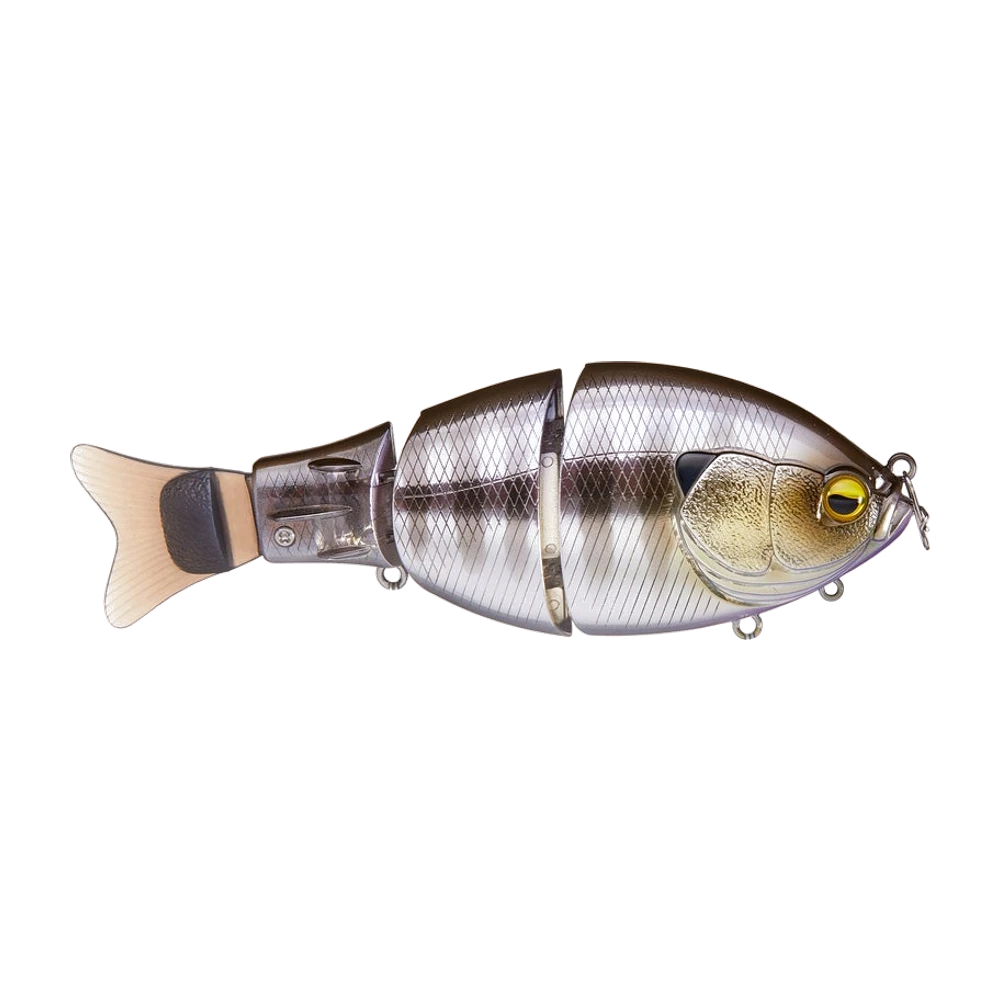
Raid Japan claims a bluegill profile, the North American sunfish that is a major bass prey. The body is deep, short and flat, very different from a slim swimbait imitating an elongated baitfish.
In Europe the bluegill is practically absent, but the deep round silhouette stays relevant: it matches what a predator reads when it sees a small bream, a large roach or a young perch head-on. On a European bass water it is a credible profile; on a pike spot a deep-bodied 13 cm bait is well within range, provided you fit a wire or titanium leader.
Not sure what to tie on?
Photograph your spot: CarnaFish reads the scene, cross-checks the conditions and gives you the zone, the lure and the retrieve. Free on iOS and Android.
What the photo shows
The lure is photographed bare: no hooks are fitted. You can make out four segments linked by three joints — consistent with the stated triple jointing — a nose ring carrying a split ring, and three belly hook hangers. The fins, caudal included, are in translucent amber material and screw-fixed; Raid Japan presents them as surfboard-style fins meant to improve how the lure bites into the water. The finish is silver-grey with fine diamond scaling, a textured gold cheek and a 3D eye with a yellow iris. Hook size and count are not published on the source consulted: the above is an observation from a product photo, not a manufacturer specification.
Colour by water
Raid Japan advertises ultra-realistic colour patterns without listing them on the source consulted. Three registers cover the ground.
- Clear water, bright light: the scaled silver-grey with a gold cheek from the photo, which plays on the fineness of the finish rather than on contrast.
- Light bottom, sand or gravel: a gold or bronze dominant, visible without flashing.
- Stained water or heavy cloud: a strongly marked dark back, which gives a clean silhouette seen from below — the real angle of attack on a surface-running lure.
Against other jointed swimbaits
The G-Dash sits in a narrow niche. A Gan Craft Jointed Claw works as a glide bait with wide lateral sweeps; a Megabass Magdraft is a weighted soft bait that tracks straight and deeper. The closest relative is a Jackall Gantarel Swimbaits, also built on a deep sunfish silhouette. What sets the G-Dash apart is the Subsurface rating combined with its responsiveness to line slack: it fishes a layer the others pass through.
A lure of this size is not cast at random: it wants an identified spot and a precise water layer, which is exactly what CarnaFish makes easier — a photo of the spot, and the app suggests the zone, the depth and the lure type suited to the day's conditions. For everything about choosing big pike lures, our guide to choosing a pike lure is a useful complement to this page.
Key takeaways
- 13 cm for 39 g: the 5.1 in and 1-3/8 oz figures in the table are conversions of a metric original.
- Subsurface class stated by the maker: the lure works just under the surface, neither floating nor diving.
- Two claimed registers: lateral swing when slow, violent water-kicking when fast — plus a reaction to line slack worth learning to exploit.
- 39 g demands a dedicated swimbait rod; whipping the cast is the quickest way to break a tip.
FAQ
What is the real size of the G-Dash?
The table states 5.1 in, that is 12.95 cm, and 1-3/8 oz, that is 38.98 g. Both round to 13 cm and 39 g, which points to a metric design: take 13 cm for 39 g as the working figures.
Does the G-Dash float?
The maker calls it neither floating nor sinking: the table's Class column reads Subsurface, meaning a lure built to run just under the surface. That is the only data available on this point, and it outranks any impression drawn from the shape.
What rod do I need to cast it?
A swimbait rod able to throw 40 g comfortably, with 0.30-0.40 mm braid. A medium-power all-round outfit is not suitable: the risk of breaking on the cast is real.
How many hooks does it take?
The source consulted publishes neither the number nor the size of the hooks, and the lure is photographed bare. Three belly hangers are visible in the image, but that is only a product-photo observation: check the packaging.
Is it suitable for pike?
A deep-bodied 13 cm bait at 39 g sits comfortably in a pike's range, and a swim just under the surface matches an edge hunt. Fit a wire or titanium leader without fail: without one, a lure of this value goes on the first bite.
Do I have to work it with the rod?
Not necessarily. Raid Japan explains that the lure reacts to simply taking up line slack, to current or to wind. Keep a small loop of line and let it work: holding it on a permanently tight line cancels part of its action.
The full bass lure guideSeason-by-season strategy: which family of lure, when, and why.Go from theory to fish
CarnaFish reads your spot from a photo and gives you the game plan: zone, lure, retrieve. Free on iOS and Android.