Missile Baits Chunky D: the creature bait built around a full-size hook
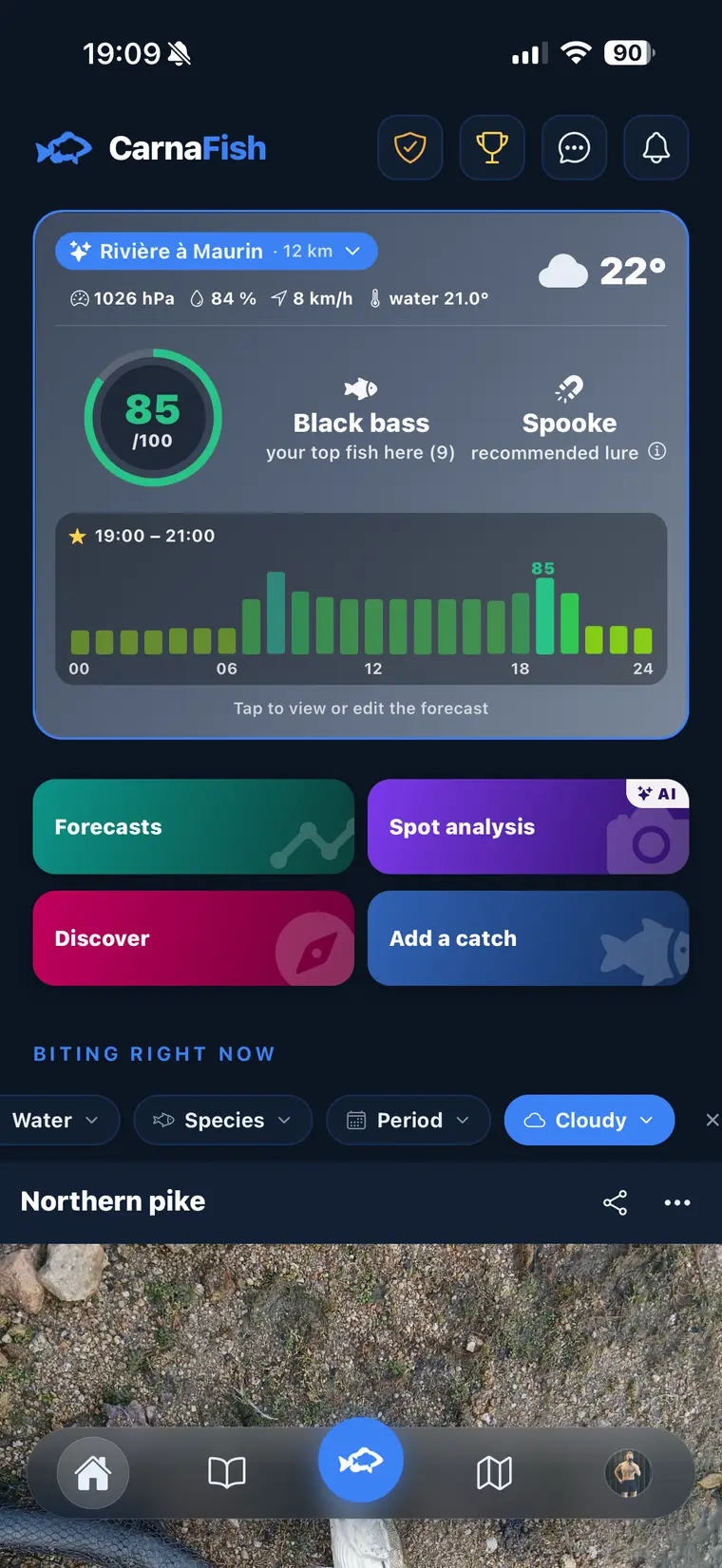
Before tying this one on, it helps to know if the spot actually calls for it. CarnaFish reads the scene from a photo.
You pitch a slim craw against a stump, you get two bites, and on the third you reel in a split bait with the hook point blown out through the side. The fish were there; the bait was not up to it. The Chunky D answers that exact problem: a creature bait thickened on purpose, drawn to take a full-size hook without tearing on the first bass.
The body: bulk exactly where the hook travels
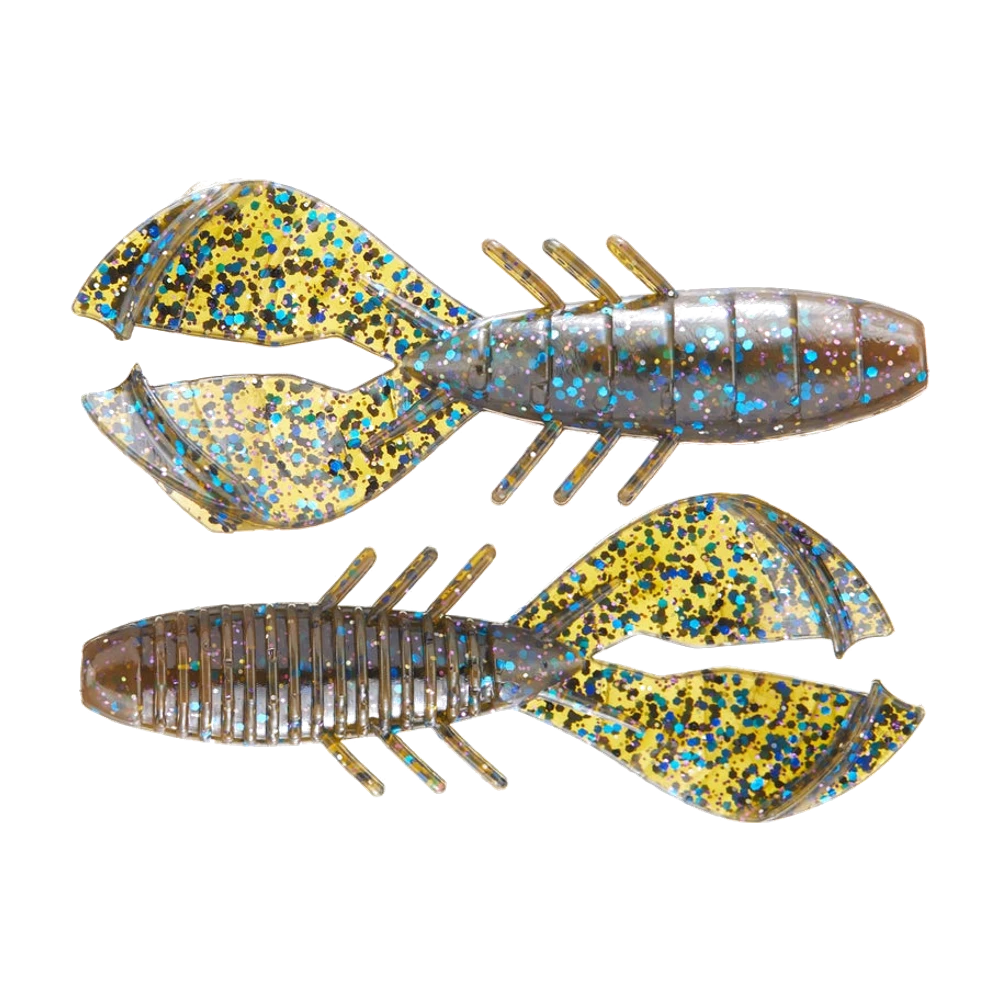
Missile Baits presents the Chunky D as the upsized version of the Mini D, and it is not just a question of centimetres. The body was thickened to accept full-size jig hooks, flipping hooks and EWG hooks — that is the maker's central claim, and it is the first thing you notice pulling one out of the bag.
The practical consequence is simple. On a slim creature bait you are stuck: a 4/0 heavy wire runs clean through the body and the point blows out of the flank on the first pull. So you drop back to a 3/0 fine wire, which bends on a good fish in heavy cover. The Chunky D removes that trade-off: there is enough material under the back to bury the point of a 5/0 heavy wire and leave it sitting flush without piercing.
The maker also stresses that the dense body resists tearing. That is what lets you keep the same bait through several fish in flooded timber, where a soft plastic shreds the moment you have to pull against a branch.
The only published dimension is the length: 8.9 cm / 3.5 in, sold six to a pack. The weight of the bare bait is not published, which hardly matters in practice since you set the whole thing up with the bullet or the jig head — but it is worth knowing before you try to compare densities on paper.
Two flappers and six legs: two frequencies on top of each other
The Chunky D carries three vibrating appendages on each side of the body and, at one end, a pair of wide flappers that Missile Baits describes as kicking hard on every drop, hop and drag.
Those two sets of appendages do not work in the same band. The flappers move a large volume of water at a low frequency: a heavy signal that travels a long way and gets through dirty water or a screen of branches. The six thin legs quiver at a high frequency at the slightest movement — including when the bait is sitting still and all you do is tighten the line.
That split has a direct effect on how you work the bait. The flappers fire on the vertical axis: free fall, sharp hop, a drop down the side of a piling. The legs fire on the horizontal axis: slow drag on the bottom, Carolina sweep, simple line tension. If you want both, alternate a drop and a drag instead of stacking ten identical hops.
Three rigs, three different jobs
Missile Baits lists three uses: jig trailer, Texas rig and Carolina rig. They do not do the same work and they are not fished at the same rhythm.
As a jig trailer
The most obvious use given the mass of the body. Behind a flipping jig or a football jig, the Chunky D adds volume and above all keeps the action going through pauses on the bottom, when the jig skirt has finished flaring and has stopped moving. Thread it up to the bait keeper collar, flappers to the rear, and slide it slightly down the bend so it sits straight.
Watch the jig weight: 14 g behind a body this bulky goes down sideways. On clean bottom down to four metres a 10 g head is plenty and leaves the flappers room to work on the way down.
Weighted Texas rig, flipping and pitching
The reference rig for flooded timber and reed edges. A 7 to 18 g tungsten bullet depending on how thick the cover is, pegged or free, a 4/0 EWG for everyday work, a 5/0 heavy wire as soon as you step up to heavy braid.
Leaving the bullet free over fifteen centimetres is the setting to try when the fish are slow: the weight hits bottom first, the bait keeps gliding and the flappers beat for two extra seconds. Pegged, the whole thing stays compact and punches through a vegetation mat better.
Carolina rig
Over a gravel flat or a clean break, the Carolina puts the Chunky D into its best horizontal register. Sweep the rod slowly over three or four seconds, pause, pick up the slack: the six legs vibrate continuously through the whole sweep, the bait stays at fish level and you cover far more water than on a Texas rig.
One reflex that changes the numbers: after every drop, give it two full seconds doing nothing, line half-tight. A bite on this bait usually shows up as line moving off at an angle during the stillness, not as a knock in the rod. Pick the contact back up too quickly and you will never see it.
The classic mistake
Rigging the Chunky D on a small hook to avoid damaging the bait. That is the opposite of what it is drawn for: a 2/0 or 3/0 with a narrow gap gets choked by the thickness of the body and you set on nothing. The body is built for big hooks — use them.
The second mistake is overweighting out of impatience. A 21 g bullet on a two-metre margin drops the bait like a rock, flappers pinned flat, with no signal at all. Take the lightest weight that still lets you feel bottom.
Not sure what to tie on?
Photograph your spot: CarnaFish reads the scene, cross-checks the conditions and gives you the zone, the lure and the retrieve. Free on iOS and Android.
Colours by water clarity
- Clear water: green pumpkin, the natural tone that works everywhere on wary bass and passes for a crayfish or a goby equally well.
- Lightly stained water: watermelon red, whose red flake gives just enough contrast without giving the bait away.
- Dark water, thick cover or low light: black and blue, a silhouette that reads cleanly under a mat of vegetation.
Where it has no business being
It is worth saying plainly: this is not a search bait. Over a big sandy flat with no relief you will spend ten times longer fishing than with a search lure, for fewer contacts. It is also too bulky for deep cold water, where a slim profile like the Keitech Crazy Flapper or a compact craw takes over, and it is of no interest at all for perch or zander. Its ground is a fish glued to an obstacle in temperate to warm water.
If you want the same family but with the fall deliberately braked by a ringed body, the Missile Baits D Bomb covers that register; the Chunky D leans instead on usable bulk and the thump of the flappers.
Choosing between a trailer, a Texas rig and a Carolina rig depends first on what is in front of you, and that is exactly what CarnaFish does: a photo of the spot, and the AI suggests the zone, the depth and the kind of presentation that suit the day's conditions. For the rest of the gear and the classic spot types, our beginner's guide to bass fishing covers the ground.
Key takeaways
- The body is thickened on purpose so a full-size jig, flipping or EWG hook sits in it without the point piercing the flank.
- Two signals stacked: low-frequency flappers on the fall, high-frequency thin legs on the drag.
- Jig trailer, weighted Texas rig and Carolina rig are three rhythms, not three ways of doing the same thing.
- The bare bait's weight is not published: you set everything with the bullet or the jig head.
FAQ
What hook size for a Chunky D?
A 4/0 EWG for everyday work, a 5/0 heavy wire as soon as you fish dense timber or move up to heavy braid. The body is thick: a narrow-gap hook gets choked and hooks badly, which is precisely what the design is meant to avoid.
How long is the Chunky D really?
8.9 cm, or 3.5 in, six to a pack. That is the only dimension Missile Baits publishes: the weight of the bare bait is not given.
Does the Chunky D work as a jig trailer?
Yes, it is one of its best uses. It adds volume and, more importantly, its flappers keep working through pauses on the bottom, when the skirt has stopped moving. Stay around a 10 g jig so you do not crush the fall.
What bullet weight should I use?
7 to 10 g on an open margin, 10 to 14 g in flooded timber, up to 18 g to get through thick vegetation. Take the lightest one that still lets you feel bottom: an overweighted bait falls with the flappers pinned and signals nothing.
Should the bullet be pegged against the bait?
Pegged, the whole rig stays compact and punches a mat better. Left free over fifteen centimetres, the weight reaches bottom ahead of the bait, which then glides much longer: that is the setting to favour when the fish are slow.
Is it a good lure for pike or perch?
Not really. It is a cover bait for bass, built for flipping and for trailer duty. For perch a compact craw or a ned rig will suit far better, and for pike it lacks the wire leader this kind of rig does not allow for.
The full bass lure guideSeason-by-season strategy: which family of lure, when, and why.Go from theory to fish
CarnaFish reads your spot from a photo and gives you the game plan: zone, lure, retrieve. Free on iOS and Android.