Missile Baits Ike's Monster Jig: the oversized jig on a 10/0 VMC hook
Rather not fish it blind? Photograph your spot — CarnaFish cross-checks the conditions and points you the right way.
You have been working a laydown for twenty minutes with a standard jig and you have landed three twelve-inch bass. The spot is good and the lure works — but it works for everyone, from this year's class to the big fish parked under the trunk. The Ike's Monster Jig starts from the opposite premise: a profile so bulky that small fish give up, leaving only the bass big enough to swallow a serious mouthful. It is a sorting tool, not a numbers bait, and that changes how you use it.
A jig built like a swimbait
Missile Baits calls it the swimbait of jigs, and the phrase describes the object well: the profile is way outside the category norm. It was designed to the specifications of Mike Iaconelli, a BASS Elite Series angler, with one stated goal — locating giant bass. Everything about the build follows from that.
That choice has a direct effect on the rhythm of a day. A standard jig gives you feedback every ten minutes: a bite, a follow, a tick. The Monster Jig can stay silent for an hour and then draw a strike that has nothing in common with the previous ones. If you need to see your line move to keep your confidence up, this is not the right tool.
The 10/0 hook, the centerpiece
The jig is built on a custom VMC jig hook in 10/0, finished with a super slick P.T.F.E. coating that speeds up penetration. That size deserves a pause: most production jigs sit somewhere between 3/0 and 5/0. Going to a 10/0 is not showing off, it is the condition for keeping the gap clear once a thick trailer is threaded onto the shank. With a smaller iron, the plastic fills the bend and your hookset finds nothing.
The PTFE coating addresses one specific point: how much force it takes to drive the point home. A hook that size needs more energy than a 3/0, and that is exactly where most fish come off, in the split second of the hookset. The slick coating offsets part of that resistance.
The tackle it demands
No point pretending otherwise: you do not bury a 10/0 with a medium rod and light braid. You need a genuinely powerful flipping or punching rod and heavy braid, tied straight through as soon as you get into dense vegetation. The motion changes too: take up the slack first, feel the weight of the fish, then sweep up and keep leaning into it. A short, snappy hookset usually slides off without catching anything.
Getting through the thickest stuff
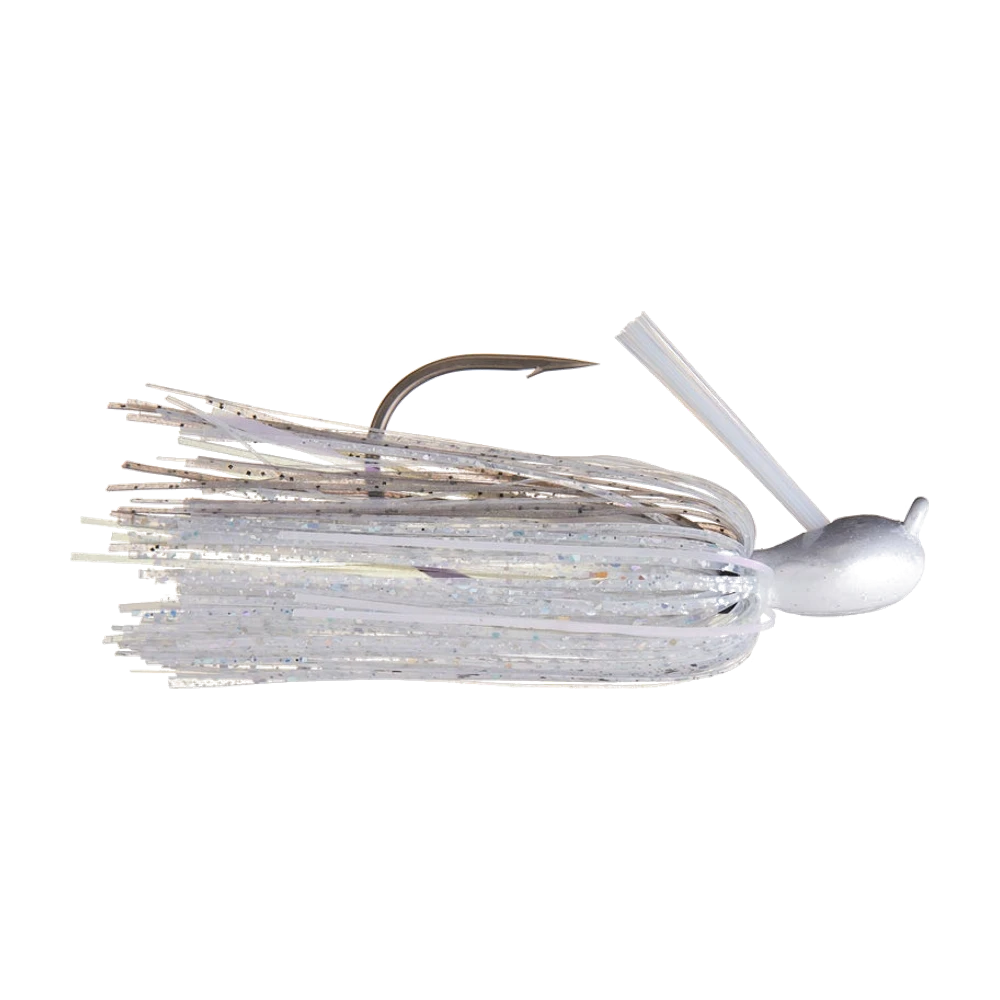
The head is described as all-purpose, balanced and snag-resistant, with a weed guard angled to let the jig pick apart the densest cover without burying itself. That is what you see on the bare lure: a brush of fibers standing just in front of the point, full enough to protect it, soft enough to collapse on the hookset.
That balanced head also explains the fall. The jig drops flat instead of nosing down, which gives the fine skirt time to open and pulse all the way to the bottom. Most bites happen during that phase, which is why you watch the line with your eyes rather than waiting for a pull in the rod.
The trailer keeper
A super spike wire keeper is set on the shank to hold the plastic. It sounds like a detail and it is not: on a jig this size, the trailer takes a beating on every branch. With no keeper, you reset the plastic every three casts, and a trailer that has slid back throws the whole package off balance. Here it stays put with no glue.
Trailer choice does half the work, by the way. A bulky creature like the Missile Baits D Bomb gives a massive profile and a slow fall; a craw with moving claws like the Missile Baits Craw Father adds kick and displacement on the drop. Two trailers, two different lures on the same head.
Flip, pitch, skip, swim
The manufacturer lists four uses, and they do not call for the same motion. Flipping, you drop the jig vertically under the rod tip into a hole in the vegetation or against a stump, and you follow the fall without working it. Pitching is the same idea at twenty or twenty-five feet, with a quiet entry you get by thumbing the spool just before impact.
Skipping is more demanding with a lure this bulky: it takes a genuinely low, flat trajectory to skate the jig under a dock. It works, but give yourself a few sessions before it gets clean.
The swimming retrieve is the least obvious use and often the most productive on water where bass see plenty of jigs on the bottom. Cast, let it drop for three seconds, then reel slowly and keep the lure just above the grass. The bulk creates a silhouette you can see from a distance in stained water, where a standard-size Dirty Jigs Scott Canterbury Flippin Jig would go unnoticed.
The bite on this jig almost never feels like a bite on a normal jig. There is no tick: the line moves off sideways, or it simply stops sinking. Fish it watching the first two yards of line, not waiting for a feeling in the handle.
Not sure what to tie on?
Photograph your spot: CarnaFish reads the scene, cross-checks the conditions and gives you the zone, the lure and the retrieve. Free on iOS and Android.
What the manufacturer does not publish
Let's be clear: the technical source gives no length, no head weight and no weight range for this model. We know the profile is oversized and the hook is a 10/0, and that is all. If you need a precise weight to match your rod or to hold a given depth, check the package or the retailer's listing before buying — making up a number here would be worse than useless.
What the description does state is the forage it is meant to match: big crawfish, bluegill, trout, hitch and gizzard shad, depending on the trailer you run. The last two are North American baitfish with no direct equivalent in Europe, but the principle carries over without trouble — a big roach or a young white fish fills the same slot in a bass's diet.
Colors by water clarity
- Clear water, silvery forage: pearl white flake, the one in the photo, which plays the baitfish card rather than the crawfish one.
- Lightly stained water: green pumpkin, the jig standby, discreet and believable against vegetation.
- Dark water or low light: black and blue, a hard silhouette that reads against the sky when visibility drops.
On a lure this bulky, color matters less than it does on a finesse bait: the fish picks up the mass and the skirt movement first.
Picking the right jig is pointless if you put it in the wrong place, and that is exactly what CarnaFish makes easier: a photo of the spot, and the app suggests the zone, the depth and the kind of presentation that suit the day's conditions. To build the tackle and spot-reading fundamentals, our beginner's guide to bass fishing is the right place to start.
Key takeaways
- An openly selective lure: fewer bites than a standard jig, but a much higher average size.
- The PTFE-coated 10/0 VMC hook demands a powerful rod, heavy braid and a long upward hookset.
- The balanced head drops the jig flat: the bite happens on the fall, with your eyes on the line.
- Neither length nor weight is published by the manufacturer, so check the package before buying.
FAQ
Why a hook as big as a 10/0?
Because a bulky trailer takes up room in the bend. With a 3/0 or a 4/0, the plastic blocks the gap and the hookset finds nothing to bite into. A 10/0 keeps the throat clear even with a large creature bait on the shank.
What trailer should I run on the Ike's Monster Jig?
A thick creature if you want maximum profile and a slow fall, a craw with moving appendages if you want kick on the drop. The wire keeper on the shank holds the plastic in place with no glue either way.
Is this jig any good for pike?
The manufacturer only targets bass, and the build — fiber weed guard, single hook, silicone skirt — matches that fishery. Nothing stops a pike from eating it, but without a wire leader you will lose the lure.
How much does the Ike's Monster Jig weigh?
The manufacturer publishes neither weight nor length. That is something to read off the package or ask the retailer, and it matters here because head weight directly controls how fast the jig drops through cover.
Should this jig only be fished on a flip?
No. The manufacturer lists four uses: flipping, pitching, skipping and a swimming retrieve. The last one surprises people most, because it pulls the lure out of the usual bottom-contact jig role and works it horizontally above the grass.
Why am I missing so many bites with this lure?
Two usual causes. Either the hookset is too short and too snappy for a hook that size — you need to lean into it upward after taking up the slack. Or the tackle is undersized and soaks up the force instead of transmitting it.
The full bass lure guideSeason-by-season strategy: which family of lure, when, and why.Go from theory to fish
CarnaFish reads your spot from a photo and gives you the game plan: zone, lure, retrieve. Free on iOS and Android.