Missile Baits Craw Father: the compact craw that lives in its claws
One lure, endless conditions. CarnaFish reads your spot from a photo so you are not just guessing.
A lily pad mat in August, thirty centimetres of water underneath, and bass that will not come out. You punch through with a 21 g weight, your big-flapper craw brakes in the vegetation, turns sideways and reaches bottom draped in debris. The problem is not the weight: it is the drag of the bait. The Craw Father was drawn against exactly that fault, by an angler who ran into it every weekend.
A 3.5-inch craw by John Crews
The Craw Father is the design of John Crews, owner of Missile Baits and an Elite Series competitor. He tells it himself: he built it because he kept looking for a compact craw with a specific action in the claws and could not find one. That kind of origin is not trivia — you can see it in the proportions, which are not trying to impress anyone on a shop peg.
The bait measures 8.9 cm / 3.5 in and comes seven to a pack. That is the only published dimension: Missile Baits does not give a weight for the bare bait, which changes nothing in practice since the bullet or the jig head sets the fall speed.
One more reference tells you something about the bait: Ish Monroe, also on the Elite Series, recounts saving a tough event on Lake Toho by switching to punching the Craw Father, and finishing in the top five with it. A competitor's story is not proof, but it at least marks out the register the bait was tested in: thick cover, hard conditions.
The claws: the only place anything happens
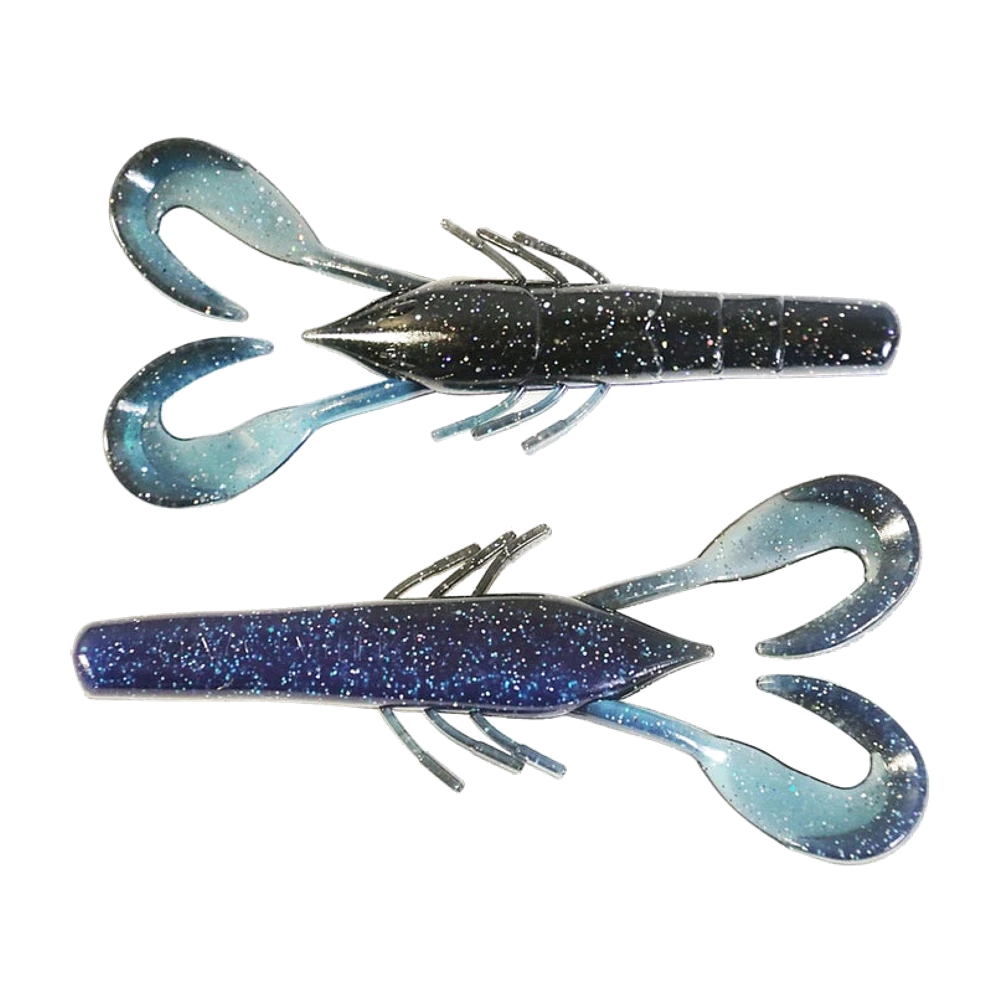
Look at the bait closely and the logic shows. The body is slim, segmented, almost smooth: it displaces hardly any water. All the action sits in the two claws, curled into a comma like a grub tail rather than flattened into paddles as on most American craws.
That geometry changes two things.
First, the claws undulate with no input at all. A flat paddle needs a decisive move to kick; a curled claw starts rolling and vibrating the moment water slides over it, including during a slow free fall. That is what keeps the Craw Father alive through the three seconds when you are doing nothing.
Second, the body offers no resistance. No bulge, no wide side appendage: the bait goes through a mat of vegetation nose first instead of turning sideways. That is exactly what punching demands, where anything sticking out catches.
The downside is worth stating: over clean bottom in dirty water, the Craw Father puts out less low-frequency signal than a thick creature bait like the Missile Baits Chunky D. This is not the noisy bait, it is the subtle-movement one.
Four uses, four rhythms
Missile Baits lists four applications: punching, flipping, Carolina rigging and jig trailer. They have almost nothing in common.
Punching
The register it was proven in. A 21 to 28 g tungsten bullet pegged against the bait, a 3/0 or 4/0 heavy-wire flipping hook, 0.35 to 0.40 mm braid, no leader. You drop it vertically, the bait punches the mat, and it is when it reaches open water underneath that the claws start to turn. Two seconds of stillness, a small twenty-centimetre lift, another fall, and you move to the next hole.
Flipping and pitching on the margins
Same rig, but a 10 to 14 g weight and a softer touch. Along a reed edge or a drowned tree, the bait enters the water without a splash and drops down the side of the obstacle. Follow the fall with the rod tip, line half-tight: a good share of the bites come before it reaches bottom, and show up only as line moving off at an angle.
Carolina rig
Over a gravel break or a clean flat, the Carolina puts the Craw Father into the one horizontal register that suits it. Sweep the rod slowly over three or four seconds, pause, pick up the slack. The claws undulate through the whole sweep, and the slim body does not lift the bait.
Jig trailer
Behind a flipping jig or a punching jig, it adds very little volume — which is precisely the point. When fish refuse a big-flapper trailer, the Craw Father keeps the jig's compact profile while adding two appendages that keep moving through pauses on the bottom.
On the water: when punching, do not count the seconds of the fall, listen to the braid. The sound changes when the bait passes the mat, and that noise is where your count starts. Anglers who count from the cast begin their pause too early and lift at precisely the moment the fish is making up its mind.
The classic mistake
Rigging a wide-gap EWG because that is the Texas-rig reflex. The Craw Father's body is slim: a 5/0 EWG leaves it hanging, the bait turns sideways and loses its passage through vegetation. Stay on a straight-shank flipping hook in 3/0 or 4/0, which holds the bait in line.
The second mistake is going too light when punching, hoping for a more natural fall. If the bait does not get through the mat, it is not fishing at all. Put on the weight it takes to punch; you can slow things down once you are underneath.
Not sure what to tie on?
Photograph your spot: CarnaFish reads the scene, cross-checks the conditions and gives you the zone, the lure and the retrieve. Free on iOS and Android.
Colours by water clarity
- Clear water: green pumpkin, the generic craw tone that never gives you away, the pick as soon as visibility passes a metre.
- Dark water or under a mat: black blue flake, the silhouette that reads best backlit from below, which is the bass's point of view under a carpet of vegetation.
- Mid stained water: a dark back with bluish claws, as in the photo on this page, which keeps contrast without turning into a loud bait.
Craw Father or a paddle craw
Against a Strike King Rage Craw, the split is clear. The Rage Craw carries wide paddles that kick hard: it carries a long way in dirty water and shines behind a jig when you want volume and water displacement. The Craw Father does the opposite: it displaces little, it travels through cover better, and it keeps moving when everything else is still.
In other words, pick according to the day's limiting factor. If the fish are not finding you, take the paddles. If the fish see you and refuse, or if the vegetation stops you reaching them, take the Craw Father.
That still leaves the question of which hole in the mat is worth a cast, and that is where CarnaFish comes in: a photo of the spot, and the AI suggests the zone and the presentation that match the day's conditions. To sharpen your reading of a spot before you even tie on, our guide to reading a fishing spot sets out the method.
Key takeaways
- All the action sits in the curled claws, which undulate on their own during the fall with no animation at all.
- The slim body is built to go through a mat nose first, not to displace water.
- Straight-shank flipping hook in 3/0 or 4/0: a wide EWG leaves the body hanging sideways.
- 8.9 cm, seven to a pack; the weight of the bare bait is not published by the manufacturer.
FAQ
What weight should I punch a Craw Father with?
21 to 28 g pegged against the bait to get through a mat of pads or hyacinth. Too light and the weight simply sits on the carpet and never fishes: the priority is punching through, and you slow things down once you are underneath.
Which hook should I use?
A heavy-wire straight-shank flipping hook in 3/0 or 4/0. The Craw Father's body is slim: a wide-gap EWG leaves it hanging off to one side and costs it its passage through vegetation.
Does the Craw Father work as a jig trailer?
Yes, and it is a good pick when you want to keep a compact profile. It adds very little volume to the jig, but its claws keep undulating through pauses on the bottom, when the skirt has stopped moving.
How big is it exactly?
8.9 cm, or 3.5 in, seven to a pack. That is the only dimension Missile Baits publishes; the weight of the bare bait is not given.
Should I animate it during the fall?
No, it is counterproductive. The curled claws turn by themselves the moment water slides over them. Your job is limited to keeping the line half-tight so you can see the bite, and waiting two seconds on the bottom before lifting.
Is it a lure for perch or zander?
Not really. The size and the heavy rigs are aimed at bass in cover. A perch may well take a Craw Father on a light jig head, but there are far smaller craws much better suited to that kind of fishing.
The full bass lure guideSeason-by-season strategy: which family of lure, when, and why.Go from theory to fish
CarnaFish reads your spot from a photo and gives you the game plan: zone, lure, retrieve. Free on iOS and Android.