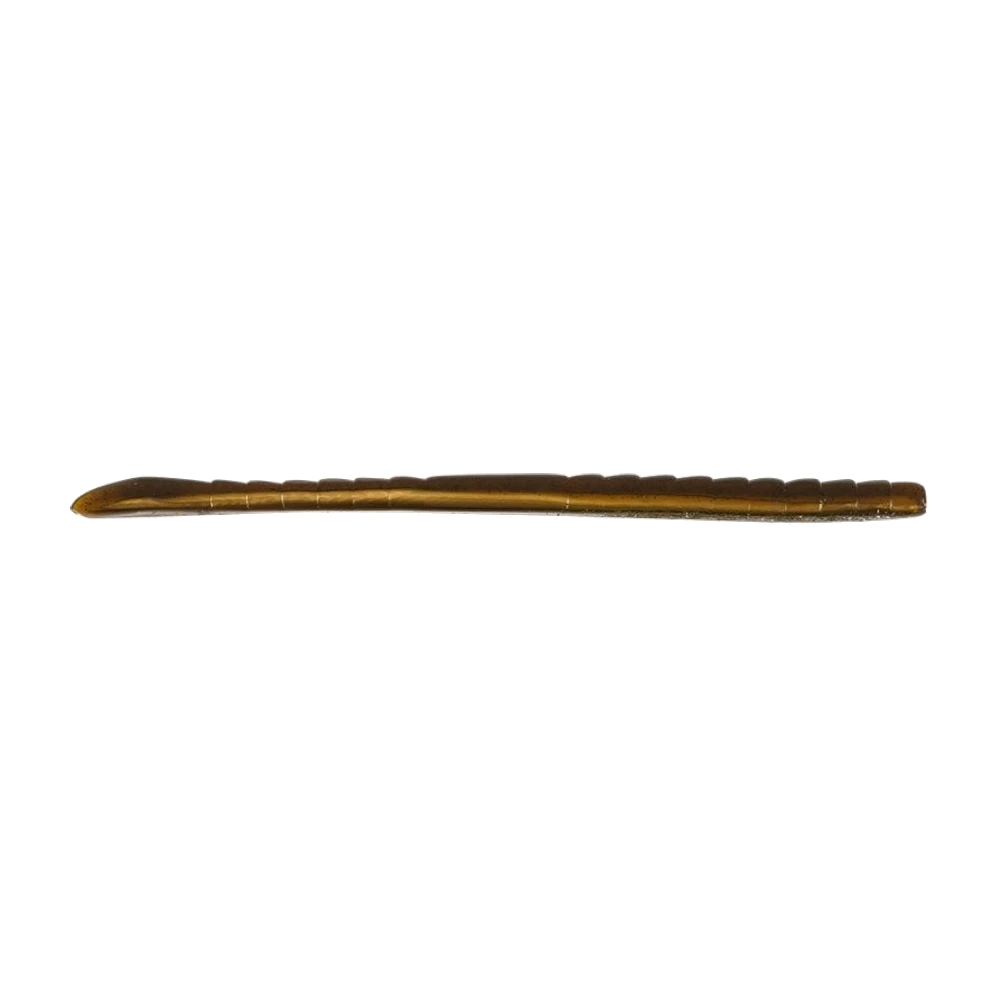
Missile Baits Magic Worm: the ribbed worm hand poured by Roboworm
Not sure this lure fits YOUR spot today? CarnaFish tells you in 10 seconds, from a photo.
You open your soft plastic box and count: one worm for the drop shot, another for the shaky head, a third for the Neko rig, a fourth for the Texas rig. Four bags, four part numbers, four versions of the same family with differences nobody could really justify on the water. The Magic Worm came out of that frustration: a single straight worm meant to cover every finesse presentation so the box stops growing.
Two workshops, one bait
The Magic Worm was designed at Missile Baits, but it is not made there: the pouring is handled by Roboworm, a shop that has specialized in it for a long time and works by hand rather than by injection. The difference is not just marketing. A hand-poured plastic has slightly more even density, no pronounced seam line, and a marginally softer surface — three details that matter when you drive a hook through the body and want the plastic to survive the third fish.
It also explains the particular feel of the material: the manufacturer describes a formula soft enough for a free action but durable enough to take a run of vicious strikes. In practice you reposition the worm on the hook several times before you have to pull a fresh one, which is not that common in this very soft category. A Roboworm Straight Tail follows the same manufacturing logic.
A ribbed body that pushes water
The profile tapers from nose to tail and, above all, carries aggressive ribs along its entire length. Those ribs are not decoration: they increase the surface in contact with the water and displace far more volume than a smooth worm of the same diameter. In practice, a four-inch pull on a smooth worm produces almost nothing perceptible; the same pull on a ribbed body sends out a small wave the fish picks up through its lateral line before it even sees the bait.
The second effect is tactile. The manufacturer stresses the feel at the moment of the take: a fish closing down on a ridged body registers something different from smooth plastic and hangs on a little longer before spitting it. When a fish holds the bait for two seconds instead of one, that converts straight into landed hooksets.
The tail stays thin and pointed. It has no paddle and generates no vibration on the retrieve: all of its work happens during the fall and the pauses, where it undulates with the slightest current.
Five rigs, one bag
Drop shot and shaky head
These are the two most direct uses. On a drop shot, nose-hook the Magic Worm, let it hang horizontally and just shake the rod tip: the ribs are enough to animate the body without moving the bait an inch. On a shaky head, the nose sits on a light jighead and the worm stands up tail-first, in the posture of a worm nosing through the bottom.
Neko rig
The Neko rig calls for a nail weight in the thick end and a hook pinned a third of the way down the body. The 15.2 cm version is the logical pick here: the bait pivots around its anchor point and the long tail whips the bottom on every pull. It is the most effective rig on hard bottom and inactive fish, in the same family of ideas as a Daiwa Yamamoto Neko Fat Worm.
Texas and Carolina
Texas rigged, with the hook point buried in the back, the worm becomes genuinely easy to pull through scattered vegetation. On a Carolina, the bait trails the weight by three to six feet and works the contour the whole time: leader length matters more than the rod work itself. In both cases, stay with a thin-wire hook, because heavy wire stiffens the body and kills exactly what makes this bait interesting.
Not sure what to tie on?
Photograph your spot: CarnaFish reads the scene, cross-checks the conditions and gives you the zone, the lure and the retrieve. Free on iOS and Android.
Two sizes, and what they change
The manufacturer offers two lengths: 4 in, or 10.2 cm, and 6 in, or 15.2 cm. The bags do not hold the same count — 16 for the small size, 14 for the large — which makes sense given the volume of plastic.
The choice is not only about fish size. The 10.2 cm version stays manageable on a light drop shot and on heads from 2 to 3.5 g; beyond that, the worm no longer has the volume to balance the head and the rig gets awkward. The 15.2 cm version, by contrast, needs weight to express itself, and that is the one to pull out for the Neko rig or the Carolina. If you only buy one to start, take the 10.2 cm: it covers more situations, and a wary bass rarely objects to a bait that is slightly too small.
With a ribbed worm, the habit to break is over-working it. Two or three shakes of the rod tip, then ten full seconds of stillness: the ribs keep working with the current through the whole pause. The line almost always moves off during that pause.
Colors by water clarity
- Clear water: the brown laminate with an amber belly from the photo, an earthworm tone that surprises no fish and works over sand or gravel.
- Lightly stained water: green pumpkin, the universal reference for bass plastics, keeping a natural look while gaining a little contrast.
- Dark water or low light: black, or black and blue, for a hard silhouette when visibility drops below a yard.
On a finesse worm, one detail matters as much as color: avoid oversized flake in very clear water under bright sun, since it throws flashes the plastic alone would never produce.
A do-everything worm does not replace reading the spot, and that is exactly what CarnaFish makes easier: a photo of the spot, and the app suggests the zone, the depth and the presentation that fit the conditions of the moment. For the rest of the fundamentals — tackle, classic spots, seasons — our beginner's guide to bass fishing covers the ground.
Key takeaways
- Designed by Missile Baits, hand poured by Roboworm: a soft plastic that still survives several fish on the hook.
- The pronounced ribs push water and change the feel in the mouth, which lengthens how long a fish holds the bait.
- Only two sizes, 10.2 and 15.2 cm, with distinct roles: light finesse on one side, Neko and Carolina on the other.
- A thin-wire hook is mandatory: heavy wire stiffens the body and cancels the action.
FAQ
Which Magic Worm size should I start with?
The 10.2 cm version. It works on a drop shot, a shaky head and a light Texas rig, and it stays coherent with jigheads from 2 to 3.5 g. The 15.2 cm is more specialized and needs weight to work properly.
How many worms per bag?
Sixteen in 10.2 cm and fourteen in 15.2 cm, according to the manufacturer's information. That is a reasonable count for a finesse season if you are not tearing the plastic on every fish.
Is the Magic Worm good on a Neko rig?
Yes, it is one of its best uses, especially in 15.2 cm. The nail weight in the thick end makes the bait pivot around its anchor point and the long thin tail whips the bottom on every pull.
How much does this worm weigh?
The manufacturer publishes no weight: it is an unweighted soft plastic whose working mass depends entirely on the lead you choose. The head or the bullet sets the fall rate, not the bait.
Why does my Magic Worm tear so fast?
Almost always because of a hook that is too thick, or one driven through the same spot twice. Shift the entry point by one rib each time you re-rig, and switch to thin wire if you are using a standard Texas hook.
Do I really need a ribbed worm rather than a smooth one?
In calm water and on wary fish, yes: the ribs produce a perceptible wave even on a tiny input, where a smooth worm displaces almost nothing. A smooth Zoom Trick Worm keeps the edge on a fast straight retrieve.
The full bass lure guideSeason-by-season strategy: which family of lure, when, and why.Go from theory to fish
CarnaFish reads your spot from a photo and gives you the game plan: zone, lure, retrieve. Free on iOS and Android.