Northland Eye Candy Paddle Shad: a narrow tail that kicks at a crawl
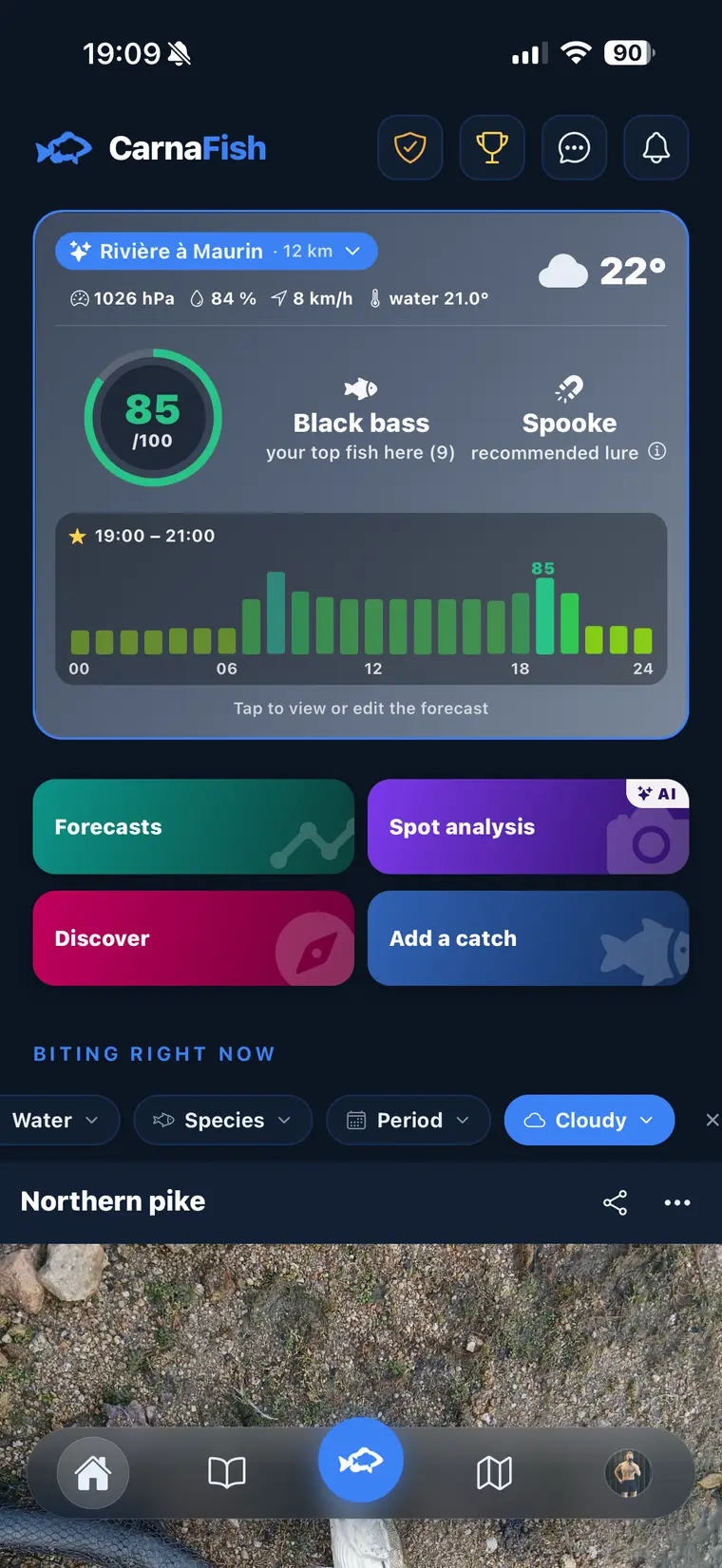
Not sure this lure fits YOUR spot today? CarnaFish tells you in 10 seconds, from a photo.
There are two families of paddle tail shads, and they get confused far too often. The ones whose tail is a big round scoop, thumping hard and slow, which you have to drive at a decent pace to wake up. And the ones whose tail is a thin blade sitting on a tapered wrist, which start vibrating at almost no speed at all. Northland's Eye Candy Paddle Shad clearly belongs to the second family, and that is what dictates how you fish it.
What the tail tells you
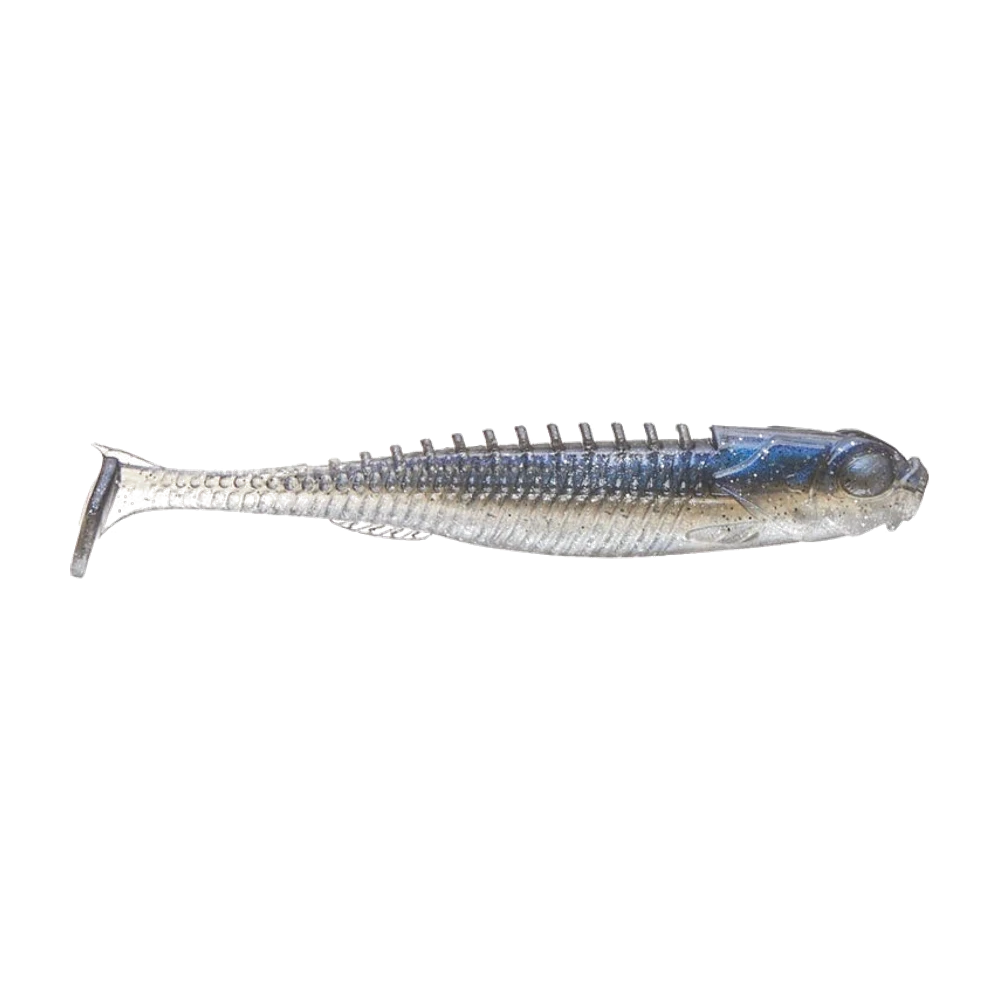
On the product photo, the paddle is nothing like a big spoon. It's a narrow, almost flat blade standing on edge, extended top and bottom by two small points that give it the silhouette of a caudal fin rather than a paddle. It sits on a very pinched wrist, clearly flattened side to side over the last couple of centimetres of the body.
That combination has a direct mechanical consequence: it takes little water to make the wrist give, so the tail starts early and kicks fast and tight, instead of tracing slow, wide sweeps. In practice, that means a crawl right on the bottom, barely a turn of the handle every two seconds, is enough to get the bait working. A wide paddle like the one on a Keitech Easy Shiner 4 stays dead at that speed and demands to be driven.
Northland does claim both registers: the bait is presented as effective whether you rip it aggressively or crawl it slowly along the bottom. That's consistent with the geometry, provided you accept that the swim changes character between the two — tight and nervous at a crawl, more of a roll once you speed up.
The ribbed back and the eye, two details that aren't decorative
The back carries a row of small upright nubs, short and evenly spaced, running from mid-body to the nape. The flanks are ringed along their whole length. Northland presents that ribbed back, together with the boot tail, as the source of the bait's swimming and wiggling action. Beyond the visual effect, those surfaces create turbulence along the body and give your fingers extra purchase when you're threading the thing onto a jighead without twisting it.
The eye explains the series name. It's an oversized moulded disc, set in a hollowed socket, framed by a moulded gill plate and pectoral fins in relief. On a bait meant to be seen close up — vertical fishing under a boat, or in a metre of clear water — that level of detail makes sense. At two metres in water with fifty centimetres of visibility, it makes none.
No published measurements: what to make of that
Let's be clear on one point: the Northland description we have in front of us gives no length, no weight and no pack count. No spec table at all. That's unusual for a soft bait sold in several sizes, and it means checking the format on the packaging before you buy, especially if you already have a specific jighead in mind.
Northland also highlights the buoyancy of its material, a Super TPE described as durable. That's a manufacturer's claim, not a measurement: nothing in this description indicates the bait floats on its own once rigged. What's worth keeping is the other half of the message — durability — which does show up in use: a well-formulated TPE takes several fish without the nose of the bait tearing at the collar.
Three ways to rig it
On a jighead
That's the main rig, and Northland explicitly points at its own Smeltinator Elite head, a slender-profile model built to imitate a thin baitfish. The logic: a narrow head doesn't break the body line, and lets the wrist do its job. Pick the lightest weight that still keeps you in contact — the heavier the head, the more you have to speed up to compensate, and the more you lose the low-speed kick advantage.
As a chatterbait or spinnerbait trailer
Northland cites both uses. On a chatterbait, a narrow paddle beats a wide one: it adds vibration without fighting the blade's own, which is what happens with an overpowered trailer that knocks the blade out of its rhythm. Same logic on a spinnerbait, where the shad lengthens the silhouette more than it generates signal.
Sight-fishing on sonar
The maker clearly positions this bait in the forward-facing sonar kit. The reasoning holds: a bait that vibrates at near-zero speed lets you stay in front of a fish you're tracking on screen instead of running past it. In Europe this style is still a minority pursuit, mostly on big lakes and reservoirs, but the quality it demands — swimming slowly without dying — matters to any zander angler working a slow straight retrieve.
Before buying, look at the barb orientation on your jighead keeper. With a ringed body like this one, a badly aligned barb tears the first ring on the third cast and the bait slides back down the hook. A ribbed keeper, the kind Northland claims on its Smeltinator head, exists precisely for that.
Not sure what to tie on?
Photograph your spot: CarnaFish reads the scene, cross-checks the conditions and gives you the zone, the lure and the retrieve. Free on iOS and Android.
Colour by water clarity
- Clear water: the blue-silver smelt of the photographed sample, with its glittered blue back and translucent pearl flanks. It works through transparency, which keeps it credible under bright light.
- Dense bait schools: a solid pearl white, which stands out against the grey mass of the school and gives the predator a point to lock onto.
- Stained water: chartreuse with a dark back, the usual compromise once visibility drops below a metre.
A rigging bait, not a finished lure
The Eye Candy Paddle Shad is only as good as what you put in front of it. Too heavy a head, too wide a hook gap, a trailer that isn't centred, and its advantage — swimming at very low speed — disappears entirely. Same logic as with a Keitech Swing Impact FAT 3.8 or a Basstrix Paddle Tail Swimbait: the body is only half the lure, the rig is the other half.
That still leaves the question of what depth and what structure to send it to. That's exactly what CarnaFish offers: a photo of the spot, and the app suggests the zone, the likely depth and the lure type suited to the moment. To build the basics of the slow retrieve and the spots to look for, our beginner's guide to zander fishing with lures covers the rigs worth knowing.
Key takeaways
- A narrow tail on a pinched wrist: the bait kicks fast and tight, and starts at very low speed.
- Northland publishes no length, no weight and no pack count in this description — check the format on the packaging.
- Super TPE material presented by the maker as durable and buoyant; durability shows in use, buoyancy stays a sales claim.
- Built to go on a slender jighead, but excellent as a chatterbait trailer thanks to a tail that doesn't crowd the blade.
FAQ
What size is the Eye Candy Paddle Shad?
The Northland description we have gives no length and no weight, and contains no spec table. Observed pricing suggests several formats exist, but the only reliable source is the packaging in your hand.
Does it float?
Northland highlights the buoyancy of its Super TPE material. That's a manufacturer's claim rather than a measured class: nothing says the bait stays suspended once mounted on a jighead, which will sink it anyway.
What jighead should I use with it?
Northland points at its own Smeltinator Elite, a slender-profile head. The principle holds beyond the brand: a narrow head and the lightest weight you can get away with, so you never have to speed up and lose the low-speed kick.
Does it work as a chatterbait trailer?
Yes, and it's one of its better jobs. The narrow tail adds vibration without clashing with the blade's rhythm, unlike a big paddle that can knock the blade out of its beat.
Is it any good for zander in Europe?
Northland aims it at bass and walleye, both of which feed on shad-type forage. European zander occupies a very similar niche, and a tight swim at low speed is exactly what it accepts on a slow retrieve near the bottom.
Why such a big eye on a soft bait?
That's the Eye Candy series signature: an oversized moulded eye in a hollowed socket, with gill plate and pectorals in relief. The detail only truly matters in clear water or vertical fishing under the boat, where the fish inspects the bait up close before committing.
The full bass lure guideSeason-by-season strategy: which family of lure, when, and why.Go from theory to fish
CarnaFish reads your spot from a photo and gives you the game plan: zone, lure, retrieve. Free on iOS and Android.