X Zone Muscle Back Craw: the craw that raises its claws at rest
Not sure this lure fits YOUR spot today? CarnaFish tells you in 10 seconds, from a photo.
A cornered crawfish does not run: it turns around, props itself on its tail and raises its claws above its head. Every bass angler knows that image, yet few soft plastics manage to reproduce it without any input from the rod. The X Zone Muscle Back Craw is built around that single idea: the moment you stop moving, the lure should take up the posture that triggers the strike.
Claws that rise, and why it matters
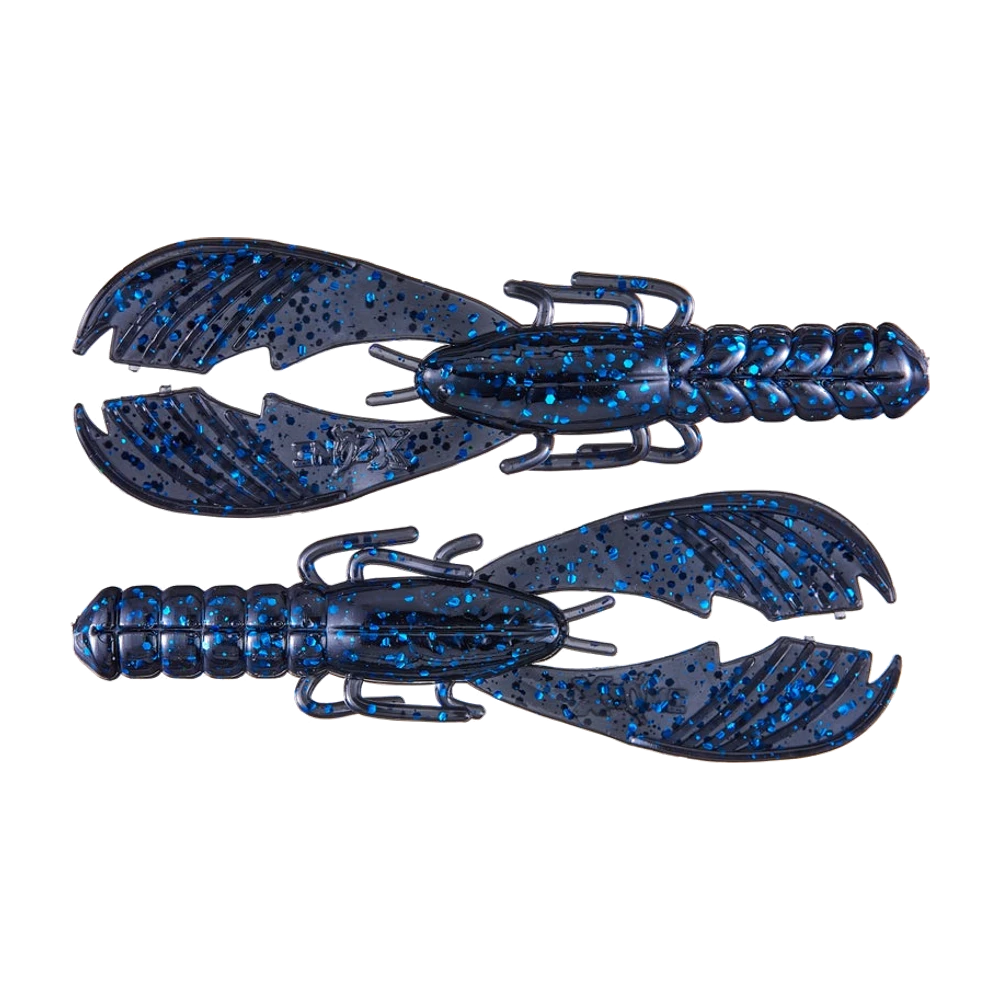
X Zone states a plastic formula that makes the claws float at rest. Sitting on the bottom, the lure therefore keeps its body flat and both claws pointing up towards the surface — exactly the defensive stance of a crawfish that has spotted a predator.
That is not cosmetic, it is a trigger. A bass does not attack a crawfish fleeing backwards, because chasing it costs too much; it attacks a crawfish planted facing it, claws in the air, offering itself as a stationary target. A lure that slumps limply onto the bottom misses that cue, and it misses a lot of bites with it.
One caveat: the plastic is also loaded with fine salt and a scent formula. Salt makes the material heavier and therefore works directly against the claimed buoyancy. The result depends on claw thickness and wear: a torn bait, or one rigged on a heavy hook, lifts far less convincingly. Check it in a bucket of water when you open a pack — it takes thirty seconds.
The cross-ribbed body, and what it actually does
The abdomen is cross-ribbed, a run of ridges that wrap around the body rather than sitting on one side only. Add two pairs of small side legs moulded along the flanks, clearly visible in the photo.
The maker speaks of a distinctive sonic signature. Stay sceptical about that phrasing: a soft plastic does not produce sound the way a rattling bait does. What it produces is low-frequency turbulence that the fish detects through its lateral line, and there the ribs and appendages genuinely play a part — at equal speed a ribbed body displaces more water than a smooth one. That is measurable, but it is a close-contact signal, not a call from ten metres away.
The claws are flat, ribbed on top and cupped along the outer edge. That channel is what makes them swim flat when the lure moves forward instead of simply trailing behind. In practice you get two behaviours in one bait: a stopped behaviour (claws up) and a moving behaviour (claws kicking), and it is the alternation between the two that does the work.
Never scrub the inside of the claw channel with a rough cloth when you rinse your lures. Sand it once and the claw stops swimming flat — and you will blame the failure on the colour.
Four rigs, four uses
Weighted Texas rig
Wide gap hook 3/0 or 4/0, tungsten bullet of 5-14 g / 3/16-1/2 oz. This is the reference rig for fishing a weed edge, a sunken tree or a pad line. The fall is the key moment: let it happen on a taut line and wait for the lure to settle before you move anything.
Punching
Same principle with a much heavier weight, 18-42 g / 5/8-1 1/2 oz, to get through a thick mat. The lure has to punch the vegetation in one go and then present itself in the open water below. It is brutal, but deadly in high summer when fish bury themselves under cover to escape the light.
Carolina rig
Separate sinker on the main line, leader of 60-90 cm / 24-36 in. The lure follows freely behind the weight with the claws working. It is the best rig over a wide stretch of bare bottom, where you have to cover ground without giving up contact.
Jig trailer
This is probably its most common use. Behind a flipping jig such as the War Eagle Jiu-Jigsu, the Muscle Back adds bulk, slows the drop and supplies most of the movement during the pause, since the skirt alone only breathes. Push it firmly onto the wire keeper on the shank so it cannot slide up.
The classic mistake: fidgeting through the pause
Plenty of anglers cannot sit still. They drop the lure, wait two seconds and start moving again. Yet it is precisely during complete stillness that the claws rise and the defensive posture sets up. Count to ten without touching anything at least once per spot: you will be surprised how many bites arrive on the seventh second.
If you want other takes on the soft craw, the Strike King Rage Craw goes the opposite way with claws that thrash on the smallest movement, and the Zoom Z Craw offers a slimmer profile for subtler rigs. The Missile Baits Craw Father is the other major reference as a jig trailer.
Not sure what to tie on?
Photograph your spot: CarnaFish reads the scene, cross-checks the conditions and gives you the zone, the lure and the retrieve. Free on iOS and Android.
Colours by water
- Stained water, dark bottom, heavy cloud: Black Blue Flake, the colour of the sample photographed, with its large blue flakes. It is the absolute jig-and-craw classic, and it owes its record to how cleanly the silhouette reads from below.
- Clear water: Green Pumpkin, the tone that matches European and North American crawfish most faithfully and puts no fish on alert.
- Early season, warming water: Brown Orange. Moulting crawfish take on red and orange tints in spring, and bass learn to spot them fast.
A craw bait only makes sense over bottom where crawfish actually live: rock, boulders, riprap, stumps. Spotting those areas on unfamiliar water is exactly what CarnaFish helps with: one photo of the spot, and the AI suggests the zone and the presentation to use. To lay the groundwork before tackling cluttered cover, our beginner's guide to bass fishing is the right place to start.
What to remember
- The claws rise at a dead stop and reproduce the defensive posture: that is the lure's main argument, and a bucket will confirm it.
- The salt in the plastic works against that buoyancy; on a worn bait or a heavy hook the effect fades.
- The cross-ribbed body and side legs produce close-contact turbulence, not a long-range call.
- Its best use remains the jig trailer, where it supplies the bulk and movement the skirt cannot.
FAQ
Which size of Muscle Back Craw should I pick?
The maker description does not list lengths and several sizes coexist depending on the retailer, so check the packaging before buying. Simple rule: the claws should extend slightly past the jig skirt when used as a trailer, without doubling the jig's bulk.
Do the claws really float?
That is the stated property, and a bucket of water confirms it easily. But the plastic is also salted, which weighs it down: the effect is clear on a fresh bait, much less so on a torn one or on a heavy hook.
Can I use it as a chatterbait trailer?
Yes, but it is not its ideal ground. A flat-clawed craw creates a lot of drag and can break the action of a fast chatterbait. Keep it for a jig or a Texas rig, where slowness is the point.
What hook for the Texas rig?
A wide gap Texas hook from 3/0 to 4/0 depending on the size of the bait. Rig it straight, point brought out and then just tucked under the skin of the back: the craw has to sit in line, or it will spin on the way down.
What time of year is this lure best?
From spring to autumn, with a clear peak when crawfish moult and leave the rocks. In cold water, the general slowdown in metabolism often makes a small finesse worm more effective.
Do I need to add attractant?
No, the plastic already carries fine salt and a scent formula. Adding gel on top brings nothing measurable and mainly ends up gumming up the storage box.
The full bass lure guideSeason-by-season strategy: which family of lure, when, and why.Go from theory to fish
CarnaFish reads your spot from a photo and gives you the game plan: zone, lure, retrieve. Free on iOS and Android.