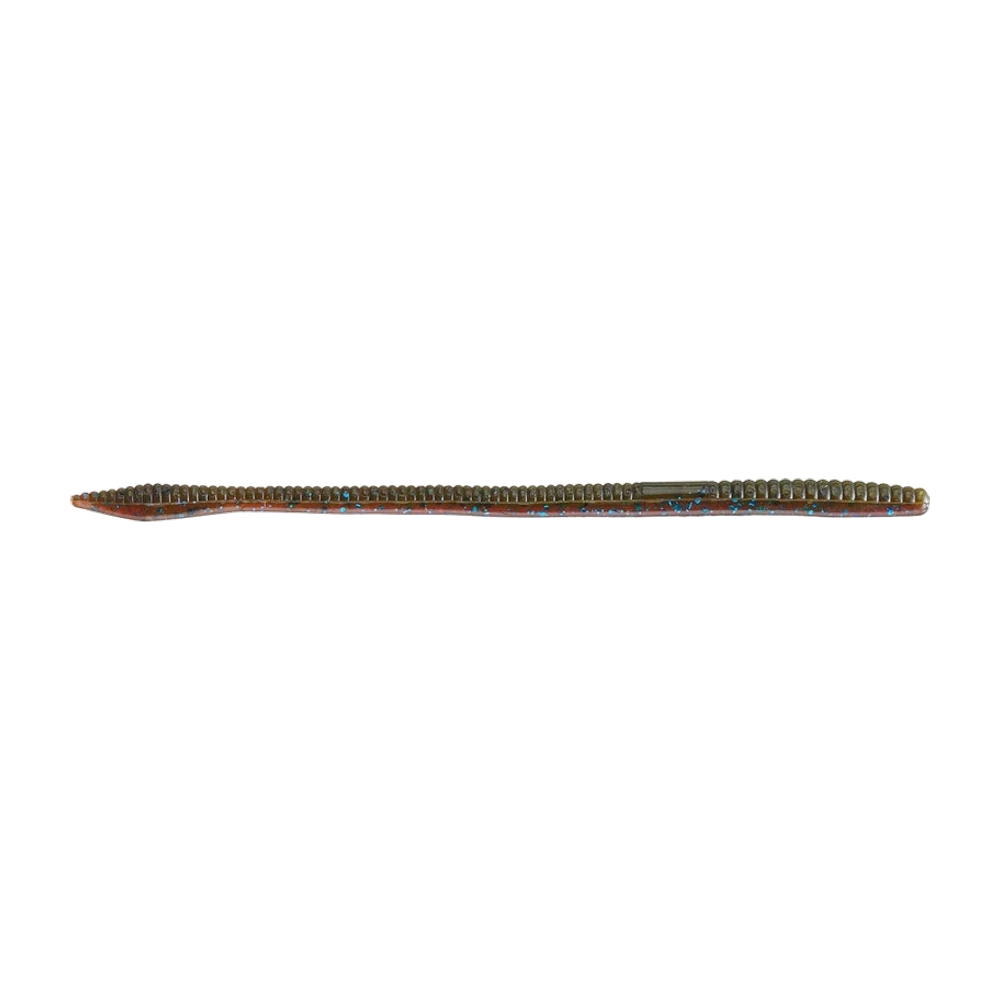
NetBait BaitFuel T-Mac Worm 6.5: the flat-bellied finesse worm
Rather not fish it blind? Photograph your spot — CarnaFish cross-checks the conditions and points you the right way.
There comes a point in the day when nothing works any more. The fish are there, the electronics show them, and they ignore everything that moves fast. That is exactly the window for a straight finesse worm: something long and soft that does almost nothing and stays in the zone for thirty seconds at a stretch. NetBait's T-Mac Worm is built for those days, and its asymmetric cross-section explains why it handles them better than a plain round worm does.
A section that is not round, and that matters
Look at the bait from the side: the back is rounded and covered in tight ribs, the belly is flat. That asymmetry is not decoration. A round-section worm rolls on itself when you pull it, and that rotation ruins the presentation — the body spins, the line twists with it, and the undulation loses all definition. A flat belly gives a bearing surface that keeps the bait on axis. The body waves vertically, which is what you want, instead of turning on itself.
The ribs on the back do a second job. They increase the surface in contact with the water, which slows the drop slightly and turns every micro-movement of the rod tip into a short vibration running the length of the body. The manufacturer uses them for a less obvious reason too: more surface means more scent in contact with the water. The plastic carries BaitFuel's X55 formula, injected into the material rather than applied on top.
The tail is bulbous rather than tapered. A worm ending in a fine point has almost no mass out there and stays dead below a certain level of input; a terminal swelling, even a modest one, gives enough inertia for the tip to keep moving a second after you have stopped moving the rod. On a presentation where you spend most of your time doing nothing, that is anything but a detail.
Here is the test that tells you whether you are overworking it: watch your slack line. If it pulls completely tight between two movements, you moved the bait. The T-Mac works properly when the line stays slightly loose and only the rod tip has travelled two or three centimetres.
Three rigs, three ways of doing nothing
Shaky head
This is the reference application. A 3 to 7 g offset-eye jighead, the worm nose-hooked and Texas-skin-hooked back into the body. Sitting on bottom, the worm stands up vertically, and the smallest shake of the rod tip makes all 16 centimetres of plastic quiver without the head moving at all. You fish one square metre for a full minute. Over a clean break or a gravel bottom, that is deadly.
Use the lightest head compatible with depth and wind: 3 g down to two metres, 5 g to four, 7 g beyond that or when it blows. Too much lead and the worm lies down instead of standing.
Wacky
Hooked through the middle, the worm folds into a V and falls with both ends fluttering. The 6.5 in is a little long for a classic wacky — it earns its place mainly when you want a slow fall and a strong silhouette in front of a fish that has already refused something shorter. Fit an o-ring or a silicone sleeve at the hook point: without one, a worm this long tears after two or three fish. The principle is covered on our wacky rig page.
Weightless floating worm
A classic American technique that the manufacturer explicitly lists among the T-Mac's uses. Worm rigged Texas-style with no weight at all, cast along a bank and retrieved in small twitches just under the surface. One caution: NetBait does not publish the density of the plastic, and a soft worm is not necessarily buoyant. Test it in a bucket before you build a session around it — if yours sinks slowly, the technique still works, but you will have to retrieve a little faster to keep it high.
The classic mistake
Striking at first contact. With a 16.5 cm worm, a bass rarely inhales the whole thing at once: it often takes it by the middle or the tail and turns afterwards. Strike on that first tap and you bring back a worm with tooth marks and nothing else. Drop the rod, give it a second, wait to feel the weight settle, then sweep into it. This is also where the scent earns its keep: a fish that holds the bait two seconds longer gives you exactly the time you need.
When to reach for it instead of something else
A finesse worm answers a situation; it is not a searching lure. You pick it up once you have already located fish — visually, on the sonar, or because a fast bait drew follows without strikes. Casting a T-Mac at random across a big flat is an hour wasted.
The three contexts where it shines: after a cold front, when fish are pinned to the bottom and refuse anything quick; on heavily fished water where the bass already know the usual profiles; and in high summer over hard bottom, when surface temperature pushes fish deep. In all three, a crankbait or any reaction bait will only move them around without making them bite.
Not sure what to tie on?
Photograph your spot: CarnaFish reads the scene, cross-checks the conditions and gives you the zone, the lure and the retrieve. Free on iOS and Android.
Colors by water clarity
- Clear to lightly stained water : Green Pumpkin Blue Flake, exactly the register of the photo on this page. Natural at rest, with flake that punctuates every small movement without turning the worm into a shiny object.
- Dark water, silty bottom, low light : Junebug, that purple-black cast that cuts a clean silhouette where a natural colour simply vanishes.
- Floating worm along cluttered banks : Bubblegum. A pink that imitates nothing at all, but lets you track your bait by eye and see the bite before you feel it. It is the one case where a loud colour has a real technical justification.
A slow bait needs a precise spot
Fishing a finesse worm means accepting that you will cover very little ground. Everything therefore happens before the cast: knowing where to put the bait is worth more than any rigging tweak. That is what CarnaFish does — one photo of the spot and the AI suggests the zone, the depth and the type of presentation that match what it sees, which saves you an hour of shaking a worm in the wrong place. For the rest of the tackle and the typical spots, our beginner's guide to bass fishing lays the groundwork.
Key takeaways
- Flat belly and ribbed back: the asymmetric section stops the worm rolling and preserves a readable vertical undulation.
- The shaky head is the main application, with the lightest possible head so the worm stands up instead of lying down.
- 16.5 cm is long: strike on a delay, after feeling the weight settle, never on first contact.
- The manufacturer publishes neither weight nor plastic density — bucket-test the buoyancy before committing to the floating worm version.
FAQ
What jighead weight should I use for the shaky head?
Between 3 and 7 g, offset eye, depending on depth and wind. The lighter the head, the better the worm stands vertical on the bottom; too heavy and it lies down, which removes most of the point of the rig.
Does the T-Mac Worm float?
The manufacturer lists the floating worm technique among its uses but does not publish the density of the plastic. Check it in a bucket before building a session on it: a slightly sinking worm fishes very well, just not in the same way.
Why 6.5 inches rather than something shorter?
16.5 cm gives a long profile visible from a distance while keeping a slim diameter, so the presentation stays discreet. That is the classic American finesse worm trade-off: visible, but without bulk, unlike a thick stickbait.
How many fish does one bait survive?
The manufacturer states a plastic soft enough for a fish to hold on to, yet durable enough for multiple catches. In practice an o-ring on the wacky rig and a clean hookset on the shaky head extend its life considerably.
Will it catch perch or pike?
It is a bass bait. A big perch may take a T-Mac on a light shaky head, but the profile stays large for it. For pike, the absence of a wire trace on this kind of finesse rig makes the whole thing a gamble.
Do I need fluorocarbon?
Yes for the shaky head and the wacky: line discretion matters as much as the bait on these slow presentations, and fluorocarbon transmits bottom contact better. A 0.20 to 0.25 mm diameter covers most situations in open water.
The full bass lure guideSeason-by-season strategy: which family of lure, when, and why.Go from theory to fish
CarnaFish reads your spot from a photo and gives you the game plan: zone, lure, retrieve. Free on iOS and Android.