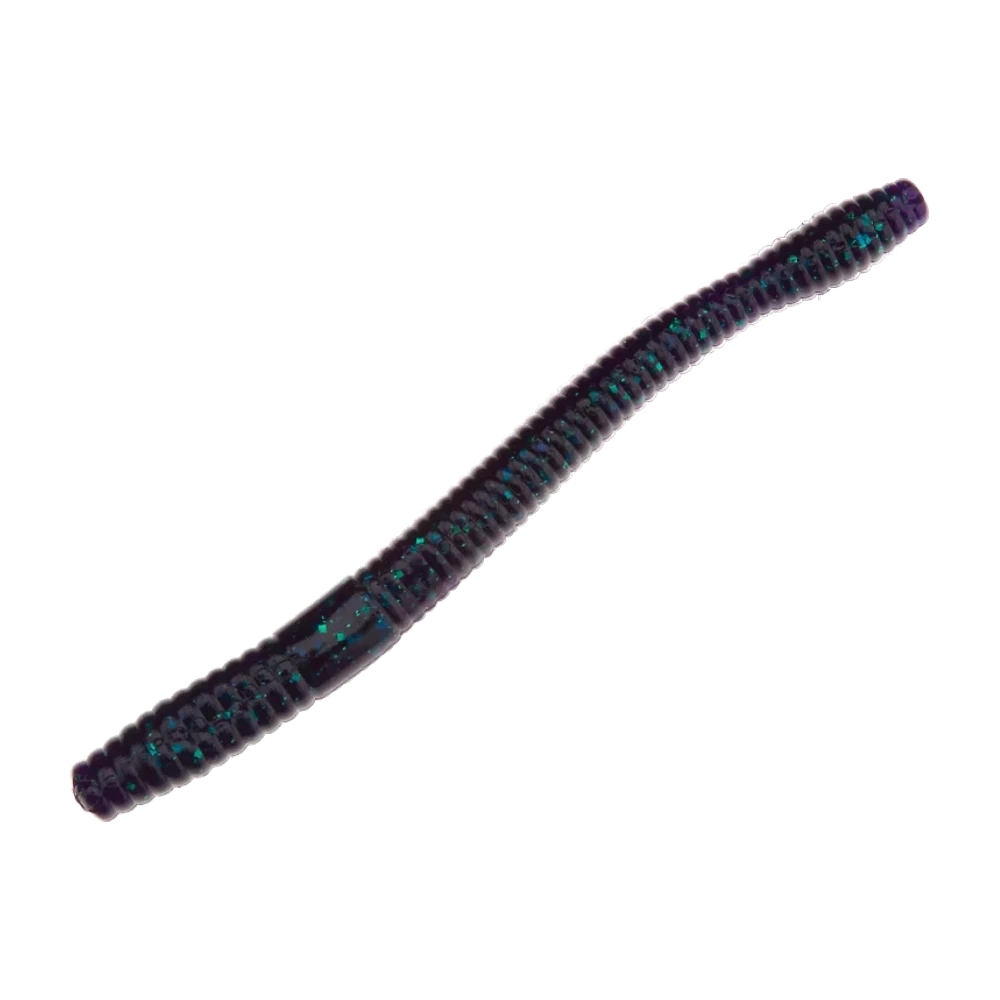
Zoom Magnum Finesse Worm: finesse without the small format
One lure, endless conditions. CarnaFish reads your spot from a photo so you are not just guessing.
The usual reasoning about finesse is binary. It is not biting, so you go down in size: a small worm, a small hook, a finer line. You end up catching fish — but often small ones, because you have built a rig any bass that comes along can swallow.
There is another way out of this problem. Keep the slow rhythm and the discreet presentation of finesse, but bring the volume of the bait back up in order to sort. That is exactly what a seventeen-centimetre straight worm on a finesse rig allows.
It is not a contradiction: finesse is a speed and a presentation, not a size. The Magnum Finesse Worm runs on that idea.
What a long straight worm adds
The silhouette is simple: a regular cylindrical body that tapers gradually to a very fine point. No appendages, no paddle tail, no mechanical vibration. That bareness is the whole point.
- The tapered tail moves constantly. Past a certain length, the tip becomes soft enough to wave under the slightest water movement — residual current, your line shifting, simply holding the rod. The bait is therefore alive at rest, which is the whole logic of a finesse rig.
- The body undulates along its whole length on the drop. A short worm falls straight; a seventeen-centimetre model bends and snakes.
- Volume sorts. A 25 cm bass will hesitate in front of that silhouette. A decent fish will not. On waters with a lot of small fish, that is a genuine filter.
Important point: this is not a reflex-hookset bait. On a long worm, the fish often takes it by the middle. You have to let it go.
The shaky head, the benchmark rig
The rig that gets the most out of this bait is the screw-lock jig head, known as a shaky head, which holds the worm vertically with the tip pointing up.
- Rig the worm on a 5 to 10 g head, 3/0 or 4/0 hook, body dead straight on the shank.
- Cast at your target — a rock, a dock piling, a weed edge — and let it sink on a semi-tight line.
- Wait for the lead to touch bottom, then do nothing for five seconds. The worm stands up, the tip waves.
- Shake the rod tip on the spot, without moving the lead. Two or three seconds. This is the core of the technique: the bait works, the head stays put.
- Move it thirty centimetres with a gentle pull, then start over.
- On the bite, drop the rod tip, let it go for one or two seconds, then set with a long sideways sweep.
On the water: do not count reel turns, count stops. Over a ten-metre stretch, aim for eight to ten stops, not two. Almost every bite comes while the bait is motionless and only the tip is moving — if you keep it travelling, you delete the one phase that produces bites.
A second useful rig is the heavily weighted drop shot: a 7 to 14 g weight, a 30 to 50 cm tag, hook through the head. You keep the worm up in the water column, off the bottom, and the length of the body becomes a clear advantage on fish holding along a break. The drop shot rig covers the knots and tag lengths.
A third option is the neko, with a nail inserted in the head of the worm: the descent becomes oblique and the tip stands up on contact with the bottom. It is close in spirit to the wacky rig, but with far more vertical behaviour.
Choosing the weight
| Depth | Wind / current | Weight | Rig |
|---|---|---|---|
| 1 to 3 m | None | 3 to 5 g | Shaky head or neko |
| 3 to 5 m | Moderate | 5 to 9 g | Shaky head |
| 5 to 8 m | Moderate to strong | 9 to 14 g | Heavy drop shot |
| Vertical break | Variable | 10 to 14 g | Drop shot |
The benchmark: take the lightest weight that still lets you feel contact with the bottom. The moment you lose that contact, you are fishing blind and no longer know whether your worm is standing up or lying down.
The line setup, often miscalibrated
This is where a lot of anglers go wrong, transposing their classic finesse habits.
Line. Fluorocarbon of 0.25 to 0.30 mm straight through, or 0.12 mm braid with a metre of 0.25 mm fluorocarbon. That is above the usual finesse diameters, and deliberately so: you are targeting bigger fish, often against cover, with a stronger hook.
Hook. 3/0 or 4/0 on a seventeen-centimetre body. A hook that is too small leaves too much loose plastic and you will miss hooksets.
Rod. A medium to medium-heavy action with a tip that stays sensitive. Too stiff and you pull the worm out of the fish's mouth while it is repositioning the bait; too soft and you will not set at fifteen metres with fluorocarbon.
Not sure what to tie on?
Photograph your spot: CarnaFish reads the scene, cross-checks the conditions and gives you the zone, the lure and the retrieve. Free on iOS and Android.
When it is not the right tool
- On active feeding fish. You waste time: a search bait catches more fish per hour.
- In very cold water on lethargic bass. The volume becomes excessive; at that point true small-format finesse takes over.
- In dense weed beds. A long worm collects vegetation, unless firmly Texas-rigged.
- On waters with small fish only. The sorting effect works against you if there is nothing big to sort.
Magnum or standard Finesse Worm: the sorting question
The classic Zoom Finesse Worm, around eleven centimetres, is the Swiss army knife of finesse: it catches everything, all the time, on every water. It is the default choice when you simply want a bite, and it remains unbeatable on difficult fish.
The Magnum changes the deal. It catches fewer fish, but bigger ones, and it handles depth and wind better thanks to heavier weights. Switching from one to the other comes down to a single criterion: if you are getting plenty of bites but the fish are small, go up in size. If you are getting no bites at all, that is not a volume problem, it is a location or a rhythm problem.
The two complement each other over a single session. Plenty of anglers fish the standard to find the fish, then switch to the Magnum once the zone is identified. Our beginner's guide to bass fishing applies the same two-stage search logic. And if you are torn between a small format and a big one when you reach the bank, CarnaFish analyses a photo of the spot and answers.
Key takeaways
- Finesse is a speed and a presentation, not a size: this worm keeps the slow rhythm and raises the volume.
- Shaky head first: shake the rod tip without moving the lead.
- Count stops, not reel turns. Eight to ten stops per spot.
- Let it go for one or two seconds before setting with a sideways sweep.
- It sorts the big ones: pointless on a water with no big fish, or on active fish.
FAQ
Isn't a 17 cm worm too big for finesse?
No, because finesse is defined by the rhythm and the discretion of the presentation, not by the size of the bait. A big worm fished slowly on a shaky head is still a very discreet presentation, with the added bonus of sorting out better fish.
Which rig should I favour?
The shaky head is the benchmark: it stands the worm up vertically and lets you shake it on the spot without moving the lead. The heavy drop shot takes over as soon as you need to fish up in the water column along a break.
What hook size should I use?
A 3/0 or a 4/0. On a seventeen-centimetre body, a smaller hook leaves too much loose plastic between the hook point of entry and the point, and you will miss a good share of your hooksets.
Should I set the hook immediately on the bite?
No. On a long worm, the bass often takes it by the middle and has to reposition it. Drop the rod tip, let it go for one or two seconds, then set with a long sideways sweep rather than a sharp upward snap.
What is the difference with the classic Finesse Worm?
The classic model of around eleven centimetres catches more fish, all sizes included, and remains the best choice when you simply want a bite. The Magnum gives fewer bites but selects the bigger fish and handles heavier weights.
What weight should I choose?
Take the lightest weight that still lets you feel contact with the bottom: 3 to 5 g down to three metres, 5 to 9 g down to five metres, 9 to 14 g beyond that or in sustained wind. Without bottom contact, you no longer know whether the worm is standing up.
The full bass lure guideSeason-by-season strategy: which family of lure, when, and why.Go from theory to fish
CarnaFish reads your spot from a photo and gives you the game plan: zone, lure, retrieve. Free on iOS and Android.