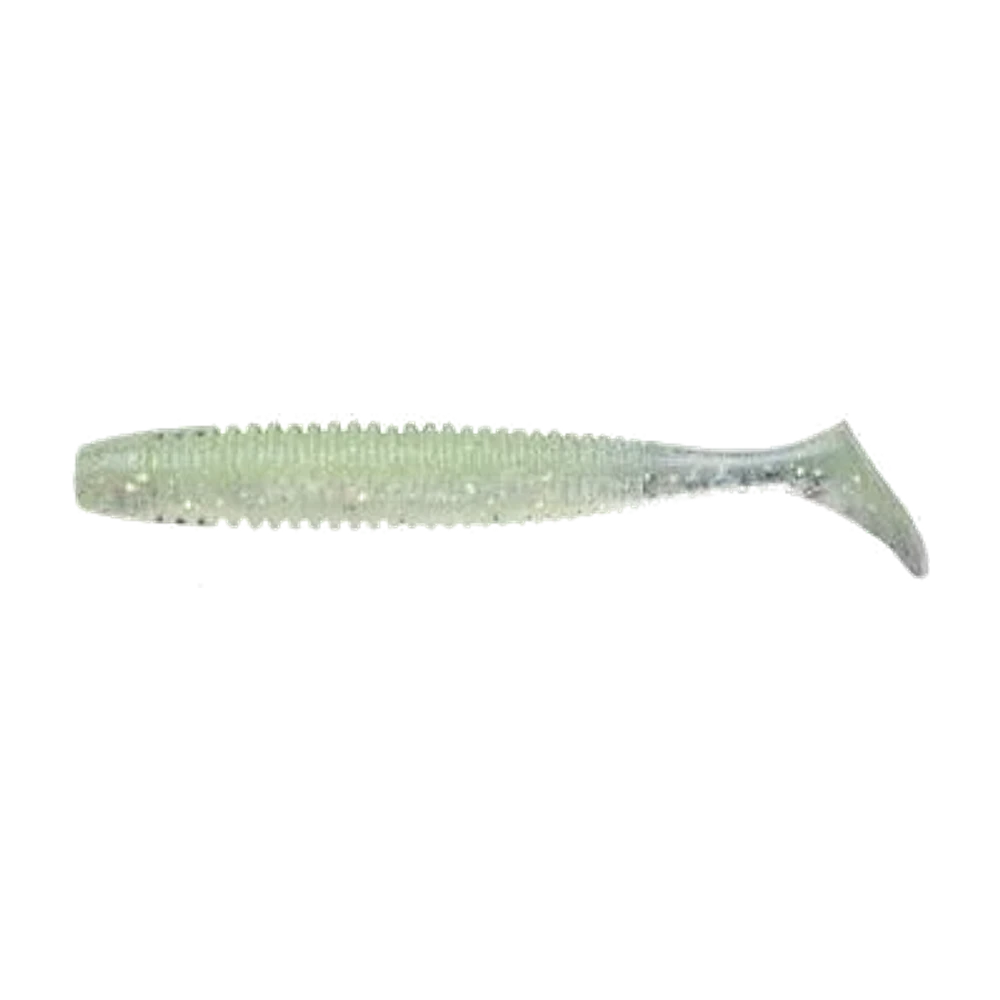
O.S.P HP Shad Tail: the mid-water shad you never let hit bottom
This lure shines under specific conditions. CarnaFish tells you in 10 seconds if today is one of them.
Most soft plastic shad anglers share the same reflex: let it drop to the bottom, then work it from the bottom. That makes sense for winter zander and for searching deep. But there is a whole category of situations where the fish are not on the bottom at all — a bass sitting halfway up against a sunken tree, a shoal of perch pinning fry two metres under the surface, a summer zander lifting off in the evening over a flat.
In those cases, a heavy shad on a jig head crosses the useful layer in two seconds and never sees it again. What you want is a lure able to stay mid-water while working at low speed — which means low weight and a tail that starts immediately.
That is precisely the design brief of the HP Shad Tail: very soft plastic, a slim tail on a short wrist, a high-frequency beat within the first few centimetres of the retrieve. You rig it light, you hold the depth you want with handle speed alone, and it never touches bottom.
A plastic that works, not a plastic that weighs
The softness of the material is not a comfort argument, it is a mechanical fact.
- The body flexes slightly with every beat. It is not just the tail moving: the wave travels back through the last two thirds of the lure. Seen from the side, the shad undulates like a small fish instead of dragging an appendage behind it.
- The tail starts with no threshold. The wrist is short and very slim, the paddle is small. A few centimetres of traction are enough for the tail to start beating, at high frequency and low amplitude.
- The density is moderate. This plastic is not overloaded with salt: the lure sinks slowly rather than plunging. On a weightless rig, you get a long, usable drop.
The trade-off is the classic one: a soft material is a fragile material. On pike teeth or big zander, the lifespan is counted in fish, not in sessions. It is a lure to save for situations where its finesse is a real asset, not for blind searching.
The retrieve: hold the depth, never stop
The fishing is counter-intuitive because it consists of nothing more than winding at the right speed.
- Cast and count — but not to the bottom. Pick a partial count matching the depth you want: three seconds for 1 m, six for 2 m, on a light rig.
- Start the retrieve on that count, steady and straight. Speed holds the depth: speeding up lifts the lure, slowing down drops it.
- Never pause. A stop makes the lure dive and takes you out of the layer. If you want to go down, slow gradually, do not stop.
- Adjust as you go: on a margin that shallows, speed up slightly to follow the slope without snagging.
- Finish the cast holding the speed to within two metres of the bank. Follows often end in the last few metres, when the lure carries on with no change of rhythm.
On the water: on a fish that follows mid-water without biting, the correction is not to slow down but to make the lure rise. Lift the rod slowly through 30 degrees over three seconds, without touching the handle. A prey climbing toward the surface is a prey escaping into a dead end, and that steady rise triggers far more often than an acceleration.
Rigging light: the table of options
| Rig | Weight | What you get |
|---|---|---|
| Screw-lock single hook, weightless | 0 g | very slow drop, swims at 0.5-1 m, margins and cover |
| Round jig head | 2 to 3.5 g | the reference mid-water setup, 1 to 2 m |
| Round jig head | 5 to 7 g | 2 to 3 m, or wind and casting distance |
| Weightless Texas, wide gap hook | 0 g | over a weed bed or in open wood |
The screw-lock single hook, screwed into the nose of the lure, deserves to be the first choice: it does not stiffen the body, unlike a Texas hook whose shank runs through several centimetres of plastic. On a lure whose main asset is the undulation of its body, that is far from a detail.
On line, 0.08 to 0.12 mm braid and a 0.20 to 0.26 mm fluorocarbon leader. Since the weight is low, it is the fineness of the braid that determines your casting distance and your ability to feel what the lure is doing.
When to pull it out, and when to leave it in the box
- Bass sitting on vertical structure — a sunken tree, a pile, a wall — where the fish waits halfway up.
- Aborted surface activity, when the fish no longer come up but stay a metre or two under the surface.
- Clear, heavily fished water, where a bulky shad gets inspected and refused.
- Summer and early autumn zander, late in the day, when they lift off the bottom over a flat.
It is poorly suited, on the other hand, to deep fishing beyond three or four metres: rigging it on a big jig head to get it down there removes everything that makes it interesting. It is also out of place in very stained water, where its fine vibration and small silhouette do not announce themselves enough. And it is too fragile for pike: a few bites are enough to destroy a soft body.

Not sure what to tie on?
Photograph your spot: CarnaFish reads the scene, cross-checks the conditions and gives you the zone, the lure and the retrieve. Free on iOS and Android.
HP Shad Tail, Prorex Classic Shad or Easy Shiner
Three shads, three water layers, three logics.
The Daiwa Prorex Classic Shad is a bottom and volume lure: a firm body, a round tail with a wide beat, rigged heavy to scrape the bottom on a slow straight retrieve. It is there to find fish over a large area, in cold or stained water. The two lures almost never cross paths, because they do not fish the same depth.
The Keitech Easy Shiner 4 is closer in intention, but its ribbed body and heavily salted plastic make it notably denser: it drops faster and fishes more naturally in bottom contact, on lift-and-drop or a low straight retrieve. The HP Shad Tail, lighter and with a smooth body, holds mid-water better at low speed.
For a livelier action and a sharper response to pulls on zander, the Westin Shad Teez fills yet another slot. Our beginner's guide to bass fishing puts these light rigs back into the context of a full season. And if you are unsure what depth to aim for when you arrive at a vertical structure, CarnaFish analyses a photo of the spot and answers.
Colours
- Clear water, fry present: translucent flake, pearl white, bleak grey. The lure is seen close up, it has to be credible.
- Low cloud, slightly coloured water: roach with a green or blue back, and a pale belly.
- End of the day, backlight: a plain dark tone. Mid-water and seen from below, it is the silhouette that counts.
Key takeaways
- Very soft plastic: the undulation travels back through two thirds of the body, not just the tail.
- A tail with no starting threshold: it beats within the first few centimetres of the retrieve.
- Fished mid-water on a constant straight retrieve; a stop takes you out of the useful layer.
- On a following fish, lift the lure with the rod rather than speeding up.
- Fragile and subtle: keep it away from pike, very stained water and deep fishing.
FAQ
What jig head for the O.S.P HP Shad Tail?
2 to 3.5 g for the reference mid-water fishing between 1 and 2 m, and 5 to 7 g beyond that or in wind. A weightless screw-lock single hook remains the best option in the margins, because it does not stiffen the body.
Why should you not let it sit on the bottom?
Because its value is its ability to work at low speed in open water. Rigging it heavy to get it down removes that advantage, and a denser, tougher shad will do that job better.
How do you hold the lure at the right depth?
With retrieve speed: speeding up lifts it, slowing down drops it. Establish your depth first with a partial sink count, then hold it without ever pausing.
What is the difference with a Keitech Easy Shiner?
The Easy Shiner is denser, with a ribbed body and a heavily salted plastic: it drops fast and fishes naturally near the bottom. The HP Shad Tail, lighter and smooth, holds mid-water better at low speed.
Does it stand up to pike?
Badly. The material is chosen for its softness, not its toughness, and a few pike hits are enough to destroy a body. Save it for bass, zander and perch.
What should you do when a fish follows without attacking?
Lift the rod slowly through about 30 degrees over three seconds without touching the handle. That steady rise imitates a prey trying to escape toward the surface and triggers more often than a sudden acceleration.
The full bass lure guideSeason-by-season strategy: which family of lure, when, and why.Go from theory to fish
CarnaFish reads your spot from a photo and gives you the game plan: zone, lure, retrieve. Free on iOS and Android.