Outkast Fighter Fly Marabou Jig: the marabou that breathes in cold water
Rather not fish it blind? Photograph your spot — CarnaFish cross-checks the conditions and points you the right way.
February, the water is hovering around seven degrees, and the fish are sitting on the bottom with no intention of chasing anything. You can drop a paddle tail, shake it, work it: nothing. That specific situation is where marabou jigs hold a place no other lure takes from them — because they keep moving once the angler has stopped.
Marabou versus synthetic fibre: what actually happens in cold water
Outkast is direct about the intent: the dressing is hand-tied marabou, and the manufacturer states that this material keeps a lifelike action even in colder water, where synthetic materials tend to clump up and lose effectiveness.
That claim is worth understanding rather than swallowing. Marabou is a downy feather whose every barbule is extremely fine and soft; at rest in the water it reacts to micro-currents and to the smallest displacement of water, with no outside input at all. A synthetic fibre is stiffer, needs a minimum of flow to open, and in cold water — denser and more viscous — it lies flat and ends up as a clump glued along the shank. The difference does not show in the box; it shows on a motionless lure two metres under the boat.
The trade-off is real. Marabou is fragile: it waterlogs, picks up silt and tears on shells and sharp stones. A marabou jig is a consumable, not a lure you keep for three seasons. Carry several if you fish cluttered bottom.
The Money Jig head and the vertical line tie
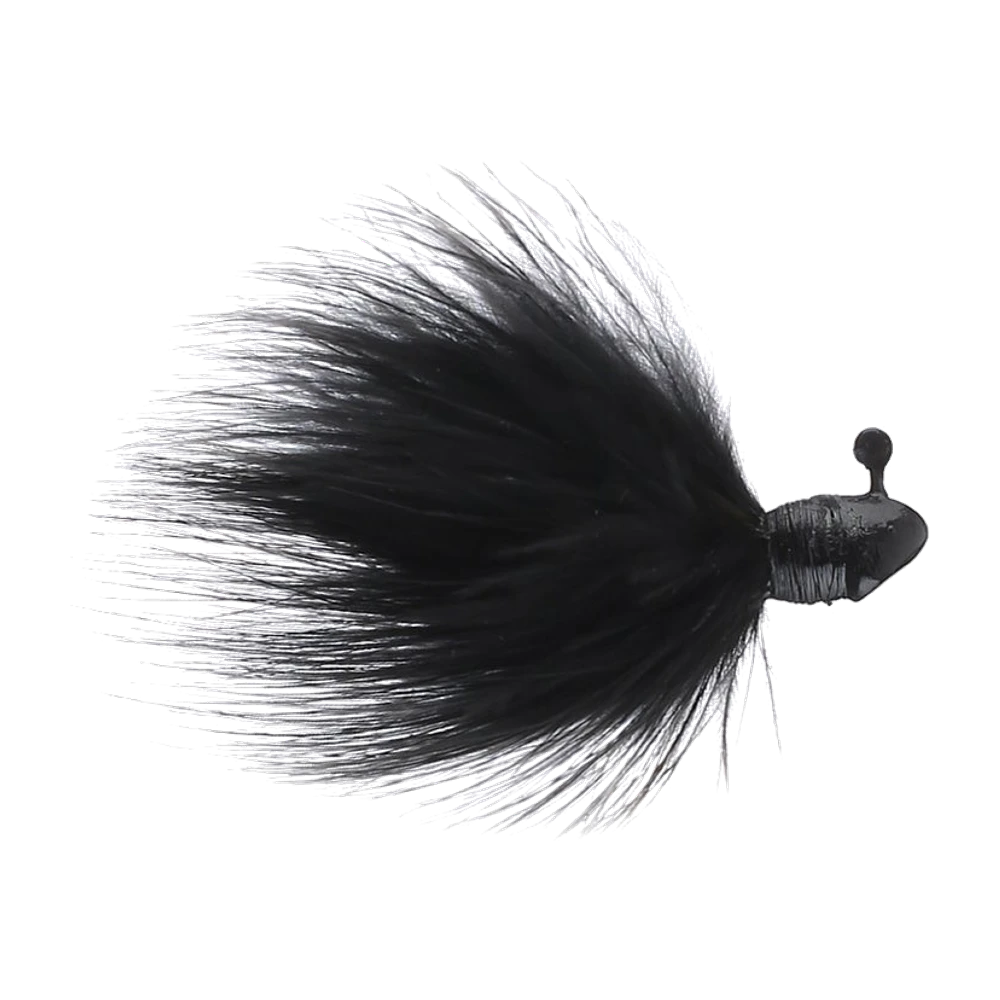
The Fighter Fly is built on Outkast's in-house head, the Money Jig Head. In the product photo you can see a small compact head, lacquered black, tapering towards the front, with a line tie that exits on top and stands almost vertical. The dressing is clamped behind the head by a clearly visible black thread wrap — the hand-tying the manufacturer refers to.
That high line-tie position is not incidental: it tips the lure nose-down as it settles, and the plume then flares back and upward into a bunch. It is exactly the posture you want in front of a fish that is looking ahead and unwilling to move.
No weed guard appears in this photo, and the bend of the hook stays completely hidden under the marabou: those are observations from a product photo, not specifications. The manufacturer simply states a Gamakatsu hook, without giving a size.
Working it: do nothing, for a long time
This is the hardest part to accept for anyone coming from active lures. A marabou jig is fished by letting the plume work on its own. The sequence that produces the most bites has three beats: you drop it, you wait, you move it ten centimetres.
The wait is the active part of the retrieve. Ten, fifteen, twenty seconds motionless on the bottom, during which the dressing contracts and reopens with the micro-movements of the line. Shake it and you press the barbules against the shank, cancelling exactly what you bought the lure for.
The tackle that goes with it
A jig this size calls for a light outfit: a light to medium-light rod to feel contact, fine braid, and a 0.22 to 0.26 mm fluorocarbon leader that stays discreet in clear winter water. The Gamakatsu hook is fine-wire and essentially sets itself, so there is no need for a violent hookset: firm pressure is enough, and it is kinder to a perch's mouth.
The mistake that ruins it
Fishing this jig too fast, and above all too high. Two reflexes combine: you lift the lure to check it is working, and you end up fishing mid-water with a technique designed for bottom contact. Keep contact, leave a little slack between moves, and watch the line rather than the rod tip: with marabou, a winter bite often shows as line easing off to one side with no tap at all.
Not sure what to tie on?
Photograph your spot: CarnaFish reads the scene, cross-checks the conditions and gives you the zone, the lure and the retrieve. Free on iOS and Android.
Where and when to use it
This is a cold-water lure for inactive fish: winter sessions, early spring before the water warms, bitter days when nothing else moves. Dock edges, the base of a breakwater, clean drop-offs and hard clean bottom are its natural ground.
In Europe, beyond the bass it was originally built for, perch make the most of it: marabou jigs are a classic for winter perch glued to the bottom. The small volume and the fine hook suit that fishing well. Do not try to turn it into a pike lure: the dressing would not survive one hit, and the hook gauge is not meant for it. If you want a jig in the same spirit with a more defined silhouette, the 6th Sense Flock Hair Jig occupies neighbouring ground, while for deep summer structure the Outkast Chicken Hair Jig from the same brand plays the opposite extreme, that of sheer volume.
When you fish a dock in winter, do not reel in after ten biteless seconds. Drop the jig at the foot of the piling and count to thirty with the rod still. Out of ten bites on that spot, seven come after the fifteenth second — that is exactly how long the plume needs to open fully and a lethargic fish needs to make up its mind.
Colours by water
- Dark water, low light or cluttered bottom: the solid black from the photo. Counter-intuitive for many, but it gives the cleanest silhouette seen from below, and black marabou keeps a visual density that pale shades lose in dirty water.
- Clear water over hard bottom: natural browns, olives and greys that imitate a crayfish or a small bottom fish without drawing attention to themselves.
- Pale bottom, sand or gravel: white. A white plume stays readable over a light substrate, where a dark lure disappears into its own background.
The manufacturer publishes no weight or length chart for this model, and several options exist at retail. Check the exact item before ordering: on a lure like this, head weight entirely governs the sink rate, and therefore how slow you can genuinely fish it. The retailer listing also indicates a two-per-pack format, which is consistent with a lure that gets replaced often.
A marabou jig is only worth anything when it sits on the right square metre, and that is decided before the first cast. That is exactly what CarnaFish helps with: one photo of the spot, and the AI suggests the zone, the depth and the presentation that fit the day. To dig deeper into finesse approaches for this species, our guide to lure fishing for perch covers the other families worth knowing.
Key takeaways
- Marabou keeps breathing in cold water where synthetic fibre lies flat: that is the model's central argument, and the manufacturer states it explicitly.
- The high line tie tips the lure nose-down and opens the plume into a bunch as it settles.
- The winning retrieve is stillness: drop, long wait, short move, repeat.
- A fragile, consumable lure: carry several if you are fishing rocky bottom.
FAQ
What head weight should I choose?
The manufacturer publishes no weight chart for this model. Work from depth: the lightest head that keeps bottom contact, because a slow descent is the whole point of the plume. Check the figure on the retailer's exact item listing.
Is marabou really better than synthetic fibre?
Not in the absolute, but the manufacturer claims a clear edge in cold water, where synthetic materials clump up. In warm water and on active fish, synthetic fibre stays tougher and lasts longer, and at that point it is a different job.
How long should the jig sit still?
Far longer than instinct suggests: fifteen to thirty seconds on a precise spot in winter. The plume opens fully during that pause, and that is when the bite arrives, often with no tap felt at all.
Should I add a soft plastic trailer?
That is not the spirit of the lure. A trailer bulks up the silhouette and slows the plume from opening, which is the one thing this jig does better than anything else. If you need more volume, a silicone-skirted jig is the right tool.
Does it suit perch in Europe?
Yes, that is its most obvious ground outside bass: small volume, fine hook and a settled presentation match winter perch glued to the bottom exactly. Pike, on the other hand, are out of reach, both for the dressing and for the hook gauge.
Why is the dressing hand-tied?
Outkast claims hand-tying for the marabou dressing. In practice, tying by hand lets you meter the density of feather and place the collar at the right point on the shank, something an automated process reproduces poorly on a material as irregular as a natural feather.
The full bass lure guideSeason-by-season strategy: which family of lure, when, and why.Go from theory to fish
CarnaFish reads your spot from a photo and gives you the game plan: zone, lure, retrieve. Free on iOS and Android.