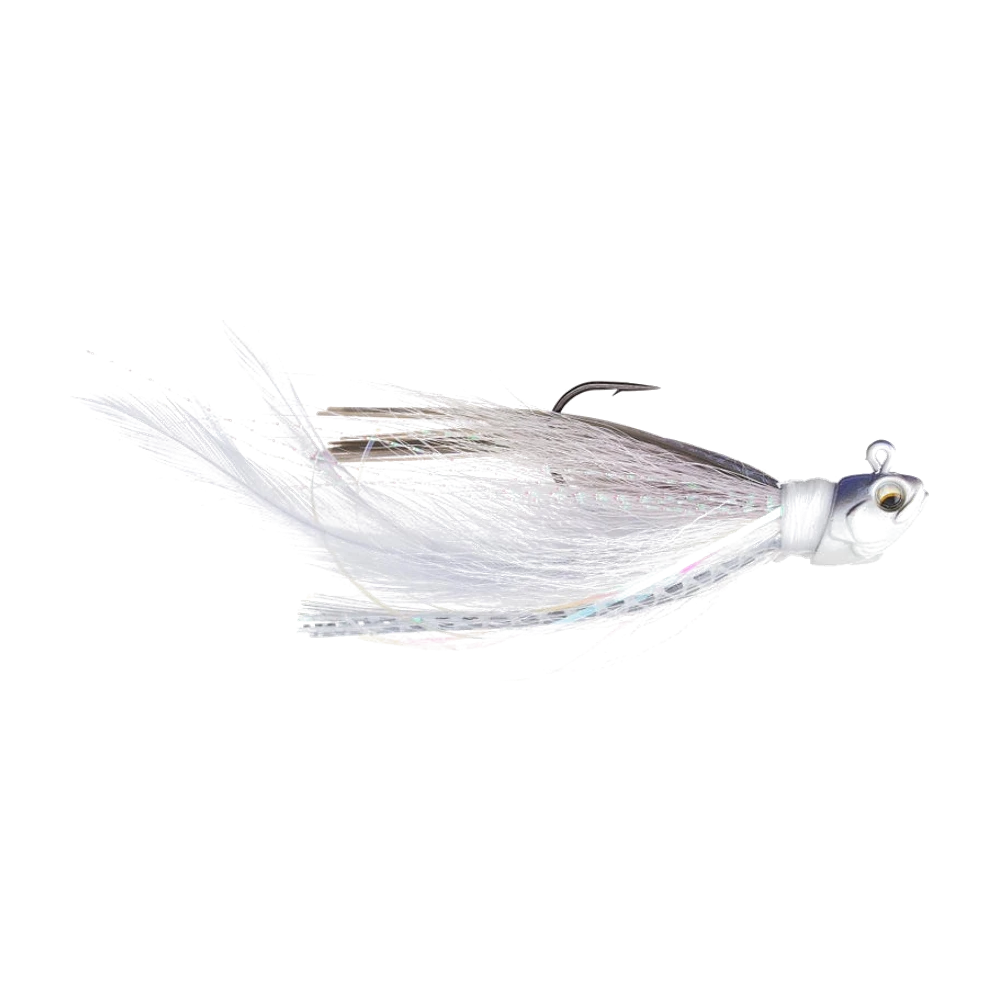
6th Sense Flock Hair Jig: hair, feathers and mylar to imitate a shad
This lure shines under specific conditions. CarnaFish tells you in 10 seconds if today is one of them.
There is a situation every predator angler runs into sooner or later. The water is cold and clear, the sonar shows fish pinned to a drop-off between six and eight metres, and nothing interests them. The shad swims past too fast, the silicone-skirted jig drops like a stone and stops moving the moment it lands, the crankbait won't get down there. That is exactly the window a hair jig is built for — a bait that carries on living when the angler has stopped doing anything at all.
Why hair instead of silicone
A silicone skirt is stiff. It flares on the pull, snaps shut on the pause, and then nothing: the bait becomes an inert object sitting on the bottom. Natural hair has a density close to that of water. It never closes completely, and it keeps drifting on the smallest movement of water, the faintest tremble in the line, the weakest current along the bottom.
That is the whole point of this family of baits. In cold water an inactive fish chases nothing. You have to show it something that stays credible through the ten or twenty seconds when the bait is not moving, because those are the seconds in which it makes up its mind. A hair jig is not a search bait, it is a waiting bait.
A blend of materials, and what each one brings
The Flock is not a single-material hair jig, and that is its distinguishing feature. 6th Sense combines four things in the same skirt.
- Bucktail, deer tail hair, hollow and stiff at the base, soft at the tip. It provides the volume and the general hold of the skirt, the part that does not collapse.
- Duck feathers, far lighter and far more mobile. They are what moves at a complete standstill, and what gives the bait a tremble no synthetic fibre imitates properly.
- Silicone, in support, to hold the bulk and guarantee a silhouette that does not pack down after ten casts.
- Mylar, fine reflective strands, for occasional flashes of light — the equivalent of a shad scale catching a stray ray.
The manufacturer is open about the direction: this imitates a shad, not a crawfish. That distinction matters a lot if you come from standard jig fishing, because it changes the animation completely. A Strike King Tungsten Football Jig gets dragged along the bottom like a crawfish rooting around; the Flock presents itself as a baitfish in trouble, higher in the water and far more static.
Ledge fishing, its reason for existing
6th Sense positions this one as a finesse and ledge fishing bait. The ledge is that clean step between a flat and a hole — the lip of a basin, a flooded old bank, a dam wall drop. Big bass hold there because forage moves along it and because they can rise or drop a metre with the temperature and the light.
Fishing a ledge with a hair jig means first locating it precisely, then dropping the bait above the lip rather than at its base. You let it fall freely, line controlled but not tight, and you count. Most bites happen during that first descent, exactly as they do with a standard jig.
If you only catch fish on the initial fall and nothing afterwards, you are working the bait too much. Leave it lying there doing nothing for a full fifteen seconds before you move it thirty centimetres. It feels long, it feels boring, and it is what makes the difference on the bigger fish.
Three presentations that work
The first is the slow drag: you move the bait along the bottom by pulling gently with the rod, no jerk, over forty or fifty centimetres, then let it rest. The skirt lays down and then opens back up slowly.
The second is the stroke: a sharp vertical pull that rips the jig a good metre off the bottom, followed by a complete free fall. That is the triggering presentation, the one to use when you know fish are there but they won't commit.
The third is the simplest and often the most effective: the dead sit. Bait on the bottom, rod tip still, all you do is gently tighten and slacken the line. The feathers do all the work. That is unplayable with a silicone skirt, and it is precisely what you are buying here.
In Europe, a winter perch presentation too
The Flock was designed for big American bass on reservoir lakes, but the principle transfers. In winter, a hair jig worked slowly over hard bottom at five or six metres is a presentation European perch anglers know well — precisely because it stays credible at rest, when perch are stacked in a tight school and won't chase anything.
You just have to accept one thing: this is a slow fishery, vertical or close to it, practised mainly from a boat or a float tube with a sonar unit. From the bank, with no way of identifying the ledge, you are fishing blind and the bait loses most of its interest.
The classic mistake
Adding a bulky trailer. The reflex is understandable — you want more volume — but a big soft trailer brakes the fall, stiffens the whole package and completely drowns out the movement of the feathers. If you want to add something, stay with a small, discreet trailer, and only to slow the descent deliberately. The rest of the time, fish the jig bare. That is what it was built for.
The second common mistake is storing the bait wet and bunched up. A hair and feather skirt that has not dried properly packs down and loses its volume. Rinse it, fan the fibres out by hand, lay it flat to dry.
Not sure what to tie on?
Photograph your spot: CarnaFish reads the scene, cross-checks the conditions and gives you the zone, the lure and the retrieve. Free on iOS and Android.
Colours by water
- Clear water, silver forage: a silver white shad tone, still the historical baseline of this family. That is the version to start with on a winter ledge.
- Cold, deep water: a pearl grey shaded with blue, duller and more credible when the light arrives weakened at six or eight metres.
- Hard bottom and stained water: a green pumpkin, which pulls the presentation towards a crawfish rather than a shad — useful when the fish are glued to the substrate.
What not to ask of it
A hair jig does not cover water. If you have to search a hundred metres of bank to find the fish, take something else: a Strike King 10XD along a deep drop-off or a 6th Sense Provoke in open water will do it infinitely faster. The Flock comes after that, once you know where the fish are and they refuse everything moving quickly. It is a second-pass bait, and it owns that.
Locating the ledge and working out what depth the fish are holding at is still half the job, and that is exactly what CarnaFish helps you narrow down: photograph the spot and the AI suggests the zone, the depth and the presentation type that fit the day's conditions. For everything to do with approaching from the water, our guide to float tube and boat fishing covers the gear and the method.
Key takeaways
- Hair and feathers keep moving with the bait motionless, where a silicone skirt goes inert the instant you pause.
- Four materials combined, each with a role: volume from bucktail, mobility from duck feathers, hold from silicone, flash from mylar.
- A drop-off and cold-water bait, to be worked very slowly, with pauses of ten to fifteen seconds.
- No big trailer: it kills the feather movement, which is the only reason to buy this bait.
FAQ
What weight should I pick for this hair jig?
6th Sense does not break the weights out in its description, and several versions sit in the catalogue side by side. On this fishery, think in terms of depth rather than model: you want the lightest weight that still lets you hold bottom contact without drifting.
Should I add a trailer to a hair jig?
Generally no. A bulky trailer brakes the fall and smothers the feather movement. If you do add one, pick the smallest and softest you have, purely to slow the descent on purpose.
What is the difference compared with a silicone-skirted jig?
The behaviour at rest. A silicone skirt flares on the pull, then shuts and stops moving. Hair, and above all feathers, keep a permanent mobility, which is what makes the bait credible through the long pauses cold water demands.
Does this bait work on perch?
Yes, and it is a common winter use in Europe, over hard bottom between four and seven metres with minimal animation. Perch stacked in a tight school often refuse to chase, and a bait that lives at a standstill suits them well.
Can you fish a hair jig from the bank?
You can, but you lose the essentials. This fishery rests on pinpointing a drop-off and on a near-vertical presentation, which assumes a sonar unit and a boat. From the bank, work a deep bank edge instead, if you know of one.
How do I look after a hair and feather skirt?
Rinse it in clean water after the session, fan the fibres out by hand and leave it to dry flat. Stored wet and packed down, a hair jig permanently loses part of its volume, and therefore part of its point.
The full bass lure guideSeason-by-season strategy: which family of lure, when, and why.Go from theory to fish
CarnaFish reads your spot from a photo and gives you the game plan: zone, lure, retrieve. Free on iOS and Android.