Outkast Chicken Hair Jig: the big hair jig for offshore summer schools
One lure, endless conditions. CarnaFish reads your spot from a photo so you are not just guessing.
July, the water is warm, and the bass have left the banks to stack up on a rock hump in 7 m. The electronics show a tight ball of fish, yet the lure that drops fast through the middle of it keeps bringing back the small ones. That is exactly the problem the Outkast Chicken Hair Jig sets out to solve: present a large profile that falls slowly, big enough that the better fish in the group commit before the others do.
Why synthetic fibre changes the fall
The base of the dressing is a synthetic fibre rather than natural hair. Outkast states that this choice serves two purposes: it builds a bulky profile and it slows the rate of fall, so the jig spends more time in the strike zone.
That is simple physics and you can feel it on the rod. A jig dressed in a thin silicone skirt drops almost vertically; the same head wrapped in a mass of fibre brakes, wobbles and takes roughly twice as long to reach the bottom. Over fish suspended on structure, that difference is the whole point of the lure: you keep the jig at fish level for several seconds instead of watching it punch straight through the active layer.
There is a trade-off worth knowing. A lure that falls slowly drifts with the wind and the boat, and the line starts to belly. Over deep structure you have to follow the drop with the rod low and the line taut, taking up slack as you go — otherwise the bite on the fall, which is the most common one with this kind of jig, goes completely unnoticed.
The two feathers, the model's real signature
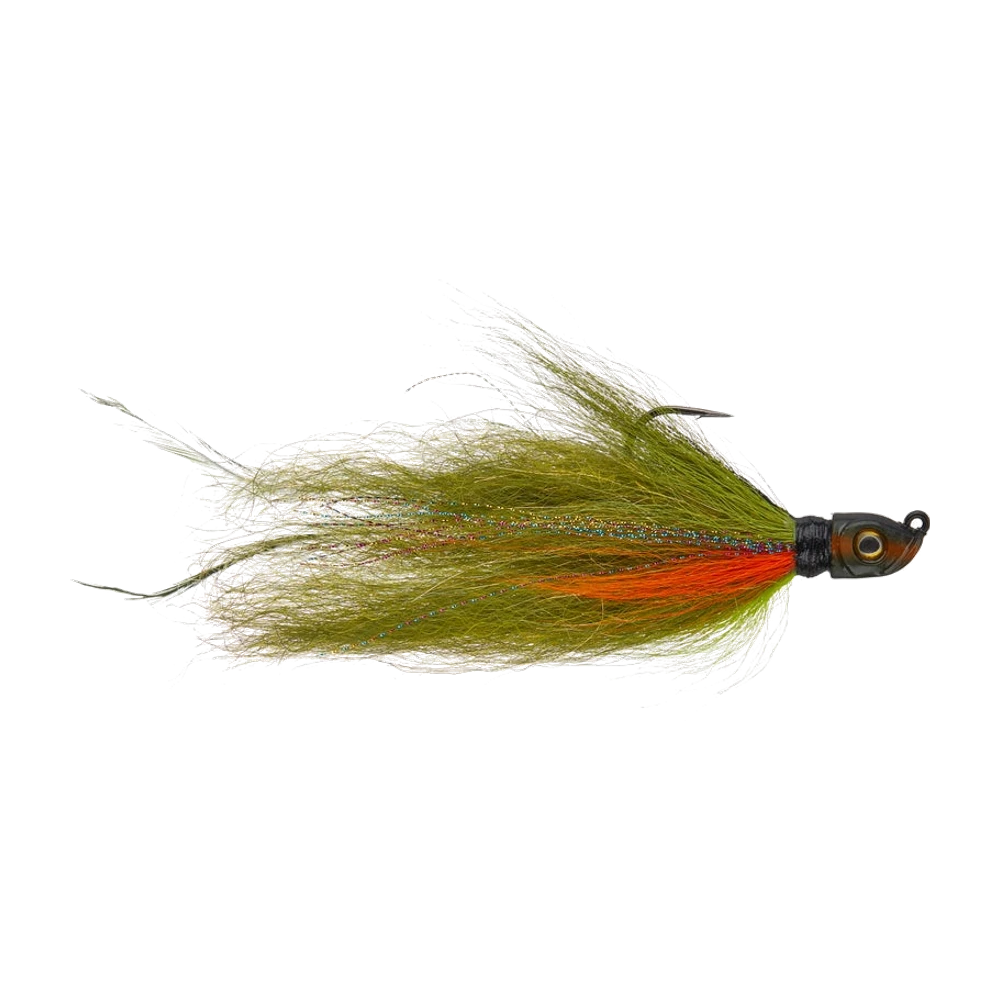
What sets this jig apart from other hair jigs is the pair of long chicken feathers tied into the middle of the dressing. They are clearly visible in the product photo: two slim olive quills reaching well past the mass of fibre.
Outkast states that these feathers produce a natural swimming action and imitate large baitfish, citing gizzard shad, blueback herring and even crappie and bluegill. Those are North American species, but the principle transfers to Europe without difficulty: we are talking about a tall, broad silhouette, not a slim minnow.
For the angler the key point is that the feathers work without any input from you. A chicken feather undulates at the slightest change in water pressure — on the fall, on the pause, on the drift. It is the same mechanism that makes a marabou dressing come alive on an Outkast Fighter Fly Marabou Jig, applied here to a far bigger lure.
The Goldeneye head and the 30-degree line tie
Outkast builds this jig on its in-house Goldeneye head, whose line tie sits at 30 degrees. The brand states that this geometry keeps the bait level and makes it run true along the bottom.
In the photo the head looks flat and compact, painted olive across the top with orange cheeks and a large gold eye with a black pupil. You can also see that the single hook rides point up and that the dressing is clamped down by a black thread wrap behind the head. No weed guard appears on this example: that is an observation from a product photo, not a manufacturer specification, but it fits a lure aimed at hard bottom rather than vegetation.
The hook, and what it demands from the rest of the set-up
The manufacturer specifies a 5/0 VMC heavy wire hook. That gauge and wire diameter are chosen to drag a big fish up from 7 m without opening, and it has a direct consequence: you need a rod that can drive that wire home. A soft-actioned medium rod will not do it. Aim for a medium-heavy outfit, braid, and a 0.30 to 0.35 mm fluorocarbon leader that cushions without soaking up the hookset.
The classic mistake with this kind of jig
Overworking it. The instinct is to make long sweeps to compensate for the feeling that nothing is happening. The opposite is true: the fibre and the feathers live on their own, and a hard sweep flattens them against the shank instead of opening them. Two short sharp twitches to stand the jig up, then a long pause during which you do absolutely nothing — the dressing blooms during that pause, and that is when the bite comes.
Not sure what to tie on?
Photograph your spot: CarnaFish reads the scene, cross-checks the conditions and gives you the zone, the lure and the retrieve. Free on iOS and Android.
Where and when to use it
Outkast is explicit about the intended water: offshore rock piles, ledges and long points, where fish group up during the warmer months. This is a deep structure lure, not a bank lure.
In Europe the same logic transfers well to large reservoirs and deep gravel pits. Bass remains the primary target, but zander respond to the same presentation on drop-offs and submerged plateaux, where a large profile sinking slowly registers from a long way off. Keep in mind that a 5/0 is an ambitious hook for an average zander: on a water where the fish run around 50 cm, a more compact jig such as a Strike King Tungsten Football Jig will convert more bites. For perch it is frankly too big.
Count the drop under your breath, every single cast, and learn at which second the line normally goes slack. The day it stops two seconds early, that is not the bottom: that is a fish that took on the fall, and you will have felt nothing in your hand.
Colours by water and season
- Stained water, late summer: the olive dressing with an orange collar and chartreuse tips shown in the photo. The contrast between dark body and orange throat stays readable in the plankton-loaded water typical of lakes in August.
- Clear water over hard bottom: natural whites, greys and silvers that match a pelagic baitfish and avoid overstating anything once visibility passes 3 m.
- Low light or real depth: black, or black and blue. Below 8 m colour disappears anyway; only the density of the silhouette matters.
Outkast announces several sizes and colours without publishing a detailed weight chart. That is a genuine limitation when ordering online: check the weight listed against the exact item code you buy, because the gap between the light and the heavy model completely changes the fall rate, and with it the way you fish the lure.
A hair jig of this bulk is not cast at random: it asks that you identify the structure before the rod ever comes out. That is exactly what CarnaFish is for — one photo of the spot, and the AI suggests the zone, the depth and the presentation that match the conditions. To learn to spot those ledges and points with the naked eye, our guide to reading a fishing spot lays out the method.
Key takeaways
- The synthetic fibre is there to slow the fall as much as to bulk up the profile: time spent in the strike zone is what makes the difference.
- The two chicken feathers work without input, so the bite happens during the pause, not during the sweep.
- Goldeneye head with a 30-degree line tie, for a level pass in contact with the bottom.
- 5/0 heavy wire hook: a medium-heavy rod is mandatory, otherwise the hookset simply does not go in.
FAQ
What weight should I pick for a Chicken Hair Jig?
Outkast announces several sizes but does not publish a detailed weight chart. Go by the retailer's exact item listing: the heavier it gets, the faster the fall and the less the fibre volume matters, which undoes the whole point of the lure.
Why synthetic fibre rather than natural hair?
The manufacturer says synthetic fibre gives a bulkier profile and slows the fall. Natural hair compresses more once wet. For a lure whose entire principle is to linger in the active layer, that is a coherent choice.
At what depth does this jig work?
It is built for deep structure: offshore rock piles, ledges and long points, typically between 5 and 10 m depending on the water. Along the bank, its bulk and slow fall bring nothing a standard jig does not already give you.
Should I add a soft plastic trailer?
Not necessarily: the fibre dressing and the feathers already supply the volume and the movement. A trailer slows the fall further and enlarges the silhouette, which can help over an aggressive school but makes the bait heavy-handed for a wary fish.
Does it suit zander in Europe?
Yes on large lakes and deep gravel pits, where the slow bottom-contact presentation suits them well. The 5/0 hook stays ambitious for average-sized zander, though: on that class of fish a more compact jig will convert better.
How does it differ from a finesse hair jig?
Everything separates them. A slim model such as the 6th Sense Flock Hair Jig targets lethargic fish in cold water with a discreet silhouette, whereas the Chicken Hair Jig is trying to pull the biggest individuals out of a summer school through sheer volume.
The full bass lure guideSeason-by-season strategy: which family of lure, when, and why.Go from theory to fish
CarnaFish reads your spot from a photo and gives you the game plan: zone, lure, retrieve. Free on iOS and Android.