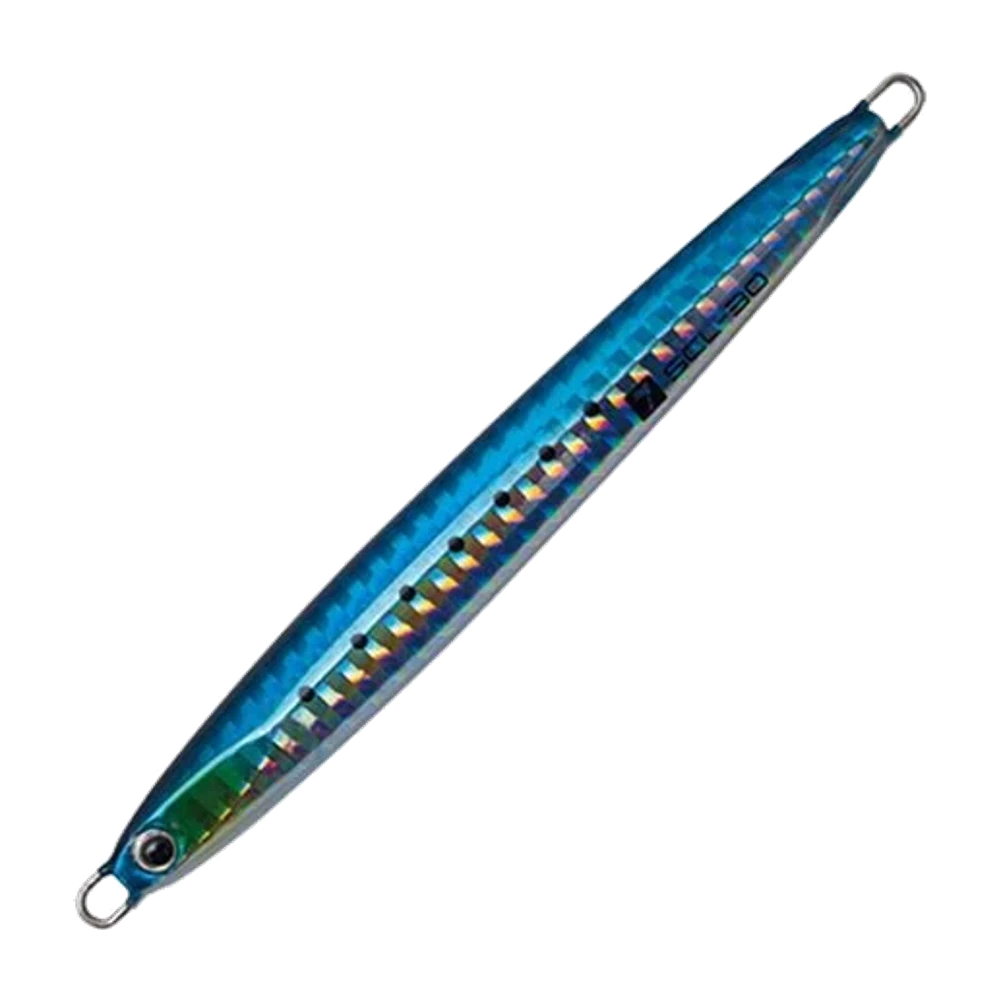
Palms Slow Blatt: the jig that works while you do nothing
Before tying this one on, it helps to know if the spot actually calls for it. CarnaFish reads the scene from a photo.
Classic jigging rests on a simple idea: bring the jig up fast, send it back down fast, and trigger a reflex in an active fish. It works very well for about two hours a day. The rest of the time, on sea bass glued to the bottom, on fish shut down by cold water or by slack tide, you go up and down through empty water and wear yourself out.
Slow jigging turns the logic around. The jig is no longer pulled upwards to attract: it is lifted and then abandoned, and it is during that free fall, when you are doing nothing at all, that everything happens. A wounded baitfish does not swim up, it goes down flapping on its side.
The Slow Blatt is built for that precise moment. Its asymmetric profile, wider on one flank than the other, makes it flip flat and slide off sideways in a glide as soon as tension disappears. It does not sink, it descends by gliding.
What a "slow" jig actually does
Three mechanical differences from a classic speed jigging jig.
- The mass is centred, not concentrated at the tail. A tail-weighted jig drops straight down like a sinker; a centre-balanced jig flips horizontal and planes.
- The profile is asymmetric. One face more rounded than the other creates a deliberate imbalance: on every drop the jig slides off one way, turns over, then goes back the other. That fluttering is what triggers a take.
- The fall is slow and, above all, irregular. It is not the speed that matters but the unpredictability: a fish following it cannot anticipate the path.
A corollary that often gets forgotten: a badly rigged slow jig does not glide. A leader that is too thick, a clip that is too heavy, or assist hooks so long they tangle are enough to turn the glide into a straight drop. The rig matters as much as the jig.
The rig, to sort out before anything else
Assist hooks. One or two at the head, on short cord — the point must not extend beyond a third of the jig's length, otherwise it taps the body on every flip and tangles are guaranteed. A tail assist helps on fish that attack from behind, but it costs you snags on rocky ground.
The connection. A solid ring plus a split ring between jig and braid, never a bulky clip. Anything that loads the nose kills the flip.
The line. Fine braid, 0.10 to 0.15 mm, to limit the grab of the current and let you feel the fall. A fluorocarbon leader of 0.40 to 0.60 mm over one to one and a half metres to absorb abrasion and teeth.
The weight. The usual rule: roughly one gram per metre of depth in light current, up to double when it pushes. Too light and you drift and never fish vertically. Too heavy and the fall goes straight, which loses you the entire point of the lure.
| Depth | Light current | Strong current |
|---|---|---|
| 10 to 20 m | 30 to 40 g | 60 g |
| 20 to 35 m | 40 to 60 g | 80 g |
| 35 to 50 m | 60 to 80 g | 100 g and up |
| Cast from the shore | 30 to 40 g | 40 to 60 g |
The retrieve: one turn, one lift, and silence
- Drop to the bottom, thumb on the spool, and stop the jig the moment it touches. Lifting straight away avoids a snag.
- Give one wide, slow lift, taking the rod from 9 to 11 o'clock while adding half a turn to a full turn of the handle.
- Lower the rod back with the jig, without dumping slack violently. The jig flips and slides away. Count one to three seconds.
- Repeat, climbing a metre per cycle, up to five or ten metres above the bottom.
- Drop back down and start again, varying the amplitude: one long lift, two short ones, a definite three-second pause.
- Set the hook into tension, not with a sharp snap. Assist hooks find their hold on their own when the fish pulls.
On the water: the commonest fault in slow jigging is not working the jig too fast, it is never letting the jig go completely free. As long as your rod follows the descent, the jig stays held by the line and falls straight. One time in three, drop the rod tip properly and give two seconds of full slack: that is when the jig slides off sideways, and that is often when it gets hit.
From the shore the same logic applies on the diagonal: cast, let it sink to the bottom on a count, then work it back with wide lifts, letting the jig fall between each one. That way you search a drop-off or a hole without a boat.
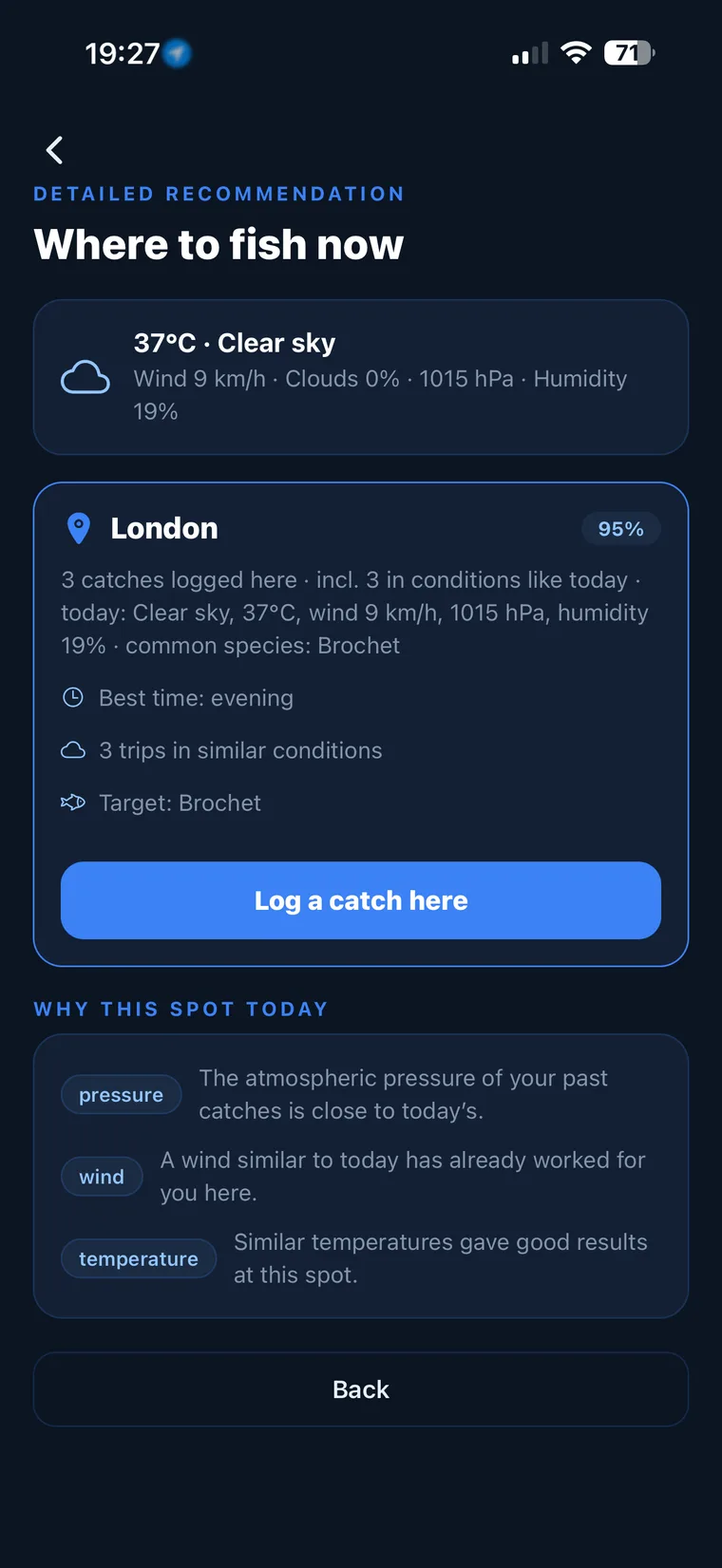
Not sure what to tie on?
Photograph your spot: CarnaFish reads the scene, cross-checks the conditions and gives you the zone, the lure and the retrieve. Free on iOS and Android.
Its windows, and when it adds nothing
It excels on:
- Sea bass sitting on rock or wrecks, outside feeding spells, when nothing is moving on the surface.
- Slack tide, when the fish are there but sluggish and refuse anything fast.
- The cold water of late autumn and winter, where the slow rhythm matches the fish's metabolism.
- Deep water, where a soft plastic loses its action while a jig keeps all of its effectiveness.
- The shoreline over a deep drop-off, in its casting version.
It adds nothing:
- On surface feeding activity. By the time the jig gets down, the feeding spell is over. A popper or a stickbait is ten times better suited.
- In very shallow water, under five metres, where it has no room to develop its fall.
- In very strong current with fast drift, where you are no longer vertical and the jig drags instead of gliding.
- On heavily cluttered ground, where two assist hooks cost you a lot of lures.
Slow Blatt or classic casting jig
A Major Craft Jigpara is first and foremost a casting jig: compact profile, fast straight fall, sustained straight retrieve. It excels when you need to cover ground quickly from a breakwater or reach distant feeding fish. It is a tool of speed.
The Slow Blatt plays the opposite game: it is not after distance but time spent in the water column. On an active fish that is feeding, the Jigpara wins easily. On a sea bass sitting on the bottom and not moving, the Slow Blatt is what goes down to get it.
Against a Savage Gear Monster Vertical, the difference is about the target and the gesture: the Monster Vertical aims at pure vertical work on big predators with a more direct approach, the Slow Blatt banks on the glide and on a finely tuned rig.
Our guide to sea bass fishing with lures places both approaches within the tide cycle. And if you are unsure what weight to send down over a drop-off you do not know, CarnaFish analyses a photo of the spot and answers.
Key takeaways
- The fish takes on the drop, not on the lift. The whole retrieve exists to create that drop.
- Asymmetric profile and centred mass: the jig flips flat and slides away sideways.
- A rig that is too heavy at the front removes the flip and cancels the point of the lure.
- Roughly one gram per metre of depth in light current, double when it pushes.
- Give it real slack one time in three: that is when the jig works hardest.
FAQ
What is the difference between slow jigging and classic jigging?
Classic jigging brings the jig up fast to trigger a reflex in an active fish. Slow jigging lifts the jig then abandons it, and relies on the gliding fall to convince fish that are settled or apathetic.
What weight should I choose?
Reckon on about one gram per metre of depth in light current, up to double in strong current. Stay with the lightest weight that still lets you fish vertically: too heavy a jig falls straight and loses its glide.
Do I need a tail assist hook?
It helps on fish that attack from behind, but it noticeably increases snags on rocky ground. Over rock, keep the head assists only; over sand or a clean wreck, run both.
Can the Slow Blatt be fished from the shore?
Yes, over a drop-off or a hole within casting range. Let it sink to the bottom on a count, then work it back with wide lifts, letting the jig drop between each one: you get the same gliding fall on the diagonal.
Why doesn't my jig glide on the way down?
Almost always because of the rig: a clip that is too heavy, a leader that is too thick, or tension held by the rod through the whole fall. Lighten the front end and give real slack to get the flip back.
Does it work on surface feeding activity?
No, or very badly. The sink time is incompatible with a feeding spell that lasts a few tens of seconds. For that kind of activity, a topwater or a fast casting jig will suit far better.
The full sea bass lure guideSeason-by-season strategy: which family of lure, when, and why.Go from theory to fish
CarnaFish reads your spot from a photo and gives you the game plan: zone, lure, retrieve. Free on iOS and Android.