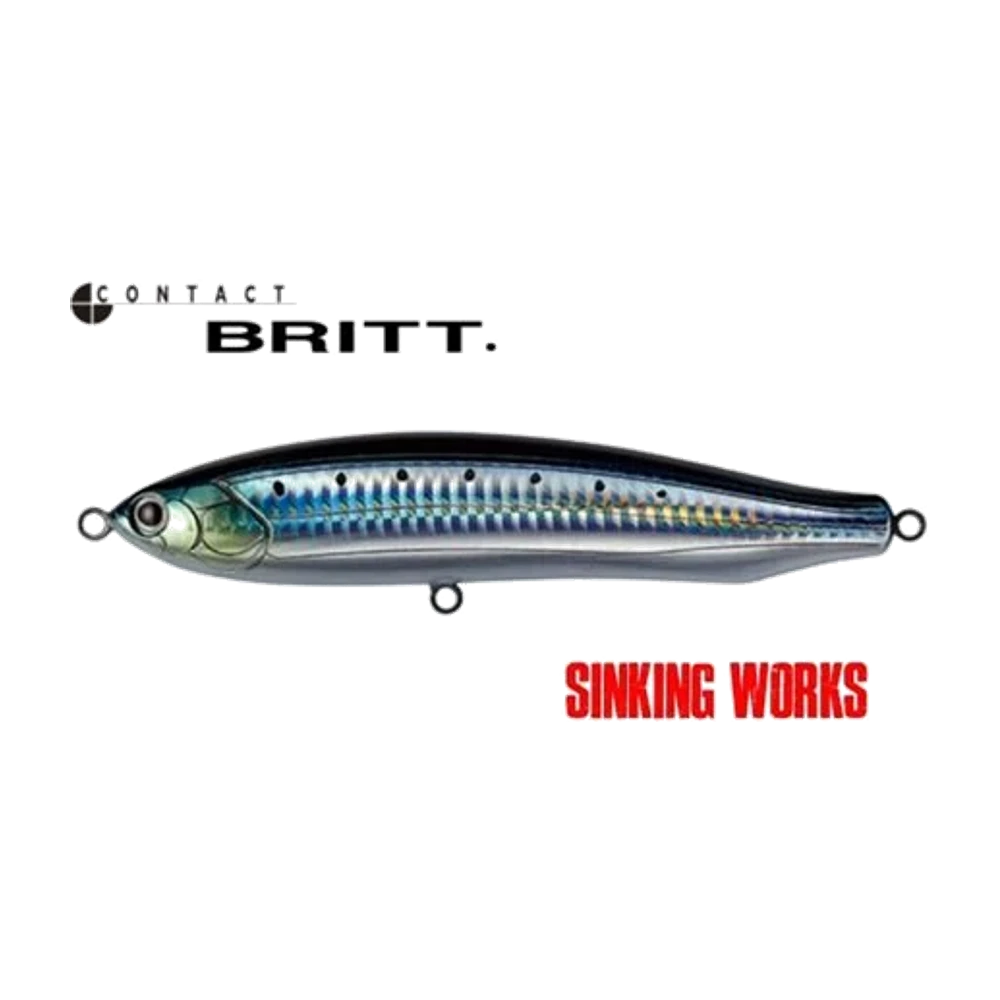
Tackle House Contact Britt: the falling-leaf descent
Rather not fish it blind? Photograph your spot — CarnaFish cross-checks the conditions and points you the right way.
The first instinct with a metal jig is to make it climb. You drop it to the bottom, rip it back up with hard rod strokes, and start again. It looks impressive, it is exhausting, and on European sea bass or a shoal of mackerel holding in mid-water, it is often the least productive way to fish.
Watch the line when you give it back: nine times out of ten, the bite is already there. The jig catches on the way down, not on the way up. The lift repositions the lure and triggers a reaction; the fall is what convinces.
The Contact Britt is built to make that fall usable. Its asymmetric shape, thicker on one side than the other, makes it impossible for it to drop straight: it tilts, skids, flattens out, sets off the other way. That falling-leaf behaviour is slow, disorderly and perfectly readable to a predator.
Why it does not drop straight
A symmetrical jig dropped on a free line noses down and spins on itself. That is fast and effective for reaching the bottom in current, but it tells no story.
The Contact Britt works differently:
- The imbalance is deliberate. Mass is distributed unevenly between the two faces. Under drag, the jig pivots around its long axis instead of diving nose first.
- Every tilt produces a flash. The wide flank passes alternately through light and shadow. Over a five-metre descent you produce a dozen separate flashes — far more visible than a constant flank.
- The sink rate is reduced. The jig slides sideways on every oscillation, so it takes longer to go down than a streamlined model of the same weight. In practice, it stays longer in the layer where the fish are.
That last property has a downside you have to account for: in strong current or real depth, it drifts a long way. You lose the vertical, the line angles off, and you end up fishing fifty metres from the boat with no real contact.
Slow jigging: the sequence
Forget the fast rhythm of classic jigging. Here, you count.
- Drop on a free line until you touch bottom, or down to the depth of the echoes you marked on the sounder. Feather the spool with a finger without braking it completely.
- Lift about a metre with the rod, in one broad steady movement, not a sharp snap.
- Follow the rod back down towards the water, keeping the line just tight — neither slack nor pulling. Count three to four seconds. This is the bite phase.
- Take one turn of the handle and start again, working gradually up the water column.
- Over the whole height, you should have done ten to fifteen cycles. If you are back at the top in five lifts, you are going too fast.
A variant for mackerel and active bass in mid-water: shorten the lift to fifty centimetres and link them faster, without ever cutting out the controlled descent. On a dense shoal, a jig dropping into the middle triggers immediate competition.
On the water: the line has to stay just tight on the drop, never completely free. That detail separates those who catch from those who feel nothing. A slack line loses almost every falling bite, because the bass inhales the jig and spits it out without you knowing; a line under tension, conversely, stops the jig oscillating and turns the drop into a pendulum swing.
Weights and rigging
| Depth / current | Weight | Approach |
|---|---|---|
| 5 to 15 m, light current | 20 to 30 g | Slow jigging, one-metre lifts |
| 15 to 25 m, moderate current | 30 to 40 g | Shorter lifts, frequent bottom contact |
| 25 to 40 m or a running tide | 40 to 60 g | Vertical first, more direct descent |
| From the shore, off a breakwater | 20 to 30 g | Cast, then fan the descents |
On rigging, three points that change your hook-up rate:
- The head assist hook is the main hook. Bass almost always attack from the front and from above during the drop. A single or double assist on a short cord — five to seven centimetres — is the reference setup.
- The rear treble is optional and often counterproductive. It catches the bottom, it tangles the assist, and it adds little on bass. Keep it for shoaling mackerel, where disorderly attacks are common.
- A ball-bearing swivel is useful at the end of the braid. A jig that oscillates this much ends up twisting the line over a full day.
Where it excels, and where to leave it in the box
Its windows:
- Bass holding in mid-water over a rock head, a drop-off or a wreck, when they refuse to come up to the surface.
- Mackerel shoals marked on the sounder between two layers: the oscillating drop triggers instantly.
- Deep water from the shore, off a breakwater or a plunging point, with a cast then a fanned set of descents.
It is unsuited to:
- Strong current or real depth on a fast drift, where its slow fall becomes a handicap: you lose the vertical and control of everything. You need a streamlined, heavier jig then.
- Fish feeding on the surface, where a topwater converts infinitely better.
- Very cluttered bottom, where the erratic fall and the assist hook invariably end up in a crevice.
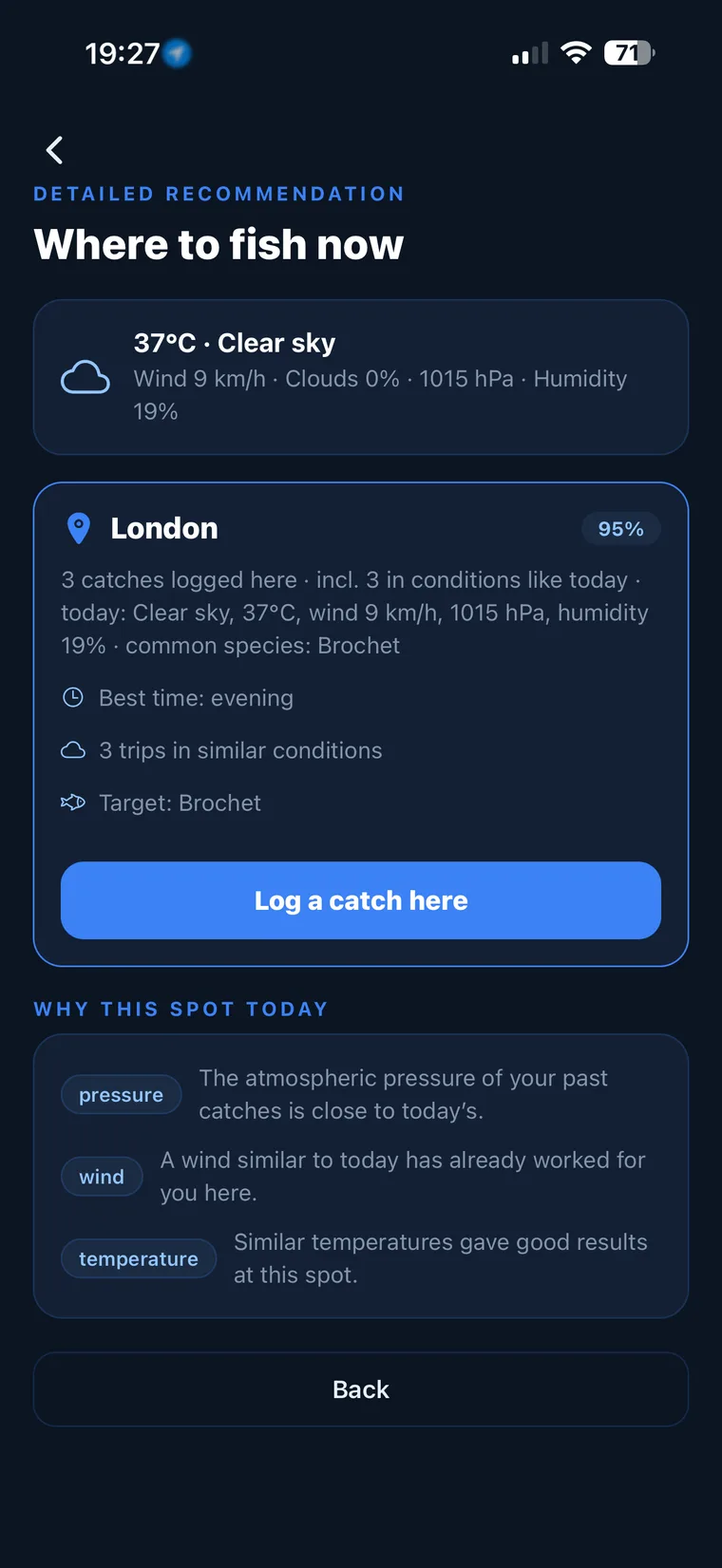
Not sure what to tie on?
Photograph your spot: CarnaFish reads the scene, cross-checks the conditions and gives you the zone, the lure and the retrieve. Free on iOS and Android.
Colours
- Full sun, clear water: silver, blue-silver, holographic. The flash of the tilt does all the work.
- Low light, dawn and dusk: gold, copper, pink. Those tones stay readable when a raking light no longer returns a clean flash.
- Coloured water after a blow: opaque, bright colours, pink or fluorescent green, which give a clean silhouette.
Contact Britt or a streamlined jig
A jig like the Major Craft Jigpara is more versatile and easier to send down straight: it suits fast jigging, current, and searching deep when the priority is reaching the bottom quickly.
The Illex Dexter Jig sits in a similar register, with a profile designed for casting and retrieving from the shore as much as for vertical work.
The Contact Britt deliberately sacrifices sink rate and current-holding to get a long, oscillating, flashy fall. That is a choice: you fish slower, you cover less depth per hour, but you spend far more time in the useful layer with a lure that is moving. On located, unaggressive fish, it is what makes the difference.
On the same session it makes a logical pair with a topwater like the Shimano Ocea Head Dip: the surface when they are feeding, the slow jig when it stops. Our guide to lure fishing for sea bass explains how to read the tide to know which one to reach for. And if you are torn between attacking the surface and going down with the jig on a given spot, CarnaFish analyses a photo of the spot and answers.
Key takeaways
- The bite comes on the drop: the lift only repositions the jig.
- The asymmetric shape produces a falling-leaf descent with a flash on every tilt.
- Line just tight during the drop, neither slack nor pulling. That is the decisive point.
- Assist hook at the head on a 5 to 7 cm cord; the rear treble is usually pointless on bass.
- A poor choice in strong current, in deep water on a fast drift, and over surface-feeding fish.
FAQ
Why do the bites come on the drop?
Because it is the only moment when the jig genuinely imitates a wounded prey coming loose and falling. The lift gets the predator's attention, the oscillating fall gives it time to commit and take.
How should I hold the line during the fall?
Just tight, following the rod down towards the water. A completely slack line loses bites, a line under tension kills the oscillation and turns the fall into a pendulum swing.
What weight should I choose for sea bass?
20 to 30 g between 5 and 15 m, 30 to 40 g down to 25 m, and over 40 g on a running tide. The benchmark is simple: when you can no longer stay under the boat, go up a step.
Should I keep the rear treble?
On bass, no in most cases: it catches the bottom and tangles in the assist hook. On mackerel shoals, where attacks are disorderly, it can improve your returns.
Can this jig be fished from the shore?
Yes, off a breakwater or a plunging point. Cast, let it sink to the bottom, then work it with short lifts and controlled descents in a fan to sweep the zone.
Is this jig suitable in strong current?
No. Its slow, drifting fall loses the vertical as soon as the current picks up. In those conditions a streamlined, heavier jig built to drop straight stays far more effective.
The full sea bass lure guideSeason-by-season strategy: which family of lure, when, and why.Go from theory to fish
CarnaFish reads your spot from a photo and gives you the game plan: zone, lure, retrieve. Free on iOS and Android.