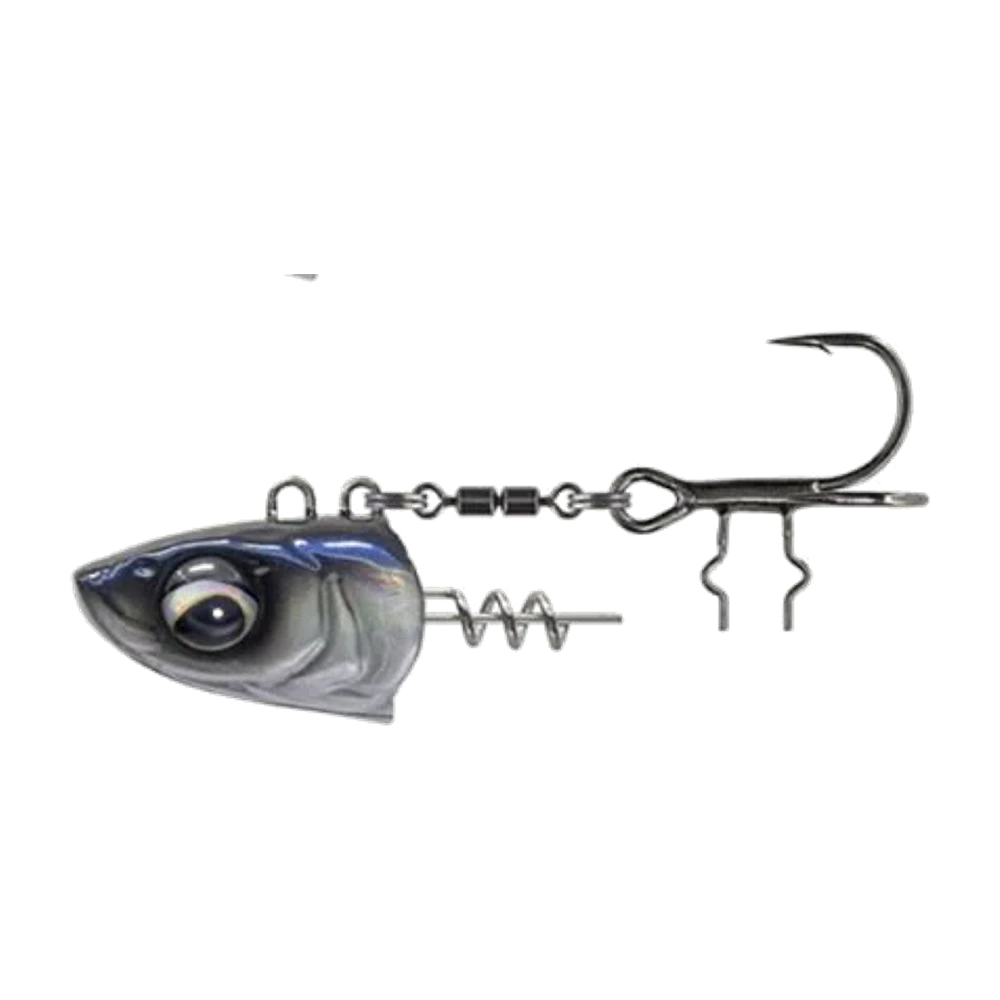
Savage Gear Monster Vertical: keeping the line vertical in twenty metres
One lure, endless conditions. CarnaFish reads your spot from a photo so you are not just guessing.
On a big river or a deep reservoir, vertical fishing almost always fails for the same reason: the line is not vertical. You watch your line leave the rod at thirty degrees, your lure is fifteen metres behind the boat, you have lost contact with the bottom, and the bites you think are subtle are simply bites you cannot feel.
Nothing you do afterwards fixes that. Not the retrieve, not the colour, not changing lure. The only parameter that matters is mass — enough lead for the line to drop straight under the boat despite the drift and the current.
The Monster Vertical is built for that situation. It is a heavy, dense jig with a narrow profile, designed to sink fast and stay directly below you in conditions where a soft plastic on a standard jig head drifts off uselessly.
Why a dense jig changes everything in deep water
Three reasons, all mechanical.
Density, not weight alone. A bulky 100 g lure brakes on the way down and gets pushed by the current over its whole fall. A narrow jig of the same mass offers far less lateral resistance: it drops straight, faster, and your line stays short.
Sink rate as a searching tool. In twenty-five metres, ten seconds saved on the descent multiplied by a hundred cycles in a day adds up to a great deal more effective fishing time. You spend more of it in the productive zone and less of it waiting.
Permanent contact. A heavy mass connected by low-stretch braid transmits the bottom with a precision no light rig reaches at that depth. You feel the nature of the substrate, the changes in hardness, the boulders — and above all you feel a bite that sometimes amounts to nothing more than a loss of tension.
Add the geometry: a flattened body that tips onto its side on the drop-back, throwing a brief flash during the fall. Most bites come on that tip.
Choosing the weight: the drift decides, not the depth
The common mistake is to pick the weight on depth alone. It is the combination of depth plus drift speed that decides.
| Depth | Light drift (under 0.5 knot) | Marked drift (current or wind) |
|---|---|---|
| 8 to 12 m | 60 to 80 g | 100 to 120 g |
| 12 to 20 m | 80 to 120 g | 150 to 180 g |
| 20 to 30 m | 120 to 180 g | 200 to 250 g |
| Over 30 m | 180 to 250 g | 250 to 300 g |
The test is simple and takes three seconds: drop the jig and look at the angle your braid makes where it enters the water. Beyond twenty degrees off vertical, go up a step. You lose a little finesse and gain everything else.
On line, stay in the 0.30 to 0.45 mm braid range. Finer and you snap off freeing a 200 g jig wedged in a rock; heavier and the current grabs it more, costing you the very verticality you were after.
The retrieve: short, sharp, and a lot of nothing
The stroke is brief. The temptation in deep water is to make big movements in order to "feel something". You need to do the opposite.
- Drop with the spool under control, thumb or finger on it. The jig has to fall on a tight line or you miss the mid-water bites — and there are some.
- Touch bottom, then lift twenty to thirty centimetres. That is your reference position and you keep coming back to it.
- Lift thirty to fifty centimetres, decisively, from the wrist.
- Follow it back down, without letting go completely. That is the phase in which the jig tips and the bite comes.
- Hold a pause of three to five seconds, jig motionless just above the bottom.
- Touch bottom again every three or four sequences to correct the depth as the boat drifts.
For zander, shorten everything: twenty-centimetre lifts, longer pauses, a lot of stillness. For catfish, do the opposite and lengthen the lifts to a metre, accepting a broader rhythm — that fish comes to displaced water as much as to sight.
On the water: with a heavy jig, never set the hook by sweeping the rod up. The weight of the lure creates leverage that tears the hook out of a zander's jaw before the point has penetrated. Set the hook by pulling backwards, arm extended, rod low, then hold constant tension without ever letting go.
The hook: the weak point of the rig
A vertical jig is usually fished with an assist hook at the head rather than a rear treble. Three practical consequences.
First, the pull-out rate depends directly on the length of the cord. Too short and the hook does not find the mouth; too long and it tangles on the body of the jig on the way down. A length that brings the point to the first third of the lure is a good starting point.
Second, the hook must be oversized and heavy-wire. On catfish, a fine hook opens out. On zander, a point blunted by repeated contact with rock will not penetrate a hard jaw: check it and sharpen it after every noticeable contact.
Third, a leader is essential. Short, strong fluorocarbon for zander, wire or very heavy fluorocarbon if you are fishing a zone holding catfish and pike. Bare braid on a heavy jig abrades through far faster than you would believe.
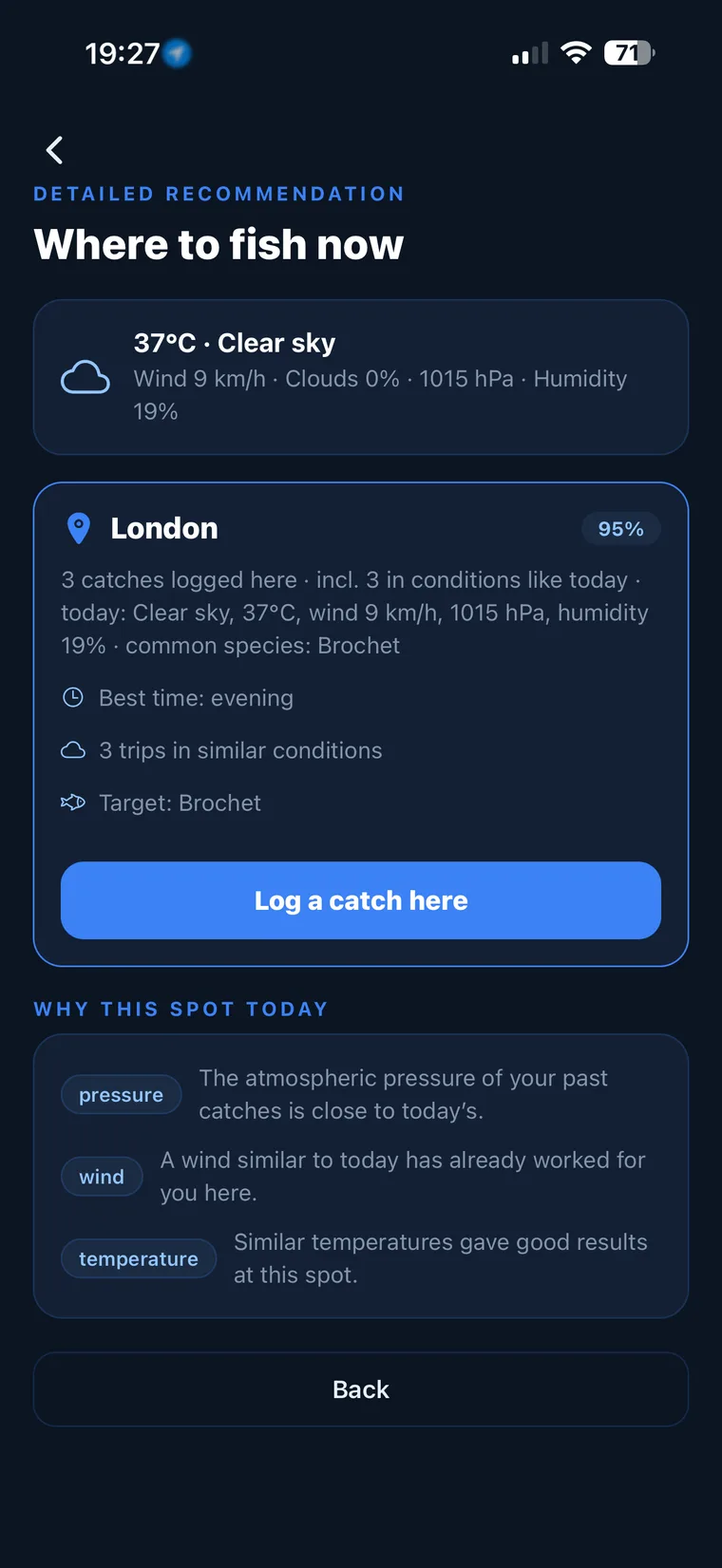
Not sure what to tie on?
Photograph your spot: CarnaFish reads the scene, cross-checks the conditions and gives you the zone, the lure and the retrieve. Free on iOS and Android.
Its conditions, and the ones where it has no business
It makes sense where verticality is possible and useful:
- From a boat on a controlled drift, on a river, a big lake or a deep reservoir.
- On fish sitting on the bottom marked on the sounder, in winter or in high summer when the thermocline concentrates the catch.
- In catfish holes, where you need to get down fast and present something visible in very little light.
- On sharp drop-offs and confluence holes, where a light lure never reaches the spot.
It is unusable from the bank, where verticality does not exist. It is also out of proportion in less than six or seven metres: the mass crushes the presentation and frightens more than it attracts. And on zander in very clear, calm water, a lightly rigged soft plastic stays more convincing.
Vertical jig or vibrating blade for vertical fishing
Vertical fishing is done with two very different families, and the choice comes down to water clarity.
A blade bait such as the Heddon Sonar produces a continuous vibration that carries. It is the tool for coloured water and for calling fish in. It does not, however, drop straight in a marked drift, and it quickly becomes unmanageable beyond fifteen metres.
The Monster Vertical plays on sight and presence, not on vibration. It assumes you have already located the fish on the sounder and are dropping on top of them. On catfish in a deep hole, it pairs well with a MadCat Clonk Teaser, which works higher in the column and serves mainly to lift a fish off the bottom. Our guide to lure fishing for catfish explains how to combine those two approaches over the same hole. And if you are unsure which weight to tie on when you arrive at an unfamiliar spot, CarnaFish analyses a photo of the spot and answers.
Key takeaways
- Weight is chosen on the drift as much as on the depth: beyond 20 degrees of line angle, go up a step.
- Controlled descent on a tight line, or you miss the mid-water bites.
- Short lifts of 30 to 50 cm, following it back down: the bite comes on the tip.
- Set the hook by pulling backwards with the arm, never by sweeping the rod up.
- Strong assist hook, a leader every time, points checked between drops.
FAQ
What weight should I use for vertical fishing in 20 m?
120 to 180 g in a light drift, up to 250 g if current or wind is pushing the boat. The control check stays the angle of the braid at the surface: beyond twenty degrees, you are no longer fishing vertically.
Why is my line going off at an angle?
Because the jig is too light for the drift at that moment. That is the number one cause of failure in vertical fishing: you lose bottom contact, you stop feeling the bites, and the retrieve stops meaning anything. Increase the mass before changing anything else.
How do I set the hook with such a heavy jig?
Arm extended backwards, rod low, with no vertical snap. Sweeping up a rod loaded with 200 g creates leverage that pulls the hook. Once hooked up, keep constant tension all the way to the net.
Does the Monster Vertical work for zander or only catfish?
Both, with different retrieves. For zander, short lifts of about twenty centimetres and long pauses just above the bottom. For catfish, wider lifts that can go up to a metre.
Can it be used from the bank?
No. Vertical fishing means being directly above the fish, which is only possible from a boat, a high pontoon or a dam wall. From the bank the line goes off at an angle and the retrieve loses all meaning.
What colour in deep water?
Beyond twenty metres, colour matters less than contrast and reflectivity. Metallic or holographic in clear water, white or fluo in dark water: either way you are after a brief flash of light, not a faithful imitation.
The full zander lure guideSeason-by-season strategy: which family of lure, when, and why.Go from theory to fish
CarnaFish reads your spot from a photo and gives you the game plan: zone, lure, retrieve. Free on iOS and Android.