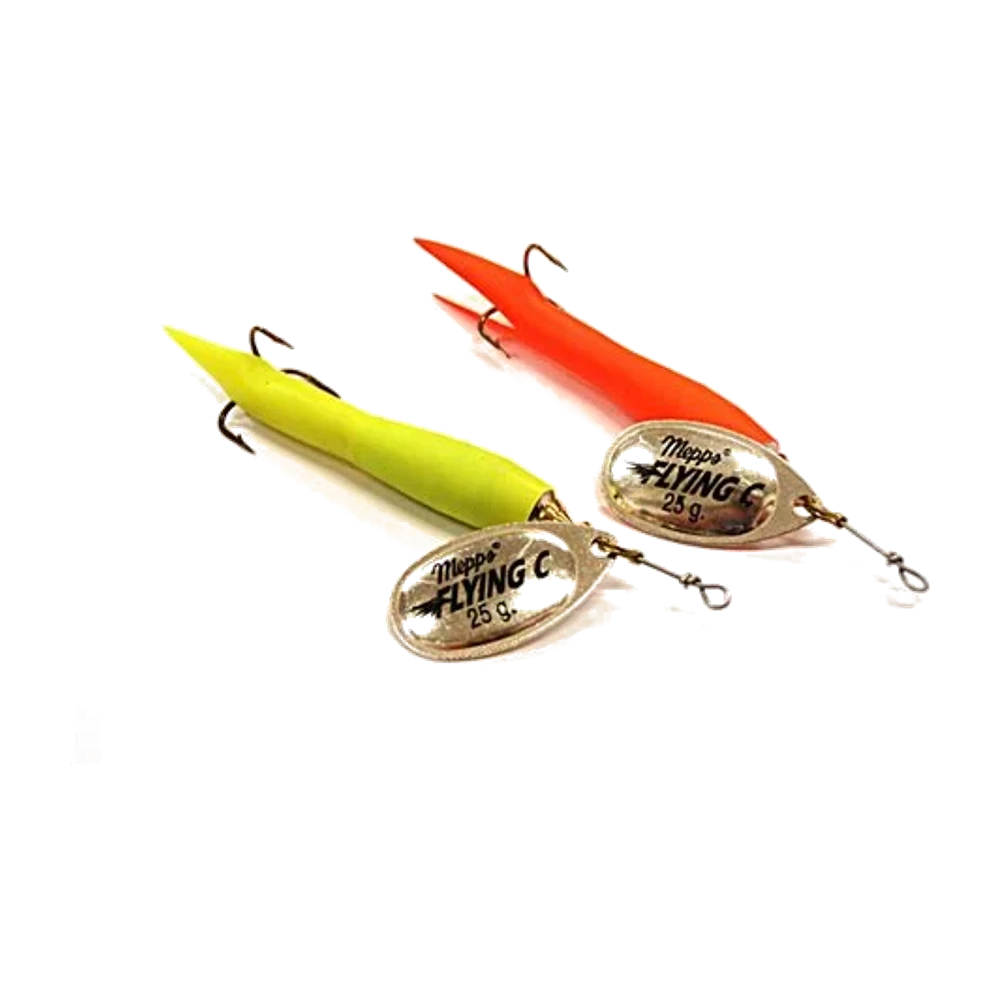
Pezon et Michel Flying Condom: the big spinner that finds pike fast
Not sure this lure fits YOUR spot today? CarnaFish tells you in 10 seconds, from a photo.
A three-hectare pond in September, green water, forty centimetres of visibility. Three hundred metres of accessible bank, a weed flat at a metre fifty running the whole length, and two hours ahead of you. You are not trying to convince one particular fish: first you are trying to find out where they are.
In that context a slow soft plastic is the wrong tool. It is excellent for working a spot you have already identified, but it will burn most of your two hours covering twenty metres of bank. What you need is a lure that casts far, stays high without snagging, puts out a signal that carries in water where a pike cannot see three metres, and that you can keep throwing at one cast every thirty seconds.
The big spinner has met that brief forever, and the Flying Condom is the French take on the idea, with one particularity: a soft skirt that extends the body.
The wide blade produces pressure, not flash
In stained water, metallic flash does not carry. What carries is displaced water.
A wide blade turning slowly around its axis pushes a serious volume of water on every revolution. It generates a low-frequency pressure wave that a pike picks up on its lateral line long before it sees anything at all. That is why a big spinner stays effective in water where a flashy jerkbait has become pointless.
Two practical consequences:
- The lure pulls hard. You feel it constantly in the rod, and that is normal. The day you stop feeling it, the blade has stopped: you have picked up weed, or you are going too slowly.
- It rides upwards. The drag of the blade creates real lift that holds the lure in the top metre as soon as you speed up. That is a huge advantage over a weed bed, and a genuine handicap if you want to fish at three metres.
The soft skirt is not a gimmick
It is the detail that sets this lure apart from other big spinners, and it plays two distinct roles.
Bulk without mass. The skirt adds several centimetres of silhouette behind the blade without weighing the lure down or slowing the blade. You get the visual presence of a large lure with the castability of a spinner. In the water, the fibres or the soft sleeve open and close in time with the blade: the lure breathes instead of staying rigid.
A soft feel in the mouth. A pike that closes its jaws on a block of metal feels hard resistance immediately and spits fast. On a soft skirt the sensation is closer to real prey, and the fish holds the lure a fraction of a second longer. On a fast style of fishing where you are often late on the hookset, that fraction of a second translates straight into your hook-up rate.
Care: rinse the skirt in clean water after a session in dirty water, and do not store it crushed under other boxes or it takes a permanent set.
The retrieve: faster than you think
- Cast long, fan-style. Three casts per bank position — left, straight out, right — then move ten metres. This is a lure for covering ground.
- Close the bail and start immediately. Do not let it sink: over weed, a big spinner that drops picks up vegetation.
- Retrieve at a brisk pace, rod at forty-five degrees. You should feel the blade thumping clearly. Plenty of anglers wind this lure too slowly out of reflex.
- Break the rhythm once per cast: two very fast turns, then a half-second stop, then pick it up again. The blade folds back and restarts, and the lure dips slightly. That is the main trigger on a follower.
- Fish the last three metres in a figure of eight under the rod. With this kind of lure, one pike in five makes its mind up at your feet.
On the water: when a pike follows without biting, do not speed up and do not slow down — change direction. Sweep the rod sideways by eighty centimetres to send the lure sharply off to one side while keeping the same handle speed. Prey that changes course is prey trying to escape; prey that changes speed is often prey the pike has time to size up.
Which size for which fish
| Size | Indicative weight | Use |
|---|---|---|
| Small | 12 to 18 g | big-river and reservoir trout, small pike |
| Medium | 20 to 28 g | pike in ponds and gravel pits, the all-round size |
| Large | 30 to 40 g | hunting big pike, large lakes, heavily stained water |
On the larger sizes the whole outfit has to keep up: a 20 to 60 g rod as a minimum, 0.20 to 0.30 mm braid, a size 3000 to 4000 reel. This lure pulls constantly and will tire your wrist fast with undersized tackle.
Not sure what to tie on?
Photograph your spot: CarnaFish reads the scene, cross-checks the conditions and gives you the zone, the lure and the retrieve. Free on iOS and Android.
The anti-twist setup, non-negotiable
A blade turning continuously for an hour will twist any line. On the bigger sizes the torque is serious and the problem gets worse.
- A large ball-bearing swivel, at the head of the leader, not a cheap snap swivel.
- A forty-centimetre supple wire or titanium leader for pike, mandatory: the skirt brings the fish's jaws very close to the line.
- Check your line every half hour. If it loops when you slacken off, the swivel has stopped doing its job and needs replacing before a break on the hookset costs you a fish.
Flying Condom or a big Aglia
A large Mepps Aglia covers part of the same need: wide blade, strong pressure, searching near the surface. It is a simpler, more compact lure, very effective in clear water where the flash of the blade counts as much as the vibration.
The Flying Condom takes the lead in two specific cases: in stained water, where the bulk added by the skirt makes up for the lost visibility, and on pike that keep coming off, thanks to that soft feel in the mouth. In exchange it is bulkier, more tiring to wind and more expensive to lose in a snag.
If your problem is the weed rather than the searching speed, another tool answers better: the Kuusamo Professor rides over dense vegetation while swimming far more slowly, whereas the big spinner needs speed to stay high. Our guide to choosing a pike lure places both approaches within a full season. And if you are unsure which zone to attack first on a big flat, CarnaFish analyses a photo of the spot and answers.
Key takeaways
- The wide blade sends out a pressure wave a pike detects in stained water, where flash no longer carries.
- The soft skirt adds bulk without mass and makes fish hold the lure longer.
- Wind faster than your instinct tells you, with one break of rhythm per cast.
- This is a searching lure: three casts per position, then move on.
- A large ball-bearing swivel and 40 cm of wire, or line twist and breakages are guaranteed.
FAQ
How fast should the Flying Condom be retrieved?
Faster than most spinners: fast enough to feel the blade thumping clearly in the rod. Too slow a retrieve stalls the blade, drops the lure into the weed and removes the lift that keeps it high.
Which size should I pick for pike?
The medium format, around 20 to 28 g, is the best compromise between casting distance, signal produced and fatigue on the retrieve. The larger 30 to 40 g sizes are there to select bigger fish or to fish very dirty water.
Can it be fished over a weed bed?
Yes, that is its favourite ground, provided you start the retrieve immediately after the splashdown and hold the speed. The moment you slow down it drops and picks up vegetation.
How do I stop the line twisting?
A large ball-bearing swivel at the head of the leader, never a light snap swivel. Check your line regularly: as soon as it loops when you slacken off, replace the swivel rather than waiting for a break.
Do I need a wire leader?
Yes for pike, over roughly forty centimetres. The skirt brings the fish's jaws very close to the line, and one sideways take is enough to cut through even heavy fluorocarbon.
Does it work for trout too?
In small sizes, on big rivers and reservoirs, yes, on trout that are looking for a decent mouthful. On a stream or in clear summer water it is out of all proportion: a more discreet classic spinner will be far more relevant.
The full pike lure guideSeason-by-season strategy: which family of lure, when, and why.Go from theory to fish
CarnaFish reads your spot from a photo and gives you the game plan: zone, lure, retrieve. Free on iOS and Android.