Teckel Honker Frog: the metal-footed frog that leaves a wake
One lure, endless conditions. CarnaFish reads your spot from a photo so you are not just guessing.
Frog fishing has a flaw nobody admits willingly: across a vast weed mat, it is slow. You walk the lure on the spot, you work every hole, and you cover very little water for a lot of time spent. The Teckel Honker Frog is built for the other approach — the one where you reel steadily and it is the wake, not the hovering, that brings the fish up.
Two metal feet, and that is the whole lure
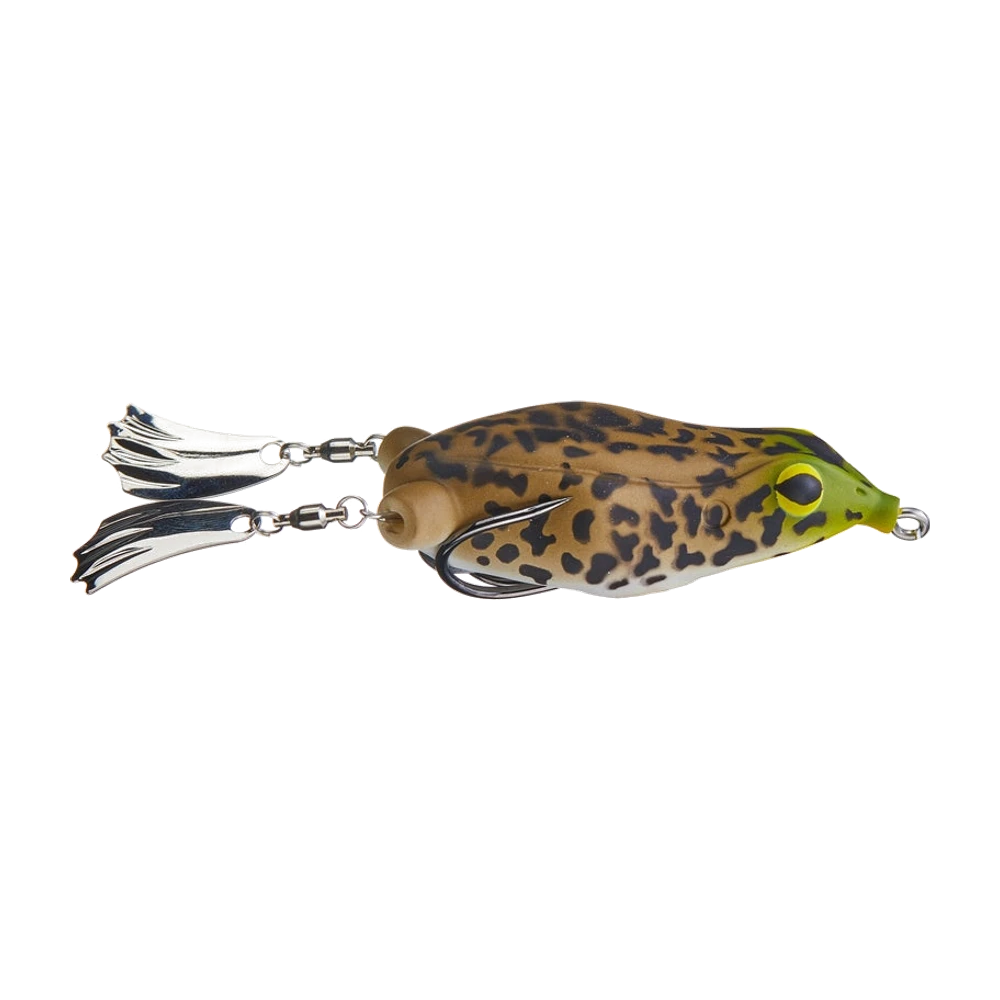
In principle the body is a conventional hollow-body frog, but the back end is unusual. Teckel has fitted two metal feet mounted on ball bearings. In the product photo those feet are two chrome pieces stamped in a webbed-flipper shape, with notches drawing out the toes, each hanging from a small barrel swivel and two split rings, themselves attached to two cylindrical stubs at the rear of the body — an observation from a product photo, not a specification.
The manufacturer explains that these feet create a distinctive waking effect meant to draw the attention of bass holding under the vegetation. In practice, two free metal parts on bearings do two things: they spin and churn as soon as the lure moves, and they add a hard metallic sound that a plastic body alone does not make. That is what puts the Honker Frog among the frogs you reel steadily, rather than among the walking frogs.
The rest follows cover-lure logic: a black double hook lying flat along the back with the points tucked against the body, a nose ring for a direct knot, and a soft body Teckel describes as extremely collapsible to improve the strike-to-hookup ratio. The brand also states that an internal weight makes casting easy and keeps the frog from landing upside down.
The figures, and how to read the table
The manufacturer's table is worth a second look, because it has three columns and it is easy to see only two. The first heading is the brand name, not a measurement: the row therefore starts with the model name, then comes the length and the weight. That gives:
- Length: 2-3/4 in, about 7 cm.
- Weight: half an ounce, 14.2 g.
Two honest qualifications. First, the table lists a single size: there is no range progression to cross-check a figure that might look odd, so both values have to be taken as published. Second, the manufacturer does not say whether those 7 cm cover the body alone or the whole thing including the feet. Given how freely the feet hang at the rear, the measurement almost certainly covers the body, but it is not written down: the real footprint in your box will be larger.
At 14.2 g this is a heavy weight for a 7 cm frog. That is consistent with the internal weight the brand mentions, and it is good news for casting: at that weight you will reach the far side of the mat even into a headwind, which is not true of every frog this size.
How to fish it
Steady retrieve, the action it was built for
Cast past the zone, reel at a constant pace with the rod at mid-height and let the feet work. You should see the wake forming behind the lure and hear it: if the surface stays smooth, you are reeling too slowly. On a wide weedy flat, that retrieve lets you cover in an hour what a conventional frog covers in three.
On holes and edges
Nothing stops you pausing. When the frog reaches a gap in the vegetation, kill the retrieve: the feet keep moving for a fraction of a second on their bearings, then the lure settles. The fish often decides at that transition. Start again sharply after two seconds.
The hookset
This is where most frogs are lost. Do not set on the sound. Wait until you feel the weight of the fish in the rod, count a full second, then set hard and to the side while reeling. The collapsible body Teckel highlights is worthless if you set into thin air before the jaws have closed.
Every time the frog comes out of the water, turn it over and squeeze the body between two fingers to clear the water it takes on. A half-full frog sits flat, loses its wake and hooks badly. I do it every five or six casts out of reflex, and it changes the conversion rate over a whole day.
The classic mistake
Fishing the Honker Frog on fluorocarbon or mono. On a topwater lure dragged across a weed mat you want heavy braid, 50 to 65 lb, tied straight to the ring. Fluorocarbon sinks and pulls the lure's nose down; mono stretches and cushions the hookset. No leader is useful here; discretion counts for nothing when a fish attacks a silhouette through a canopy of vegetation.
Second mistake: a rod that is too soft. At 14.2 g, cast long and set through weed, this frog wants a powerful casting rod and a high-ratio reel. A medium outfit will not pull the fish out of cover.
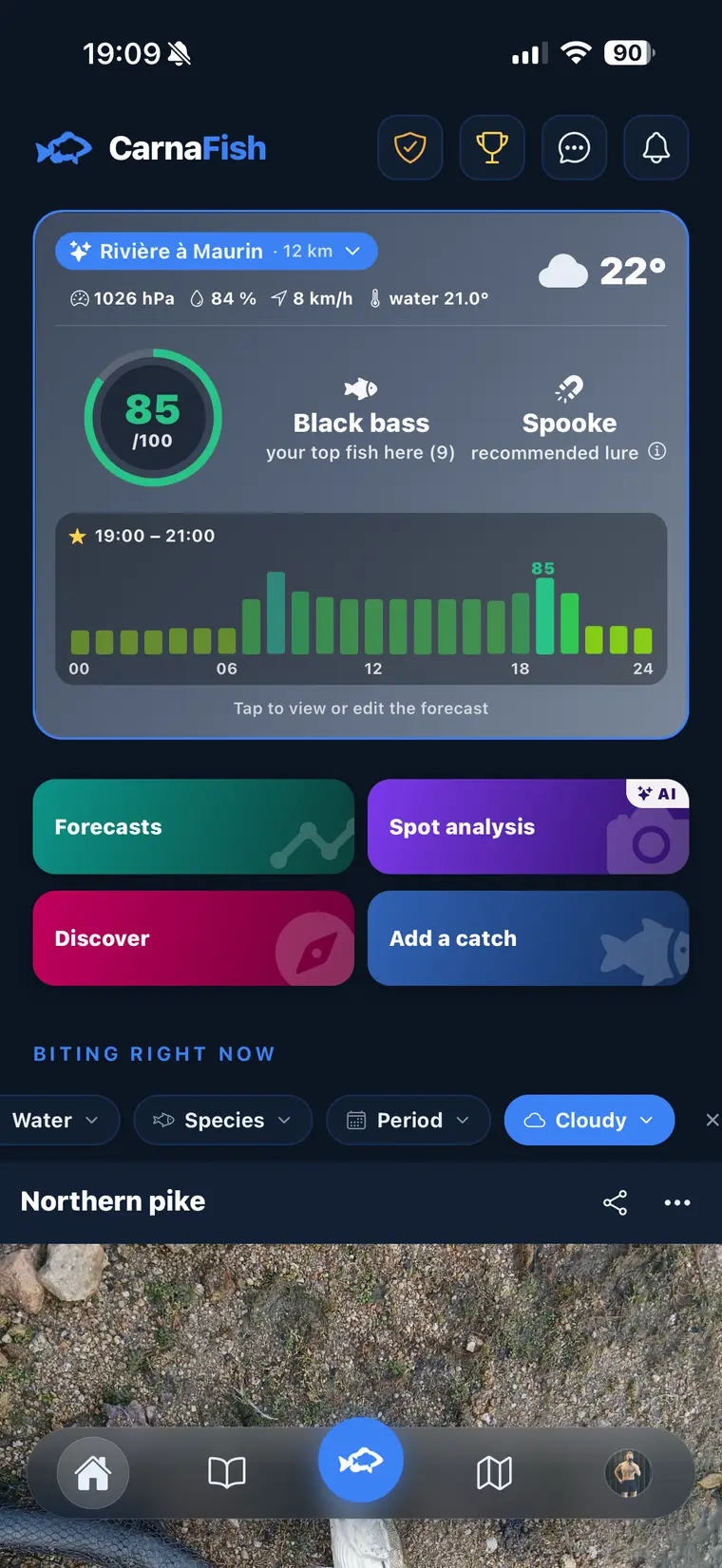
Not sure what to tie on?
Photograph your spot: CarnaFish reads the scene, cross-checks the conditions and gives you the zone, the lure and the retrieve. Free on iOS and Android.
Colours by light
- Green water, weed mat, bright light: the brown leopard shown in this page's photo, a brown back mottled with black, a white belly and a chartreuse green head. It is the dress closest to a real frog and the default choice.
- Overcast sky, or fish seeing the frog backlit: a clean white belly. A bass looking up sees only a silhouette, and white gives the sharpest contrast against grey sky.
- Dusk or very dark water: all black, for the opposite reason — a solid silhouette that reads in low light.
Knowing which part of the mat to work matters as much as the lure choice, and that is exactly what CarnaFish makes easier: a photo of the spot, and the AI suggests a zone, a depth and a presentation consistent with the day's conditions. To learn which clues to read before you cast, our guide to reading a fishing spot gives directly usable reference points.
Key takeaways
- Two metal feet on ball bearings: this frog is made for a continuous retrieve, not for hovering in place.
- One size only in the table, 2-3/4 in or about 7 cm, for 14.2 g — heavy for this size, thanks to the stated internal weight.
- The manufacturer does not say whether the length includes the feet; the real footprint is probably larger.
- Heavy braid tied direct, a powerful casting rod, and a hookset delayed by a full second.
FAQ
How big is the Honker Frog?
The manufacturer's table gives 2-3/4 in, about 7 cm, for half an ounce, 14.2 g. Read it carefully: the first column of that table carries the brand name, and the row starts with the model name before giving length and then weight. Only one size is offered.
Do the 7 cm include the metal feet?
That is not stated. The feet hang freely at the rear on swivels, so the measurement almost certainly covers the body alone, but the manufacturer does not write it down. Allow for a bigger footprint in the box.
Steady retrieve or walk it in place?
Steady: it is the metal feet on their bearings that create the wake, and they only work when the lure moves. You can pause over holes in the vegetation, but the base action is a straight retrieve, unlike a walking frog such as the Spro Bronzeye Frog.
What line and rod?
Braid of 50 to 65 lb tied straight to the nose ring, no leader, on a powerful casting rod with a high-ratio reel. At 14.2 g and setting through vegetation, too light an outfit will not land the fish.
Why do I miss so many frog bites?
Almost always a hookset that comes too early. The noise at the surface is not the bite: wait until you feel weight in the rod, count a second, then set hard while reeling. Remember to squeeze the water out of the body regularly too, a waterlogged frog hooks badly.
Does it work for pike in Europe?
Over weedy flats in summer, yes. A 7 cm topwater with a strong wake matches the way pike ambush under vegetation, and the double hook holds fish. For the same water just under the surface, a Teckel Bladewaker or a prop frog like the Lunkerhunt Prop Frog covers a neighbouring register.
The full bass lure guideSeason-by-season strategy: which family of lure, when, and why.Go from theory to fish
CarnaFish reads your spot from a photo and gives you the game plan: zone, lure, retrieve. Free on iOS and Android.