Queen Tackle Tungsten Flipping Jig: the dense jig built for cover
One lure, endless conditions. CarnaFish reads your spot from a photo so you are not just guessing.
On an arm of the lake choked with laydowns, fishing comes down to a single question: does your lure drop straight to the bottom between two branches, or does it lie down on the first fork it meets? That is the whole point of the flipping jig, a family you rarely cast beyond ten metres and that you drop vertically, within rod reach. Queen Tackle's Tungsten Flipping Jig plays that tune with a tungsten head instead of lead.
What the tungsten actually changes
Queen Tackle states a head made of 97% tungsten and, for a given weight, a more compact profile than a lead head. That argument holds up physically: tungsten is roughly one and a half times denser than lead, so the same weight fits into a noticeably smaller volume. On a flipping jig this means a head that threads between two branches instead of settling on them, and that pops out of a fork with a single flick of the rod tip.
The brand's second claim, added sensitivity, needs qualifying. Tungsten is stiffer than lead and does transmit impacts better: a contact on gravel reads differently from a contact on silt, where a lead jig sends back a duller signal. But that transmission depends as much on your braid and your rod tip as on the metal. Fish mono on a soft rod and you will not notice. The flip side is cost: on a technique whose whole job is to drop a lure into the worst snags on the lake, the tally of lost jigs adds up.
The wire-tied skirt, and why that detail matters
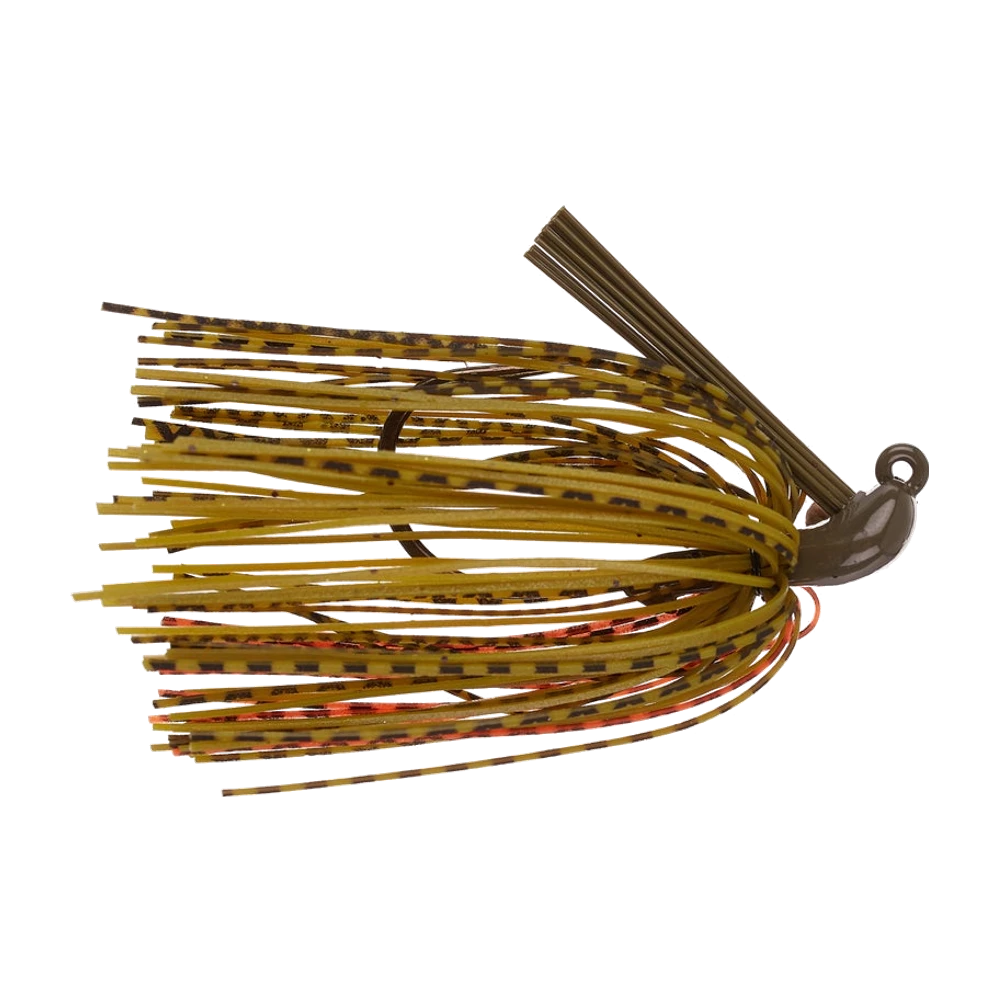
Queen Tackle specifies a silicone skirt, described as fine, tied on with wire — a tight metal wrap around the collar, as opposed to the rubber band found on many entry-level jigs. Two concrete consequences. First, durability: a rubber band eventually splits or slides after a few dozen fish, a wire tie does not. Second, strand freedom, since each strand stays individually mobile instead of being crushed under a collar.
That freedom is what produces the action the brand claims: a skirt that keeps working even with the jig parked motionless on the bottom. In a technique where the lure spends most of its time at rest, that is the difference between a dead lure and one that breathes. Queen Tackle adds that the skirt can be trimmed to change the action — true of any silicone skirt, but a wire tie takes scissors far better than a band does. The brand also claims the skirt is infused with coffee scent, meant to make fish hold on longer: a marketing claim no public data lets you verify.
Before the first cast, spread the skirt by hand underwater and fan the strands out. A jig straight out of the pack keeps its strands stuck together from the packaging fold: it fishes at half its volume for the first ten minutes, which is exactly when you are casting at the best spots.
The three moves the brand claims
Queen Tackle presents the lure for three uses: pitching, skipping and a swimming retrieve. These are not stylistic variations, they are three different ways of fishing.
Pitching into cover
The basic move. Let about a metre of line hang, grab the jig, send it under a branch on a low arc and follow the fall on a tight line. Nine times out of ten the bite comes during that drop, and often without a sharp tap: the line moves sideways or stops before it should have reached the bottom. That is when you set. The compactness of tungsten helps keep the fall straight, which is what triggers the reaction.
Skipping under docks
Same move but flat, bouncing the jig under a dock or a leaning tree. The arched head visible in the photo helps that skip, provided you add a flat trailer to act as a skid: a trailer that is too thick dives on the first contact and the skip dies after a metre.
The swimming retrieve
Less intuitive on a flipping jig, but effective over submerged grass: reel slowly and steadily, rod tip low, letting the jig tick the top of the vegetation now and then. That is the job of the Queen Tackle Tungsten Swim Jig, whose head is designed for it, but a flipping jig copes over short distances.
Trailer, bait keeper and the classic mistake
The lure carries a built-in bait keeper whose job is to lock the trailer in place. Rig a thick craw or chunk: the compact profile of a tungsten head needs some bulk behind it to slow the fall and fill out the silhouette. A Keitech Flex Chunk or a Raid Japan Egu Chunk both do the job, the latter with thicker claws that brake the drop harder.
On the line side, the technique calls for 0.30-0.40 mm braid and a powerful fast-action rod: you have to pull a fish out of a tangle of wood in three turns of the handle, not play it on light line. Queen Tackle states a sharp Mustad hook, but no hook makes up for a soft hookset inside a branch.
The mistake that costs the most fish
Going heavier to get down faster. An overweight jig crosses the strike zone in a second and the bass has no time to commit. In cover the logic is the reverse: take the lightest weight that still falls straight through the vegetation, and let the drop last. If you feel nothing for two seconds, you are fishing too heavy.
Not sure what to tie on?
Photograph your spot: CarnaFish reads the scene, cross-checks the conditions and gives you the zone, the lure and the retrieve. Free on iOS and Android.
Colour by water
Queen Tackle advertises a range of colours developed with its pro staff, without publishing the list on the source consulted. So reason by families, which hold true for any flipping jig.
- Clear water: the brown-barred green pumpkin tone seen in the photo, with a few orange strands under the skirt. The universal crawfish dress, the one that never spooks a wary fish.
- Stained water: black and blue, the most readable pairing in loaded water without going fluorescent.
- Dirty water or night fishing: solid black, which no longer plays on colour but on how cleanly the silhouette reads from below.
A jig that earns its place in a full box
Next to a Dirty Jigs Tour Level No Jack Version 2 Flipping Jig, the Queen Tackle offers the same fishing with a denser, smaller head for a given weight. If you mostly fish open banks, the gap will not show. If you spend your days dropping a lure into stumps, it shows on every cast.
The right jig never replaces reading the spot, and that is exactly what CarnaFish makes easier: a photo of the spot, and the app suggests the zone, the depth and the lure type suited to the day's conditions. To rebuild the fundamentals, our beginner's guide to bass fishing covers the whole base.
Key takeaways
- Head stated at 97% tungsten: for a given weight, a more compact profile than lead, and you feel it in wood and grass.
- Fine wire-tied silicone skirt: it keeps moving while the jig sits still, which is exactly when the lure spends most of its time.
- Queen Tackle publishes neither length nor weight on this source: check the pack label before buying if you need a specific weight.
- The lightest weight that still falls straight always beats the comfortable weight: a slow drop is what draws the bite.
FAQ
What weight should I pick for this flipping jig?
Queen Tackle does not publish the weight range on the source consulted, so go by the pack label. The fishing logic does not change: the lightest weight that still falls straight through the cover you are targeting, and not a gram more.
Does tungsten really improve sensitivity?
The metal transmits impacts better than lead, which is physically correct. But the gain only shows with low-stretch braid and a fast-action rod. On mono and a soft rod, you will not hear the difference.
What trailer should I run behind this jig?
A thick craw or chunk, locked on the built-in bait keeper. A bulky trailer slows the fall and widens the silhouette, which offsets the reduced profile of a tungsten head. For skipping, prefer a flat trailer that encourages the bounce.
Is this jig good for anything other than bass?
It is a tool built for bass in cover, and that is where it shines. Nothing stops a pike from hitting it along a weed edge, but without a wire leader you will lose the lure, and a flipping jig is not the best choice if pike are the target.
Should I trim the skirt?
Not by default. Shortening the strands that reach past the hook bend tightens the silhouette and improves the hook-up rate on fish that nip. It is an adjustment to make once you have missed several bites, not before the first cast.
Why does my jig keep coming back snagged?
Two causes, in order: a fibre guard crushed or trimmed too short, which no longer protects the point, and too much weight, which buries the head in the substrate instead of setting it on top. Fan the guard back out by hand before you change weights.
The full bass lure guideSeason-by-season strategy: which family of lure, when, and why.Go from theory to fish
CarnaFish reads your spot from a photo and gives you the game plan: zone, lure, retrieve. Free on iOS and Android.