Rapala OG Rocco 5: the silent balsa squarebill from Ott DeFoe
Before tying this one on, it helps to know if the spot actually calls for it. CarnaFish reads the scene from a photo.
Some days the fish are not out deep. They are tight to the bank, under a stump, against riprap, inside the branches of a tree that fell in last winter — and you have to go in after them, a foot off the wood, accepting that you will bang into it. That is exactly the water the OG Rocco 5 was built for: a small balsa crankbait shaped by Ott DeFoe, a Bassmaster Classic champion who built his career on this kind of bank fishing.
Balsa, and what it changes against wood
Rapala states a premium balsa body and extreme buoyancy. That is not catalogue language, it is the whole working principle of the bait. At equal volume, balsa weighs far less than injected plastic. The moment you stop reeling, the lure rises — fast, and above all predictably.
That is what makes the only retrieve that really matters with a bank squarebill possible: bump, release, let it climb. When the lip catches a branch or knocks into a rock, you give it half a second of slack, the body rights itself and clears the obstruction on its own, and you pick the retrieve back up. With a dense plastic squarebill, the same pause leaves the bait pinned against the wood, and you end up unhooking trebles from branches far more often.
The other consequence of balsa is that each bait swims slightly differently from the next. That is inherent to the material and you can already see it on the Rapala Shad Rap or the Rapala Fat Rap. In practice it gives a lively action, less mechanical than a perfectly repeatable plastic mould.
A square circuit board lip
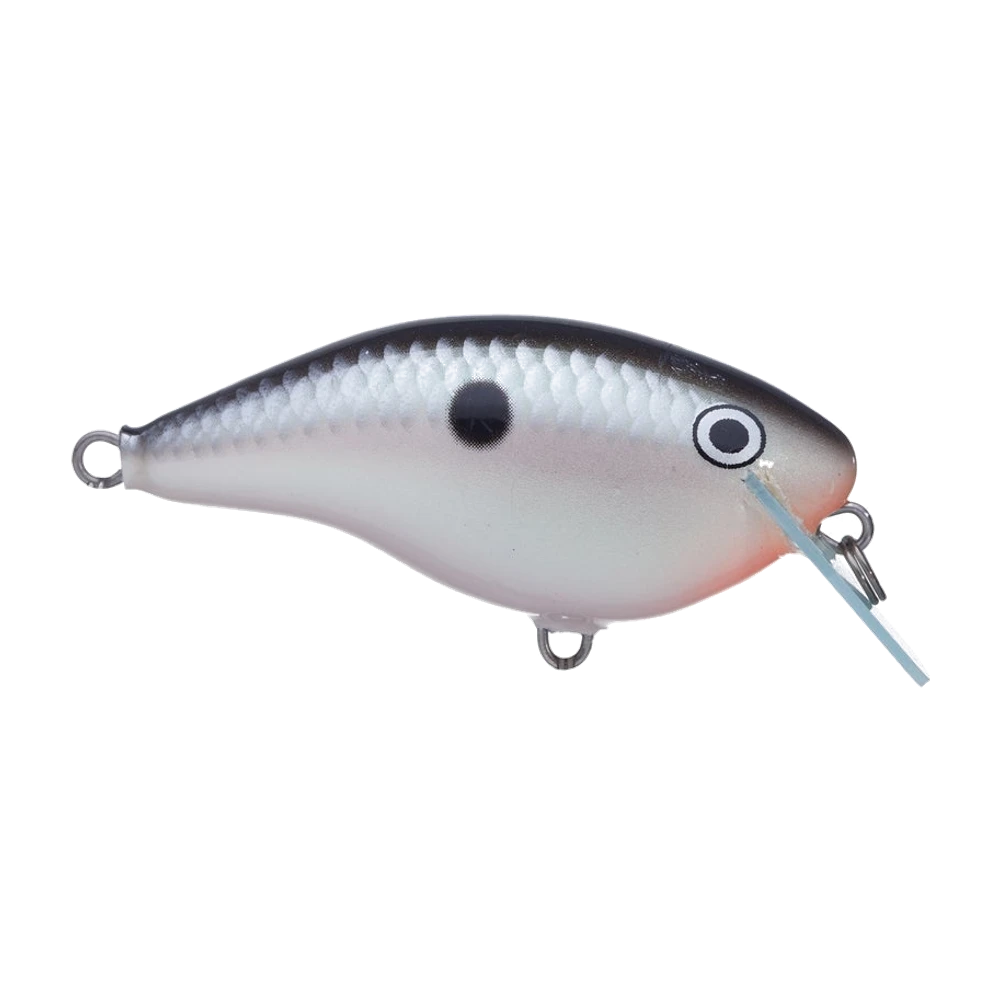
The Rocco 5 lip is not moulded polycarbonate like most cranks on the market, but cut from circuit board — a thin, stiff material that resists bending. On the product photo you can clearly see a flat, slim blade with a pale blue edge set into the nose of the rounded body.
Because it is thin, the lip presents less surface when it hits something: instead of jamming head-on, it slides off and deflects. That is precisely the function Rapala claims for it, deflecting off cover and backing out of sticky situations when paused. Combined with the buoyancy of balsa, it makes this little crankbait something you can grind through a laydown without spending the day retrieving your lure.
Rapala states a medium wobble: neither the tight roll of a flat sided bait nor the wide sweep of a deep diver. That intermediate amplitude explains its year-round range, enough signal for water at 12 degrees without overloading a summer fish in clear water.
Silent, and that is a choice
The most interesting thing about the Rocco 5 is what it does not have: no rattle, no sound chamber. Rapala presents it as completely silent and highlights the value of that subtlety when fish are under pressure from other anglers.
On a busy lake, where every boat runs the same rattling squarebill along the same banks, a mute bait genuinely changes things. The fish no longer receives the signal it has learned to ignore; all it gets is water displacement and a silhouette. That is the same thinking behind baits like the 6th Sense Crush Silent Squarebill 50S.
The trade-off is real and worth stating: in heavily coloured water, a rattling crank gets found from much further away. If you are fishing water with less than a foot of visibility, the Rocco 5 is not necessarily the right tool, and a noisy bait or a lipless will keep the edge.
The numbers you want before you buy
The manufacturer table is short: 2-1/2 inches, that is 6.4 cm, for 3/8 oz, about 10.6 g, with a stated running depth of 5 ft, around 1.5 m. The number in the name therefore refers to that depth in feet, not to a length.
Ten and a half grams on a 6.4 cm body is heavy for balsa: the brand claims castability well above that of some balsa cranks on the market, which lets you punch a cast into the wind.
Rigging
Fluorocarbon in the 10 to 14 lb range, with a fast snap or a loop knot. A knot cinched straight onto the split ring chokes the lip and flattens the swimming amplitude, which holds true for every crankbait. On the rod side, a moderate or medium action is not only comfort: it stops you tearing the treble out of a fish that smacks a buoyant bait at the end of a long cast.
Rapala ships the Rocco 5 with two VMC hybrid trebles. On the product photo shown here, the bait is pictured bare: the tail and belly hangers are empty, which gives a clean view of both anchor points and the nose loop, but does not reflect how the lure comes out of the pack.
When you fish a wooded bank, set your speed so the lip knocks into something every three or four seconds. If you touch nothing, you are too far off the bank or going too fast. If you hang up constantly, slow down rather than change lures: with balsa, speed is what decides whether the body has time to rise.
The classic mistake
Reeling at a constant speed and never stopping. It is the reflex you bring over from open-water cranking, and it is what ruins this bait most often. All the buoyancy of balsa is wasted if you never give it time to work. The bite nearly always comes on the restart that follows a contact: the lure deflects, lifts slightly, then takes off again, and that stumble mimics a baitfish that has just bumped into something and panicked.
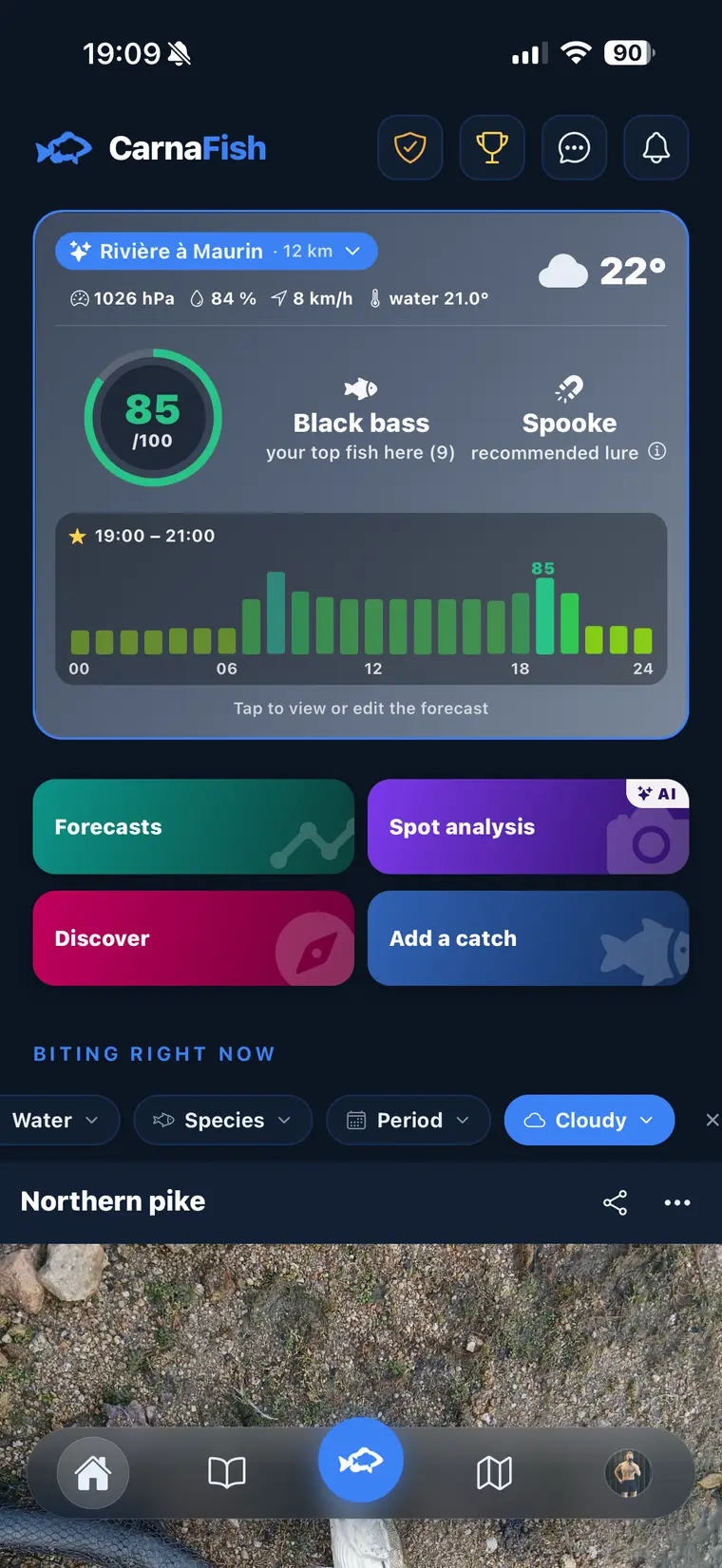
Not sure what to tie on?
Photograph your spot: CarnaFish reads the scene, cross-checks the conditions and gives you the zone, the lure and the retrieve. Free on iOS and Android.
Colours by water clarity
Rapala does not publish a fixed list for this model and simply runs the Rocco 5 through its house palette, which changes from season to season. Think in families of tones rather than catalogue references.
- Clear water: a pearly grey and white shad finish like the one in the photo, with a dark back and strongly printed scales. The default choice on high-visibility lakes.
- Stained water: a brown-orange craw tone, which matches what bass actually eat in spring when they are grubbing through rock.
- Muddy water: a dark-backed chartreuse, where the contrast between back and belly carries the silhouette far more than the colour itself.
Where it sits in the box
The Rocco 5 is not a search bait: at 1.5 m it covers the bank strip and nothing else. Keep a diver like the Rapala DT6 for breaklines, and a louder plastic squarebill for coloured water.
Knowing which lure to tie on starts with the spot in front of you, and that is exactly what CarnaFish does: one photo of the spot, and the AI suggests the zone, the depth and the type of lure that fit the conditions of the day. To build the groundwork on bank fishing and typical holding spots, our beginner guide to bass fishing is a solid starting point.
Key takeaways
- Highly buoyant balsa body: the pause after a contact is what frees the lure from cover, not arm strength.
- Square circuit board lip, thin and stiff, designed to deflect off wood rather than bury itself in it.
- No rattle at all: a real advantage on pressured fish, a real handicap in heavily coloured water.
- 6.4 cm for about 10.6 g and a stated 1.5 m: this is a bank bait, not a breakline searcher.
FAQ
Does the OG Rocco 5 float?
Yes, strongly. Rapala states an extremely buoyant balsa body, which makes it rise as soon as you stop reeling. That fast rise is what lets it free itself from branches and rock when you give it half a second of slack.
How deep does it actually run?
Rapala states 5 ft, around 1.5 m. In practice the depth depends on line diameter and cast length: thick fluorocarbon and a short cast will have it working closer to a metre.
Why pick a crankbait with no rattle?
Because on heavily fished water, bass end up associating the clack of a crank with danger. A silent bait only transmits its water displacement and its outline. In very dirty water, on the other hand, a rattling model stays easier for the fish to locate.
What line and rod suit this lure?
Fluorocarbon in the 10 to 14 lb range, on a snap or loop knot so the lip is not choked. A moderate or medium action rod limits pulled hooks, which matters with a buoyant bait carrying trebles.
Does the Rocco 5 work for perch?
Yes, and it is a good perch size in Europe: 6.4 cm with a medium action works well on active perch along riprap and jetties. On wary perch, a smaller model is still more consistent.
Should I swap the factory hooks?
Not straight away: Rapala fits VMC hybrid trebles that are already good. Avoid stepping up to noticeably heavier trebles, which would change the buoyancy and therefore the behaviour on the pause.
The full bass lure guideSeason-by-season strategy: which family of lure, when, and why.Go from theory to fish
CarnaFish reads your spot from a photo and gives you the game plan: zone, lure, retrieve. Free on iOS and Android.