Rapala Crush City Ned BLT: the stick that stands up on its own
The right lure in the wrong spot still catches nothing. CarnaFish spots the zone that works, from a single photo.
The Ned rig has a quirk you only really understand once you have watched one underwater: it is not the pull that catches fish, it is the stillness. The lure spends most of its time sitting on a mushroom head, and everything depends on what its back end does while you touch nothing. A stick that slumps flat on the sand says nothing. A stick that stands up vertically imitates a baitfish rooting head-down in the bottom — and that is exactly what the Ned BLT does.
A stick designed to lift, not to lie down
Rapala states a TPE body that allows the bait to float off the bottom, and that single fact shapes everything else. On a mushroom head the lead stays on the floor while the rear of the lure rises slowly, held up by the buoyancy of the material alone. The bait then sits almost vertical, and stays there as long as you do nothing.
The brand points out that the Ned BLT was developed with Jacob Wheeler, an American Major League Fishing competitor, and puts forward a tapered ribbed tail designed to react to the smallest movement. That is a manufacturer claim rather than a measurement, but it matches what you see on the bait.
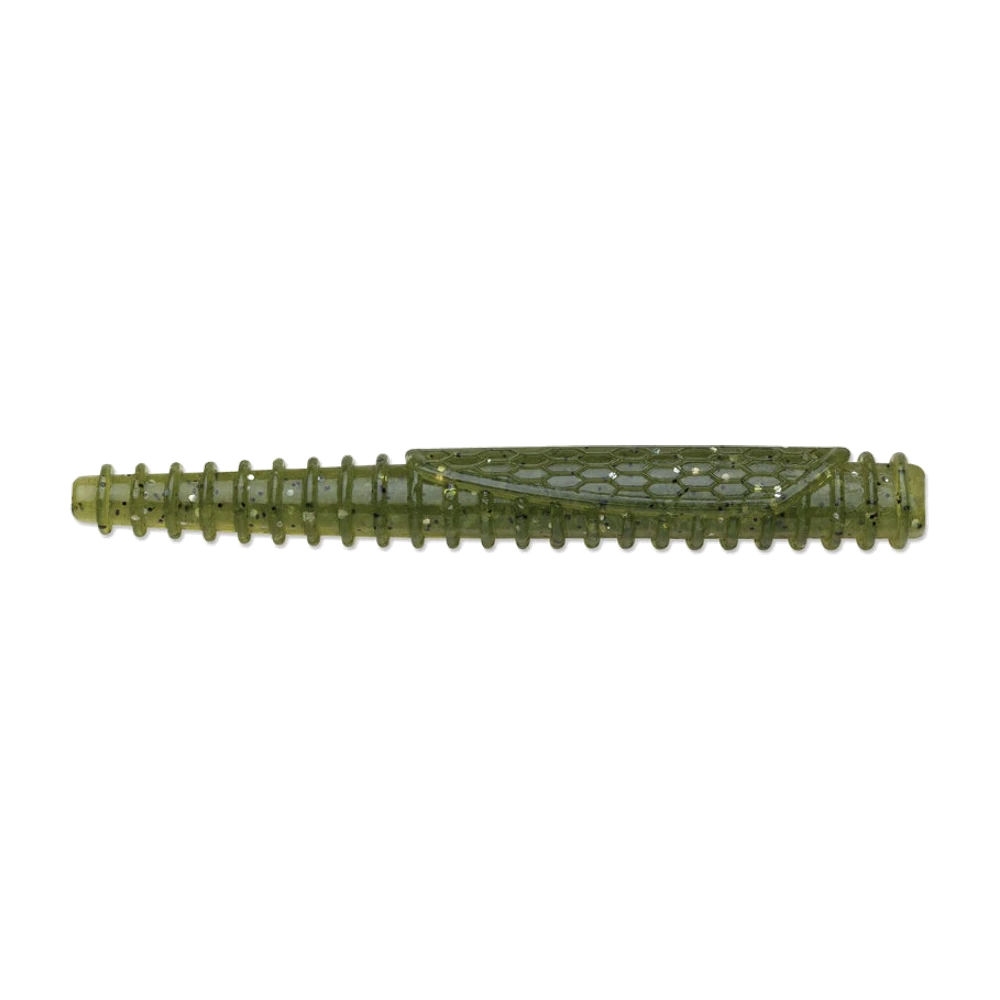
In the product photo, the body is encircled with regular transverse rings along its whole length, like a run of raised collars. The rear half flattens into a wide flat blade, textured with a honeycomb pattern, thinning gradually until it meets the diameter of the body before the tip. The other end is simply rounded. Those are observations from a product photo, not specifications, but they explain the behaviour: the flat blade grips water in a way no cylindrical stick can, and the rings multiply the edges that catch the slightest shift of water.
One size only, and no published weight
The manufacturer offers a single length: about 7.6 cm. Be careful with the chart published by retailers, whose header reads length and quantity: the figure next to the size is the number of pieces per bag, ten in this case, not a weight. The weight of the bare lure is not stated.
That matters on a Ned rig, where the balance between head weight and body buoyancy decides everything. Without that figure, the only reliable method is empirical: rig the bait on a 2 g head, drop it into a metre of clear water at your feet, and watch how long the rear takes to stand up. You will know straight away whether to go heavier or lighter.
Working it mostly means doing nothing
The most common mistake with a Ned stick is working it like an ordinary soft plastic. Two sharp pulls, a bit of straight retrieve, cast again — and you never fish where the fish is actually looking.
The right sequence is the opposite. Let the rig sink on a tight line, wait for the lure to touch down and the rear to rise, then do nothing for five to ten seconds. Only then a short twenty centimetre pull to move the head, and another pause. Most bites come during the pause, often a second or two after you stop, just as the back of the lure finishes lifting.
Fish with the line slightly slack during the pause. A tight line stops the rear of the bait from rising fully: you lose exactly the posture that makes the rig worth fishing, and you never notice, because none of it is visible from the bank.
The drop shot, the second intended rig
Rapala also lists the Ned BLT for the drop shot, where the floating behaviour takes on another meaning: nose-hooked on a single hook, the bait stays horizontal on the leader instead of dropping towards the weight. The rings along the body then carry every rod-tip shake through to the rear blade, which waves without the rig travelling. This is the rig to favour when fish sit off the bottom, typically over shoals located on the sonar.
For the knot and the placement of the weight, our drop shot rig page covers the basics, and the Ned rig page goes into choosing the mushroom head.
Where and when it takes over
The Ned rig was born for difficult American bass, and that is the use the manufacturer puts forward. In Europe it has become a formidable perch technique, especially on pressured waters where the fish have seen everything. The Ned BLT has one precise advantage there: its flat rear blade gives a slightly stronger visual signal than a smooth stick, without adding volume or speed.
The right conditions are easy to spot. Hard bottom — gravel, sand, shingle, the edge of a rock bank — where a mushroom head sits without sinking in. Fairly clear water, because for the fish this is a close-range visual presentation. And cold water or high pressure: as soon as fish are active and feeding in open water, a faster lure will outfish it.
The limit has to be stated: this is not a lure that covers ground. On an unknown stretch of bank you will spend an hour fishing thirty metres. Keep it for spots you have already identified, after searching with something else.
Not sure what to tie on?
Photograph your spot: CarnaFish reads the scene, cross-checks the conditions and gives you the zone, the lure and the retrieve. Free on iOS and Android.
Colors by bottom type and clarity
- Weed or dead wood: the green pumpkin with black and silver flake from the photo, the colour that disappears over a green-brown bottom while keeping a little sparkle.
- Clear water over sand or gravel: translucent natural finishes, which let light through and create no hard silhouette.
- Coloured water or low light: black, or a touch of chartreuse on the rear, to restore a contrast point once visibility drops.
The Ned rig does not forgive a misread bottom: dropped onto soft silt, the lure vanishes and never stands up. That is precisely what CarnaFish helps you anticipate — one photo of the spot, and the AI suggests the zone, the likely bottom type and the matching presentation. For the rest of the method, our guide to getting started with bass fishing covers tackle and reading a spot.
What to remember
- The TPE lifts the rear of the bait off the bottom: that is the entire point of the Ned rig.
- Single 7.6 cm size; the figure next to the length in retailer charts is a pack count, not a weight, and the bare lure weight is not published.
- The retrieve comes down to a short pull followed by a five to ten second pause, on a slightly slack line.
- A lure for known spots, not for searching: it is slow by design.
FAQ
Does the Ned BLT really float?
The manufacturer states a TPE that allows the bait to float off the bottom. On a mushroom head the rear lifts and the lure sits almost vertical, nose down, for as long as you leave it alone.
Which jig head weight should I use?
A 2 to 5 g mushroom head covers most situations. Since the bare lure weight is not published, the simplest approach is to test it in a metre of water at your feet and watch whether the rear stands up clearly.
How does it differ from the Ned BFG in the same range?
Size. The Rapala CrushCity The Ned BFG plays on a much larger volume to select bigger fish, where the Ned BLT stays on a classic finesse format that gets more bites.
Is it a good lure for perch?
Yes, it is one of its best uses in Europe, on pressured waters with hard bottoms. The flat rear blade adds a visual signal that a cylindrical stick like the Z-Man TRD Ned Rig does not have.
Do I need a weedless rig?
Not over clean bottom: the standard exposed-hook mushroom head hooks far better. Save the weedless version for wood-lined edges, accepting a slightly lower hook-up rate.
How long should I leave the lure still?
Five to ten seconds after each pull, longer still in cold water. It feels endless at first, but that pause is precisely when the rear of the bait finishes rising and triggers the bite.
The full bass lure guideSeason-by-season strategy: which family of lure, when, and why.Go from theory to fish
CarnaFish reads your spot from a photo and gives you the game plan: zone, lure, retrieve. Free on iOS and Android.