Rapala OG Tiny 4: the small balsa crankbait with a very tight wobble
Not sure this lure fits YOUR spot today? CarnaFish tells you in 10 seconds, from a photo.
There are days when the standard crankbait stops producing. The water is clear, the fish are pinned to the bottom, and every pass of a wide wobbling crank pushes them back a metre instead of pulling them in. That is exactly the situation Rapala built this small Ott's Garage model for, designed with Bassmaster Classic champion Ott DeFoe: a crankbait that deliberately moves very little water.
Balsa, and a circuit board bill
Two material choices shape everything else. The body is balsa, and the bill is cut from circuit board, rounded at the tip. Those are the two elements Rapala puts forward, and neither is decorative.
Balsa has a consequence familiar to anyone who has fished a Rapala Shad Rap: the material lacks the consistency of injected plastic, each individual bait works with a slightly different personality, and the action gains a liveliness that moulding reproduces poorly. Be careful about what the description actually says, though: it publishes no buoyancy class. No floating, suspending or sinking label, no column in the size chart to settle it. Balsa is traditionally a buoyant material, but on a weighted and hooked lure, only a test at your feet will tell you how this one behaves at rest. Do not build a retrieve around an assumed rise until you have seen it.
The circuit board bill is thin and very light. The manufacturer states that it moves less water than the thick plastic bill of a standard crank, and that it transmits the nature of the bottom better. That is the kind of detail nobody notices on the shelf and everybody feels by the third cast.
A very tight wobble, and what it implies
The stated action is a very tight wobble and what the manufacturer calls a finesse style action, produced by the combination of a thin profile, flat sides and that rounded bill.
That has to be translated into fishing terms. A wide wobbling crank sends out a pressure wave the fish detects from a distance: it is a search bait, it brings fish in. A tight wobbling crank sends a far quieter signal, but a far more believable one for a fish that has already watched ten lures go past that day. You do not use it to cover water, you use it to convert a fish you already know is there.
In other words, it is not the lure you start a session with on unfamiliar water. It is the one you tie on afterwards, once you have located the drop-off or the rock pile and the wide action has produced nothing but follows.
Bottom feel becomes information
The manufacturer insists on a point few spec sheets mention: because the bill is thin and light, you feel the bottom structure precisely, and you therefore know when to pause.
That is the key to the retrieve. You wind slowly until the bill starts to scrape. As soon as the feel changes — sand turning to gravel, gravel turning to rock, the dry knock of a branch — you stop for a second. The bait lifts slightly off the bottom, changes attitude, and that is almost always the exact moment the bite comes. On a crank with a big plastic bill, that information arrives too late, drowned in the vibration of the lure itself.
The real specs, and what the name does not tell you
The manufacturer chart is a single line, and its first column carries the model name, not a measurement. What follows reads: length about 5.7 cm, weight about 8.9 g, stated depth about 1.2 m. The first two values come as fractions of an inch and an ounce in the source: those are rounded conversions, to be taken as orders of magnitude rather than specs to the decimal.
The 4 in the name is not a size. It is a range designation, just like the Silver that follows, which refers to a finish. Do not go looking for 4 cm or 4 inches in your box.
One point is worth flagging: about 8.9 g for 5.7 cm is a high density for a balsa lure. The description does not detail the internal ballast, so there is no saying where that weight comes from. In practice it changes one thing for you: this little crank casts far better than its size suggests, which solves the usual problem with finesse cranks, impossible to throw into a breeze.
Not sure what to tie on?
Photograph your spot: CarnaFish reads the scene, cross-checks the conditions and gives you the zone, the lure and the retrieve. Free on iOS and Android.
Factory hardware and rigging
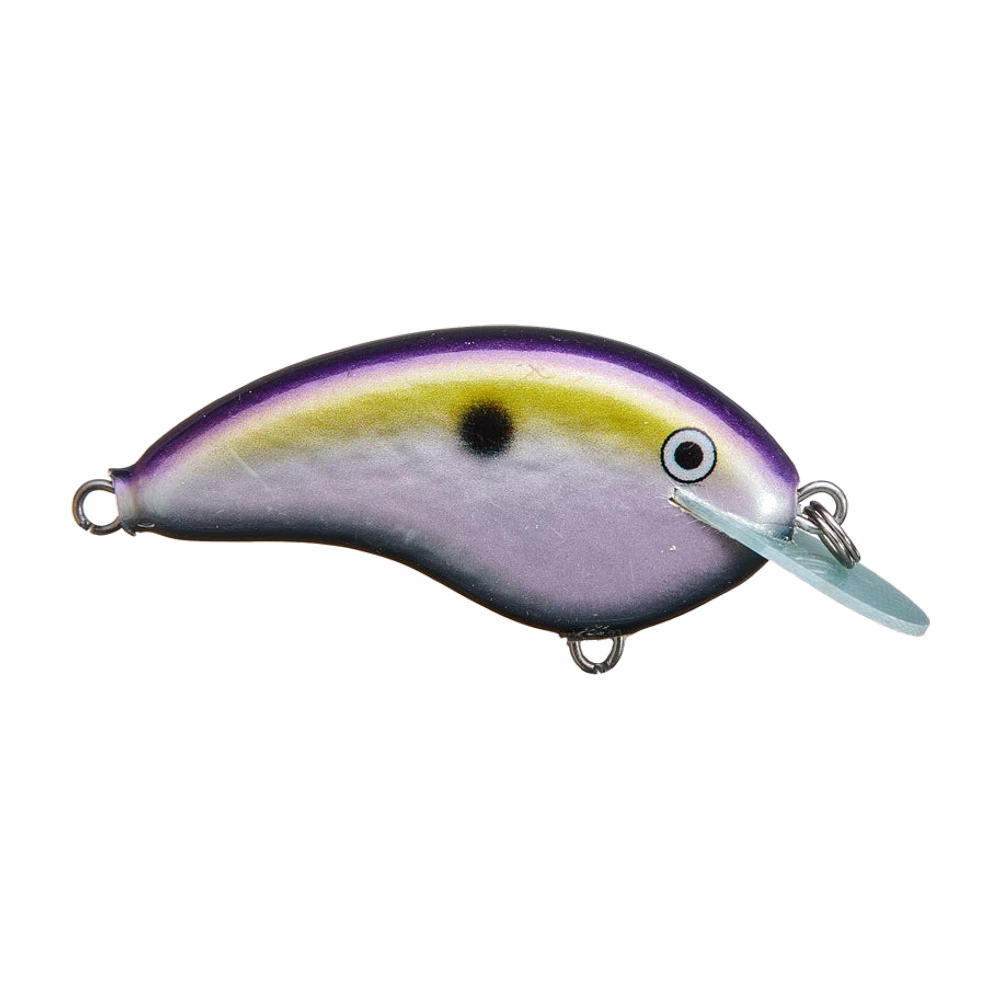
Rapala states VMC Black Nickel 1x Strong Hybrid trebles. The 1x Strong label means a wire gauge heavier than standard, a consistent choice on a lure whose small size sometimes attracts fish much bigger than itself. In the product photo the lure appears with no trebles fitted, split rings in place at the nose and belly — an observation from a product photo, not a statement about what comes in the box.
As for rigging, the balsa crankbait rule applies without exception: a knot cinched directly onto the nose ring restrains the bill and crushes the already narrow amplitude of this model. Loop knot or a small clip, nothing else. Fluorocarbon in 20 to 25 hundredths does the job, discreet enough in clear water and strong enough to pull the bait off a rock.
Fish this crank on too stiff a rod and you will lose half your bites. The tight wobble is barely felt, fish come off small trebles quickly, and you need a tip that absorbs a head shake instead of tearing the hooks out.
Colors by water
- Clear water: the pearl finish with a purple back and olive lateral band seen in the photo, which stays quiet while keeping one contrast point with the black spot on the flank.
- Rocky bottom in spring: a craw tone, red-brown, matching what the fish are actually rooting for at that time of year.
- Stained water or low light: a chartreuse base, the one case where this quiet lure needs some help being seen.
A finesse crankbait is only worth something if you put it in the right place, and that is exactly what CarnaFish makes easier: one photo of the spot, and the AI suggests the zone, the likely depth and the type of lure suited to the day. To work on technique for perch, our guide to perch fishing with lures covers the other families worth knowing.
What to remember
- Balsa body and circuit board bill: little water displacement, a very tight wobble, a quiet signal on wary fish.
- About 5.7 cm for 8.9 g and a stated 1.2 m running depth; the 4 in the name is not a measurement.
- No buoyancy class published: test the behaviour on the pause before making it part of your retrieve.
- The thin bill transmits the bottom: it is the change in feel that triggers the pause, not a stopwatch.
FAQ
Does this crankbait float at rest?
The manufacturer never says so: there is no floating or sinking label and no class column in the size chart. Balsa is usually buoyant, but with ballast and hardware added, only a test at your feet will give you the answer for your individual bait.
How deep does it run?
About 1.2 m according to the manufacturer, on thin fluorocarbon with a steady retrieve. Heavier line or a high rod tip reduces that depth, a long cast increases it slightly.
What does the 4 in OG Tiny 4 mean?
It is a model designation within the Ott's Garage range, not a measurement. The real length is around 5.7 cm, and the Silver that follows refers to a colour finish.
Is it a good perch lure?
Yes, that is its most obvious ground in Europe: a 5.7 cm bait working around 1.2 m over hard bottom matches margin perch spots exactly. For a faster approach over the same water, a Rapala Ultra Light Crank covers more ground.
Why choose a tight wobble over a wide one?
A wide action brings fish from a distance, a tight action convinces a fish that is already there but wary. In clear water, after several hours of fishing pressure, it is usually the second that turns follows into bites.
Should the factory trebles be changed?
Not for strength: the stated VMC 1x Strong hooks are already heavy wire. On a lure this light, though, any change of treble alters the attitude and the running depth, so check how the bait behaves after a swap.
The full bass lure guideSeason-by-season strategy: which family of lure, when, and why.Go from theory to fish
CarnaFish reads your spot from a photo and gives you the game plan: zone, lure, retrieve. Free on iOS and Android.