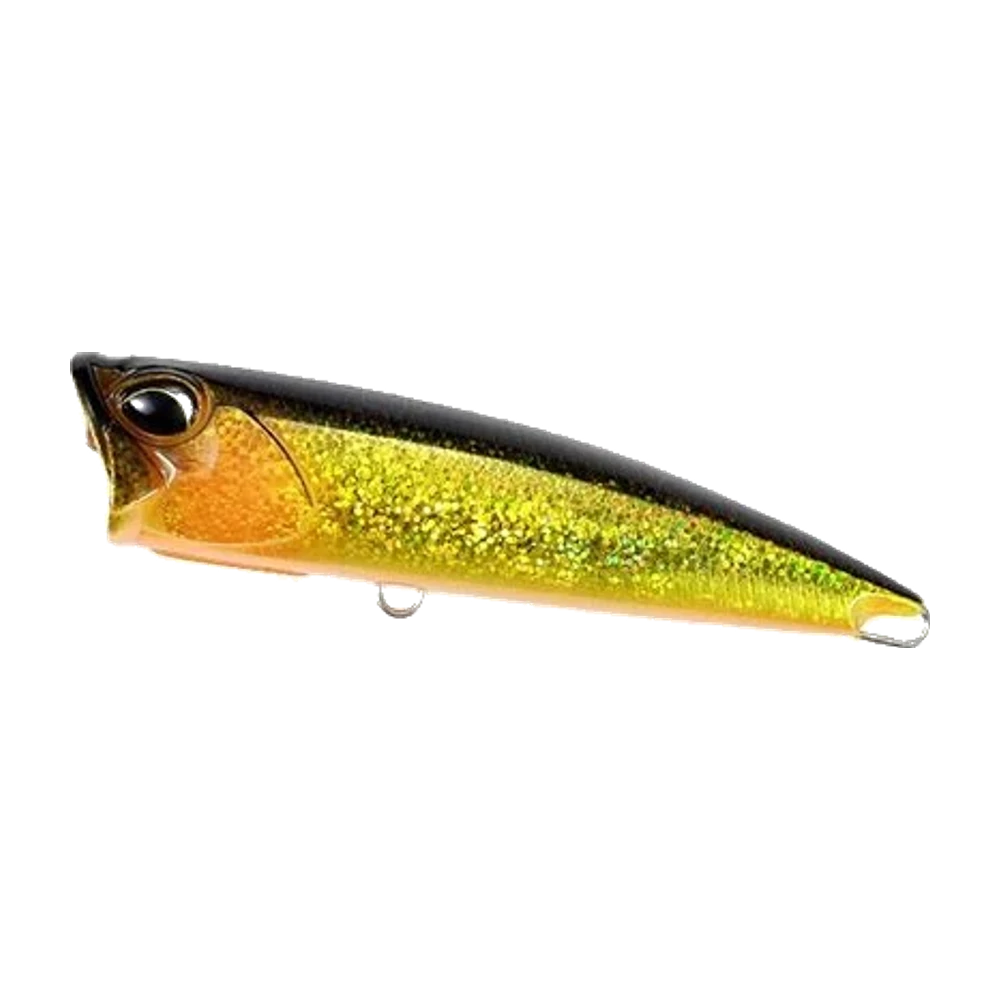
DUO Realis Fangpop: a popper that can also walk
Before tying this one on, it helps to know if the spot actually calls for it. CarnaFish reads the scene from a photo.
A popper imposes a rhythm on the angler: pop, pause, pop, pause. That works as long as the fish have made up their minds. The problem comes when they have not — a sea bass that comes up to look then drops back without touching it, a bass that follows the spray for three metres and turns away. With a classic popper you then have only one lever: change the length of the pauses. Sometimes that works. Often it does not.
The Fangpop gives you a second option. Its cupped head throws water normally on a sharp jerk, but its mass distribution also lets it walk from side to side, walking the dog, on short regular jerks. Two registers, on the same lure, with nothing to change on the line.
That versatility is more than a gimmick: it lets you deal with the two commonest surface behaviours within a single cast.
Two retrieves in one body
The difference between a pop and a walk comes down to how the lure reorients itself after each impulse.
Popping, you give a sharp jerk, sweeping the rod down from high. The cupped mouth digs in, catches water, throws it, and the lure returns to position. It is a strong visual and acoustic signal that carries far and calls fish in.
Walking, you give short, regular jerks with the rod low, taking up a little line each time. The lure never gets time to realign: it slides alternately to one side then the other. That movement makes almost no noise but covers a considerable width sideways, and it never stops — a following fish stays committed.
The two registers answer two distinct needs:
- The pop calls in a fish that has not spotted the lure, in broken water or over a large area.
- The walk converts a fish that has spotted the lure but is hesitating, by denying it the stop it needs to decide against biting.
The sequence that works: call, then convince
- Cast beyond the target zone, often an eddy, a rocky point, a weed bed edge.
- Two clean pops, two seconds apart, to announce your presence.
- Watch. If a fish comes up or boils behind the lure, do not pop again.
- Switch to walking immediately: short jerks, rod low, steady rhythm, no pause at all.
- Hold that rhythm to the end of the cast. Do not slow down, do not stop — it is the stop that gives the fish time to refuse.
- If nothing follows, go back to two pops and start the sequence again further along.
On the water: the moment you see the fish is the moment to stop making noise. On a sea bass that has come up once, a third pop loses it nine times out of ten, whereas switching straight into walking with no pause keeps it behind the lure until it takes.
Setting the register for the sea and the wind
| Conditions | Dominant register | Rhythm |
|---|---|---|
| Flat sea, clear water | almost exclusively walking | short, sustained jerks |
| Ripple, light wind | alternating 2 pops / walking | pops 2 s apart |
| Marked chop | clean pops dominant | wide jerks, 1 s pauses |
| Calm fresh water, bass | single pops, long pauses | 1 pop, 3 to 5 s stop |
At sea, two parameters weigh heavily. A headwind kills the walk: the jerks are lost in the bow of the line. In that case, stay on wide pops, which are more forgiving. The tide run orients the lure: always work it across or with the current, never against it, or the lure climbs back over itself and loses its walk.
In fresh water on bass, the context is almost the reverse: less wind, less current, and fish more inclined to long pauses. The pure popper register often produces more there, with pauses of three to five seconds as on a Megabass Pop-X.
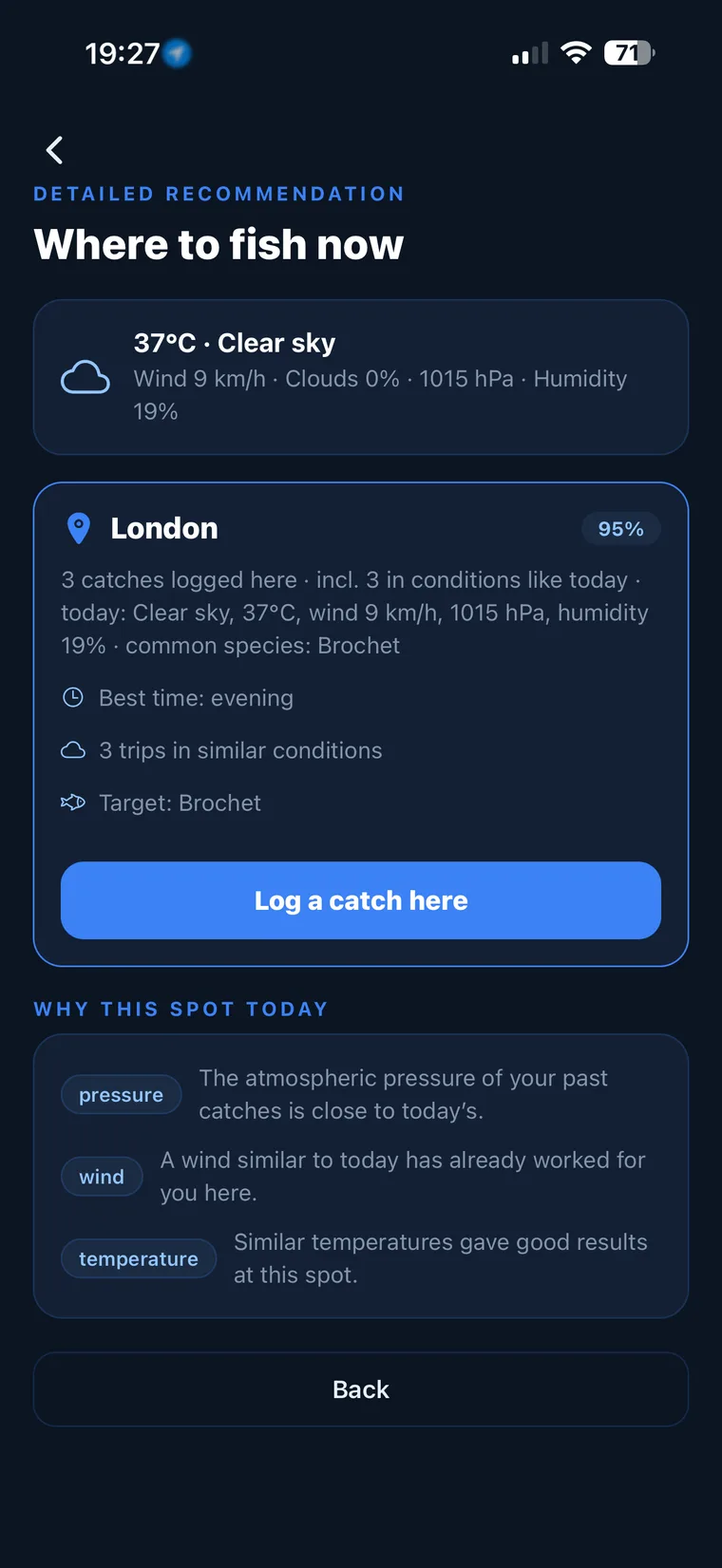
Not sure what to tie on?
Photograph your spot: CarnaFish reads the scene, cross-checks the conditions and gives you the zone, the lure and the retrieve. Free on iOS and Android.
Hooks and gear, especially at sea
A topwater lure at sea takes violent hits and bass that shake their heads on the surface. The stock hardware holds up most of the time, but three checks are worth making.
The split rings. They are the weak link well before the hooks. Move to upgraded models if you are fishing a mark that holds good fish.
The trebles. At sea, pick stainless models of the same wire diameter as the originals. Heavier ones would sink the tail and kill the walk.
The knot and the leader. Fluorocarbon of 0.30 to 0.40 mm, with a check on the knot after every fish. On the surface, the line rubs on scales and gill covers throughout the fight.
One last useful habit: rinse and dry the lure after every session at sea, and check the rings before it goes back in the box. One session in three is enough to pit an unprotected ring.
Fangpop or a single-register popper
Against a pure popper such as the Rapala X-Rap Pop, the Fangpop gives up a little in sheer spray: a lure designed only to pop throws more water for the same effort. If your fishing is about calling from a distance in a working sea, that kind of model is still more direct.
Against a pure walking stickbait such as the Lucky Craft Sammy 100, it also gives up a little fluidity in the walk: a stickbait with no cupped mouth slides better and is easier to steer over long distances.
The point of the Fangpop is not to be better in either register, it is to save you from changing lure at the exact moment you have no time to do it: when a fish has just shown behind it. On a shoreline where the windows of activity last a few minutes, that gain outweighs a little less spray.
Our guide to sea bass fishing with lures covers the states of tide when topwater takes over. And if you are unsure which register to pick for the state of the sea, CarnaFish analyses a photo of the spot and answers.
Key takeaways
- Two registers on the same lure: clean pops to call, walking to convert.
- As soon as a fish shows, stop popping and switch to walking with no pause.
- Flat sea and clear water: almost exclusively walking. Chop: wide pops.
- Never work it against the tide run, the lure loses its walk.
- Check the split rings before the hooks, they are the weak link at sea.
FAQ
Can you really walk the dog with a popper?
With the Fangpop, yes: short regular jerks with the rod low, taking up a little line on each impulse, make it walk from side to side. The movement is less ample than with a dedicated stickbait, but it is enough to keep a fish committed.
What should you do when a sea bass comes up without attacking?
Stop popping immediately and switch to continuous walking with no pause. An extra pop loses most fish that have just shown, whereas a steady movement keeps them behind the lure.
What line should you use for topwater fishing at sea?
Fine braid joined to a fluorocarbon leader of 0.30 to 0.40 mm. The braid lets you give crisp jerks at long range, the fluorocarbon takes the rubbing during a surface fight.
Should you work it into the current or with it?
Across it or with it. Worked against the current, the lure climbs back over itself, loses its attitude and stops walking properly.
Is the Fangpop suitable for bass in fresh water?
Yes, but on a different rhythm: single pops and pauses of three to five seconds, closer to classic popper use. Walking mainly earns its keep there on fish that have already refused a first presentation.
Should you replace the stock hooks?
Not as a matter of course, but do check the split rings, which often let go before the hooks. If you do replace the trebles, keep the same wire diameter: heavier models sink the tail and kill the walk.
The full sea bass lure guideSeason-by-season strategy: which family of lure, when, and why.Go from theory to fish
CarnaFish reads your spot from a photo and gives you the game plan: zone, lure, retrieve. Free on iOS and Android.