Reaction Innovations Vixen: the loud 12 cm walking bait
This lure shines under specific conditions. CarnaFish tells you in 10 seconds if today is one of them.
An August morning with no breath of wind, on a shaded reservoir arm, and sound carries a hundred feet. That's where the stickbait choice becomes a question of dosage: too much bulk and clatter and the fish leaves; not enough and it never registers the lure at all. The Reaction Innovations Vixen sits in that middle ground, and the maker says so explicitly — a more restrained sweep than a big stickbait, but a sound signature that still carries.
A hard body, and what that changes
Reaction Innovations states that the Vixen is moulded from a special plastic formulation that is harder and more resonant than usual, and calls the lure extremely loud on the retrieve. That's a manufacturer's claim, not a measurement: nobody publishes decibels for a topwater. But the physics holds up — a stiffer shell transmits the knock of the internal rattles better and cracks harder on each direction change than a softer shell that damps it.
What that means on the water is simple. The Vixen is a long-range calling lure, not a stealth presentation. If you're working a clear river pool on fish that are already edgy, you have better tools. On open water, along a pad edge or on a wind-blown bank, it's exactly the right call. It still sits a tier below a prop bait like the River2Sea Whopper Plopper 130, which ploughs the surface instead of scratching it: two different levels of signal, not two versions of the same lure.
The manufacturer's chart is short but clear: a single size, 12.1 cm for 21 g (4.75 in, 3/4 oz), with a stated Topwater class. It's a strictly surface lure that never drops below the film. No sinking version, no other size to go hunting for.
Walking the dog: cadence over technique
Reaction Innovations presents the Vixen as incredibly easy to walk, with a side-to-side action more subtle than that of a big stickbait like the Heddon Super Spook — their words, from which they conclude it isn't too much for calm water while still pulling attention when there's a little chop.
The basic motion doesn't change: rod tip down at about 45 degrees, short sharp downward snaps, one turn of the handle between each to pick up the slack. The secret isn't the size of the snap but the regularity: it's when the zigzags chain together without a break that the lure starts to read as alive.
Three cadences, in this order
Start with a steady, sustained walk over the first ten yards. If nothing follows, switch to a walk broken by two-second pauses: nine times out of ten the bite comes during the pause or on the first snap after it. Finally, if you see fish busting bait on the surface without connecting, try a very tight, fast walk, almost on the spot, keeping the lure within a yard of the same piece of water.
When a fish misses the lure on the surface, whatever you do don't set the hook and don't change anything: carry on at exactly the same cadence for two or three more snaps. A stickbait that stops dead after a miss is a prey item that has spotted the predator. A stickbait that keeps going is a prey item that understood nothing — and it gets eaten within the second.
Recessed eyes and moulded gills: why it matters
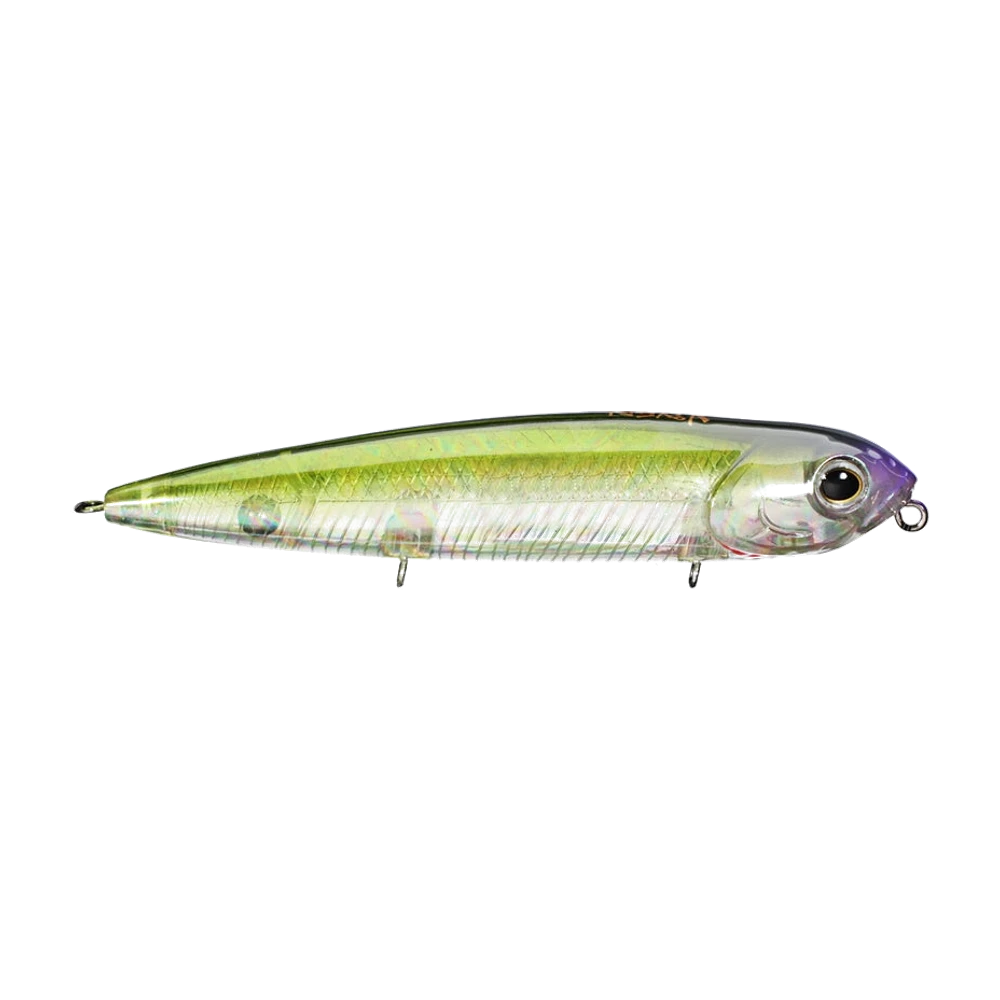
The maker explains that the holographic eyes are recessed deep into the head so they won't get knocked off by fish, sticks or an accidental rock. That's a very concrete detail: on a topwater you throw at cover all day, an eye glued flush to the surface eventually pops off every time. The product photo backs up a large eye set clearly back from the profile of the head.
Reaction Innovations also specifies that the gills are not just a red stripe painted in the throat area but a relief moulded into the body with ridges. On the photographed sample you can indeed make out a raised gill plate and a trace of red under the throat. Treat that carefully, though: it's an observation from a product photo, and the real level of detail is judged with the lure in hand.
One point that matters to the buyer: in the photo, the Vixen carries no trebles at all. You can see the three hook hangers — the two belly eyes and the tail one — but they're bare. The manufacturer, meanwhile, states the lure is armed with three super-sharp trebles. That gap between catalogue photo and description is common — don't judge the hooks you'll receive from the picture.
Not sure what to tie on?
Photograph your spot: CarnaFish reads the scene, cross-checks the conditions and gives you the zone, the lure and the retrieve. Free on iOS and Android.
The rig that doesn't choke the lure
For a walking bait, braid is close to mandatory: it doesn't stretch, so every snap of the rod reaches the lure intact. Monofilament eats half the movement and turns walking into a soft retrieve. Run a mid-diameter braid, then a good yard of 30 to 40 lb class fluorocarbon leader for abrasion and discretion.
Tie a loop knot, or go through a small quick-snap. A knot cinched tight to the nose eye chokes the lateral swing and makes walking hard work, exactly as it does on a billed crankbait. If you fish sea bass with it in Europe, swap the factory split rings and trebles for stainless: a 21 g freshwater lure comes out of a single session in salt with hooks already rusting.
Colors by light
- Clear water, full sun: the translucent chartreuse-backed finish of the photographed sample, which lets light through and avoids the opaque-block look under strong light.
- Dawn, dusk, backlight: a black back. On the surface a fish sees a silhouette against the sky, not a color — contrast is what counts, and black cuts out best.
- Silver baitfish: pearl white belly, the pick when the blow-ups are happening over schools of small silver baitfish out in open water.
Knowing how to walk a stickbait is worth nothing if you cast it in the wrong place, and that's exactly what CarnaFish fixes: photograph the spot and the AI gives you the zone, the depth and the lure family that suit today's conditions. For the groundwork on reading water before you even open the box, our guide to reading a fishing spot starts from scratch.
The short version
- One size only in the range: 12.1 cm for 21 g, Topwater class, so strictly surface.
- Reaction Innovations claims a harder, more resonant plastic and an extremely loud lure on the retrieve: that's a manufacturer's statement, not a measurement.
- The sweep is presented as more restrained than a big stickbait's, which makes it a pick for calm water as much as for light chop.
- In the product photo no treble is fitted at all, while the manufacturer states three trebles.
FAQ
What size is the Vixen?
One only: 12.1 cm for 21 g, or 4.75 in and 3/4 oz. The manufacturer's chart lists a single line, with a Topwater class. There is no junior or magnum version to look for.
Is the Vixen louder than a Super Spook?
Reaction Innovations claims a harder, more resonant plastic and an extremely loud lure. The brand places its side-to-side action as more subtle than a big stickbait like the Heddon Super Spook, though. Noise and amplitude are not the same thing.
Do I need braid to walk it?
Very much preferably. Monofilament stretches and absorbs a good part of the rod snap, which makes the walk soft and irregular. Braid plus a yard of fluorocarbon leader stays the reference rig.
When should I fish a topwater stickbait?
Low light and water of at least 15 to 18 degrees are the two conditions that matter most: dawn, dusk, overcast skies, or all day long if the surface is covered with vegetation that throws shade. In cold water fish rarely come up.
Why do I miss so many topwater fish?
Because the reflex is to set on sight. Wait until you feel the weight of the fish in the rod before setting, and never set upwards: a sideways sweep keeps the trebles inside the mouth instead of tearing them out.
Is the Vixen usable in saltwater?
Its 12 cm profile and 21 g weight suit sea bass in Europe, but it's a lure built for freshwater. Swap the split rings and trebles for stainless before the first trip to the coast, or corrosion will do its work in a single tide.
The full bass lure guideSeason-by-season strategy: which family of lure, when, and why.Go from theory to fish
CarnaFish reads your spot from a photo and gives you the game plan: zone, lure, retrieve. Free on iOS and Android.